The GRANOLAS: A Look at Europe’s Magnificent Eleven
The Magnificent Eleven are Europe’s version of the Magnificent Seven, providing investors with a potential avenue for growth.


There are always market leaders within every region, but the degree of outperformance by an industry leader is what truly determines how they are perceived in the marketplace. In the U.S. the Magnificent Seven have come to represent U.S. technological advancement and the integral nature of these companies in the U.S. and global economy.
In Europe, there has emerged a grouping of companies that have distinguished themselves from others, given their classification as internationally exposed quality growth firms. Together these firms are referred to as the Magnificent Eleven (alternatively referred to as GRANOLAS) and are being dubbed Europe’s version of the Magnificent Seven.
This article will detail and highlight firms within the Magnificent Eleven/ GRANOLAS grouping and profile ETF solutions that provide investors with exposure to said companies.
What are the GRANOLAS stocks?
The GRANOLAS was first coined by Goldman Sachs in 2020, referring to GSK, Roche, ASML, Nestlé, Novartis, Novo Nordisk, L'Oréal, LVMH, AstraZeneca, SAP, and Sanofi; 11 stocks that reflect approximately a quarter of the STOXX 600's market cap and exhibit solid earnings growth, low volatility, high and stable margins, strong balance sheets, and durable dividends. In contrasting the Magnificent Seven with the GRANOLAS, the most apparent distinction between the groups lies in the industries they represent. While the Magnificent Seven primarily focuses on information technology, the Magnificent Eleven encompasses the Health Care, Consumer Cyclical, Consumer Defensive, and Technology sectors
In segmenting the Magnificent Eleven companies into their respective sectors and looking at the distinct value proposition of each firm, alongside their global reach, the material significance of each firm becomes quite clear.
Health Care: Novartis, Novo Nordisk, Roche, AstraZeneca, Sanofi, and GSK
This grouping of companies represents a few of the major pharmaceutical companies globally. Each of them is a powerhouse in the industry, known for developing innovative drugs and treatments across various therapeutic areas. Novartis, Roche, and AstraZeneca, for instance, are renowned for their contributions to oncology and other areas of healthcare. Novo Nordisk specializes in diabetes care, while Sanofi and GSK have diverse portfolios ranging from vaccines to consumer healthcare products.
Specifically, regarding Novo Nordisk, the success of weight-loss and diabetes drugs Wegovy and Ozempic are poised to be pivotal contributors to the firm’s growth, as they have proven to be game changers for health professionals and their patients battling obesity.
Consumer Cyclical: LVMH
LVMH, or Moët Hennessy Louis Vuitton SE, is a multinational luxury goods conglomerate headquartered in Paris, France. It is renowned for owning a prestigious portfolio of luxury brands spanning various sectors including fashion, leather goods, perfumes, cosmetics, watches, jewelry, and wines. When consumers think about luxury items, qualities such as exclusivity, timelessness, and desirability often come to mind, but said qualities are also appealing to investors who are seeking assets that can maintain or appreciate in value over varying market cycles.
LVMH’s portfolio of luxury brands and items allows the firm to have strong pricing power, a large addressable market, and both strong revenue and earnings growth. Furthermore, the luxury industry has historically displayed increasing resilience with minimal cyclicality, while tapping into an expanding array of growth opportunities.
Consumer Defensive: Nestle and L’Oreal
Nestlé and L'Oréal are both prominent companies in the consumer goods sector.
Nestlé, based in Switzerland, is one of the world's largest food and beverage companies. It offers a vast array of products, ranging from bottled water and baby food to coffee, chocolate, and pet care. Some of its well-known brands include Nescafé, KitKat, Maggi, Nespresso, and Purina.
L'Oréal, headquartered in France, is the world's largest cosmetics and beauty company. It operates in skincare, haircare, makeup, and fragrance categories, with brands such as L'Oréal Paris, Maybelline New York, Garnier, Lancôme, and Kiehl's. L'Oréal is renowned for its innovation in beauty products and its commitment to research and development.
Both Nestlé and L'Oréal are consumer-facing brands that have broad product optionality and have garnered strong consumer mind and wallet share. The success of these companies stems from their ability to provide products that are necessities to a large consumer base, whilst always building and affirming brand loyalty with them over time.
Technology: SAP, ASML
SAP SE is a German multinational software corporation known for developing enterprise software to manage business operations and customer relations. SAP's products typically focus on enterprise resource planning (ERP), which integrates various business processes such as accounting, human resources, supply chain management, and more. The company's software is widely used by businesses of all sizes across different industries to streamline operations and improve efficiency.
ASML Holding NV, headquartered in the Netherlands, is a leading supplier of photolithography equipment used in the semiconductor manufacturing industry. Their cutting-edge machines enable the production of integrated circuits on silicon wafers, playing a crucial role in the advancement of semiconductor technology. ASML's lithography systems are used by major semiconductor manufacturers worldwide to produce chips for a wide range of applications, from smartphones and computers to automotive electronics and artificial intelligence.
SAP’s technological offerings provide clients with a platform that can be holistically integrated into an organization, allowing for a seamless information-sharing experience across an entire company. SAP benefits from the fact that ERP systems entail high switching costs for users. Once a client adopts SAP for their technological architecture, they establish a long-lasting and continuous relationship. ASML’s specialized role within semiconductor development provides them with a high degree of power and influence, and as Buffett would say, 'Moat Status'. Holding such a position makes the firm unique, thus making it an essential player in an industry that is experiencing a high level of growth.
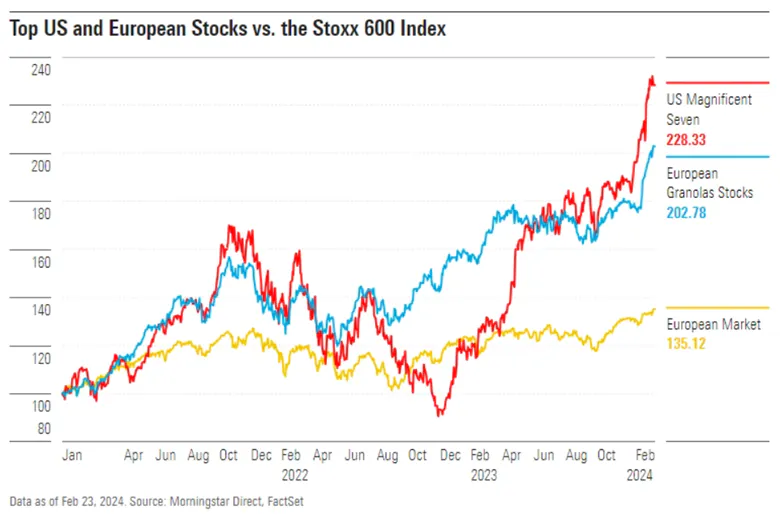
In looking at the performance of the Magnificent Eleven/ GRANOLAS firms, it is evident that investors would have benefited materially from their exposure. The chart below captures the performance of an equally weighted portfolio of the companies in question since 2021. Though total return performance would have been less than the Magnificent Seven, the return would have been extremely compelling.
ETFs with Exposure to the Magnificent Eleven
For investors interested in gaining exposure to these companies, there are several ETF offerings available that provide significant exposure. The following ETFs represent a selection of investment solutions worth considering:
Horizons Europe 50 Index ETF (Ticker: HXX)
This passively managed ETF seeks to replicate the total return performance of the Solactive Europe 50 Rolling Futures Index, which is designed to measure the performance of 50 of the largest companies that are sector leaders in the Eurozone. In looking at the factsheet for the index, as of March 8th, 2024, ASML, LVMH, SAP, L’Oreal, and Sanofi are among the fund’s top ten holdings. For calendar year 2023, the fund returned 23.84%.
CI WisdomTree Europe Hedged Equity Index ETF (Ticker: EHE and EHE.B)
This ETF provides access to dividend-paying companies in Europe while hedging exposure to fluctuations between the U.S. dollar and the euro, or between the Canadian dollar and the U.S. dollar in the CAD-hedged version. The solution replicates the price and yield performance of the WisdomTree Europe CAD-Hedged Equity Index, which is based on dividend-paying companies in the WisdomTree International Equity Index that are domiciled in Europe and are traded in Euros, have at least $1 billion market capitalization, and derive at least 50% of their revenue in the latest fiscal year from countries outside of Europe. The component securities are weighted in the Index based on annual cash dividends paid with the following caps: maximum individual position capped at 5%, maximum sector weight capped at 25%, and maximum country weight capped at 25%. The index also aims to neutralize exposure to currency fluctuations.
As of January 31st, 2024, ASML, LVMH, L’Oreal, Sanofi, and SAP were among the fund’s top 15 holdings. For the calendar year 2023, the CAD-Hedged version of the fund returned 24%, while the un-hedged version returned 23.4%.
RBC Quant European Dividend Leaders ETF (Ticker: RPD, RPDH, and RPD.U)
This actively managed fund provides exposure to a diversified portfolio of high-quality European equity securities that are expected to provide regular income from dividends and that have the potential for long-term capital growth. The managers of the fund utilize a quantitative multi-factor approach to gauge a company's financial strength and prioritize companies that are consistent and growing dividend payers.
As of March 7th, 2024, Novo Nordisk, Novartis, ASML, and Roche are among the top ten holdings. For calendar year 2023, the fund unhedged version returned 20%, the CAD-hedged version returned 18.7%, and the USD -version returned 23.1%.
Please note this article is for information purposes only and does not in any way constitute investment advice. It is essential that you seek advice from a registered financial professional prior to making any investment decision.