Investing In The Middle: A Look At U.S. Mid-Cap Equities
Mid-cap equities offer growth and stability. Canadian investors can access them through ETFs tracking U.S. mid-cap stocks.


The Financial Industry Regulatory Authority (FINRA) states that midcap equities fall within the market capitalization range of $2 billion to $10 billion. In looking at the Russell mid-cap Index fact sheet, as of January 2025, there are approximately 1007 U.S. companies that are considered midcap. Though the number of publicly traded U.S. large-cap companies (i.e., Russell 1000 Index: 1,007) and U.S. small-cap companies (i.e., Russell 2000: 1,960) outnumber those categorized as US mid-cap, the performance of the equity category over time has been noteworthy. Over the past 5 years, U.S. mid-cap equities have generated compelling returns.
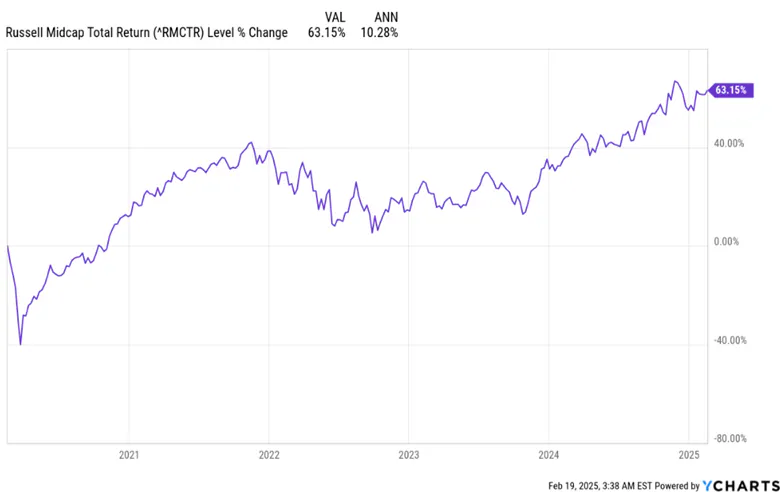
The mid-cap equity category includes fast-growing, young companies that have outgrown their small-cap origins and mature companies operating in stable and profitable corners of the market. Though small-cap equities tend to exhibit greater volatility, and large-cap equities tend to be slow-growing, mid-cap equities capture the best of both worlds, as they are less volatile than fast-growing small-caps and have more growth potential than mammoth large-cap companies.
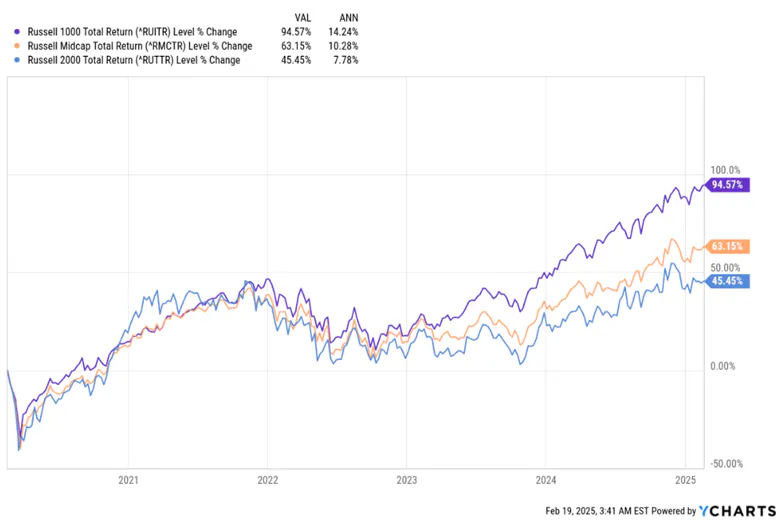
Gaining Access To U.S. Mid-Cap Equities
For Canadian investors interested in U.S. mid-cap equities, several ETF offerings can be utilized to gain this market exposure, namely:
The CI U.S. MidCap Dividend Index ETF (Tickers: UMI/UMI.B), which seeks to track the price and yield performance of the WisdomTree U.S. MidCap Dividend Index CAD, a fundamentally weighted index designed to provide exposure to the mid-capitalization segment of the U.S. dividend-paying market. The Index is comprised of the companies that compose the top 75% of the market capitalization of the WisdomTree Dividend Index after the 300 largest companies have been removed.
As the tickers show, the ETF has a currency-hedged and currency-unhedged version, so investors can choose whether they want foreign exchange exposure. From a fund holdings perspective, notable names within the fund include American Financial Group Inc., Hormel Foods Corp, and Carlyle Group Inc.
Both the iShares S&P U.S. Mid-Cap Index ETF (Tickers: XMC/XMH/XMC.U) and BMO S&P US Mid-Cap Index ETF (Tickers: ZMID/ZMID.F/ZMID.U) seek to replicate the performance of the S&P MidCap 400® Index, which reflects the performance of 400 mid-sized companies.
While offering both currency-hedged and unhedged versions, investors also have a USD-currency option. From a holdings perspective, notable names within the fund include Williams Sonoma Inc, DocuSign INC, and Dicks Sporting Inc.
The Dynamic Active U.S. Mid-Cap ETF (Ticker: DXZ) is an actively managed solution that seeks to invest in high-quality companies with attractive free cash flows and growth. The managers employ a Quality At a Reasonable Price (QUARP®) process that focuses on a diversified portfolio of securities that pay dividends and incorporates a capital preservation philosophy. Strict due diligence measures include both top-down analysis and bottom-up fundamental research. Companies included in the portfolio represent best-in-class businesses with strong management teams, balance sheets, and free cash flow generation plus growth that are purchased at an attractive valuation.
Publicly available holdings within the fund include Lennox International Inc., Brown & Brown, Inc., and Rollins, Inc.
Franklin U.S. Mid Cap Multifactor Index ETF (FMID): A Smarter Take on Mid-Caps?
Franklin Templeton’s FMID is the latest addition to the Canadian ETF market, offering a multi-factor approach to U.S. mid-cap equities. The fund is built to reduce volatility and enhance risk-adjusted returns over time, making it a compelling option for investors looking for a smoother ride in the mid-cap space.
FMID tracks the LibertyQ U.S. Mid Cap Equity Index – NR, a rules-based strategy selecting stocks from the Russell Midcap Index – NR. The methodology blends four key factors:
- Quality – Strong balance sheets & earnings consistency
- Value – Stocks trading at attractive relative prices
- Momentum – Companies with sustained upward price trends
- Low Volatility – Stocks with historically lower price swings
While FMID itself is new to the market, its underlying index has outperformed comparable mid-cap strategies over the past five years (as of Dec 31, 2024).
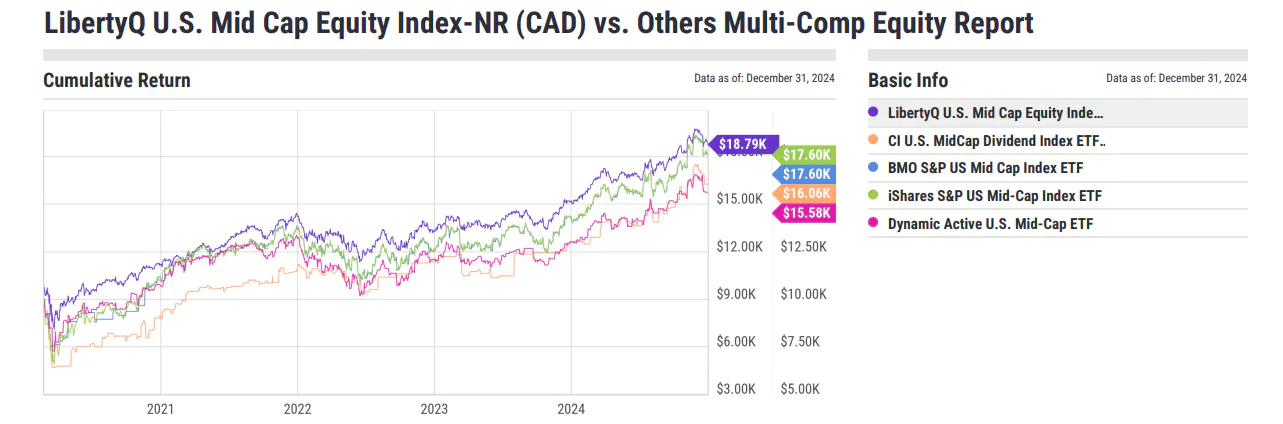
With a 0.30% expense ratio, FMID is listed on Cboe Canada, offering a systematic alternative for investors seeking factor-based exposure in the mid-cap universe.
Please note this article is for information purposes only and does not in any way constitute investment advice. It is essential that you seek advice from a registered financial professional prior to making any investment decision.