The 2025 Market Outlook and ETFs to Watch
The shifting economic landscape of 2025 offers ETF investors new opportunities to seize anticipated growth and market potential.


The end of November/beginning of December is a special time in the calendar year—not solely because the Holiday Season is nearing—but because it is Outlook Season, a time when most investment management firms begin sharing their perspectives on the macroeconomic and investment landscape in the year to come.
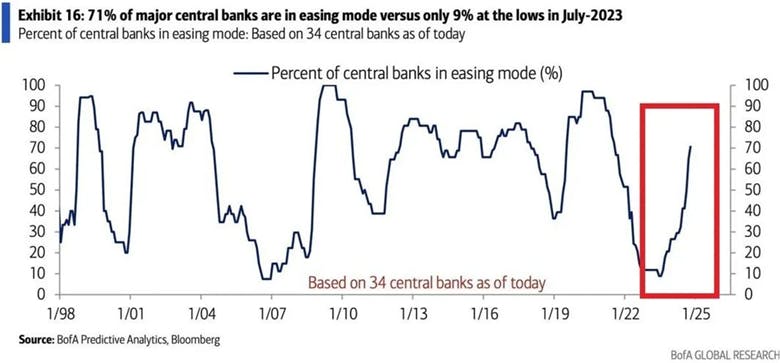
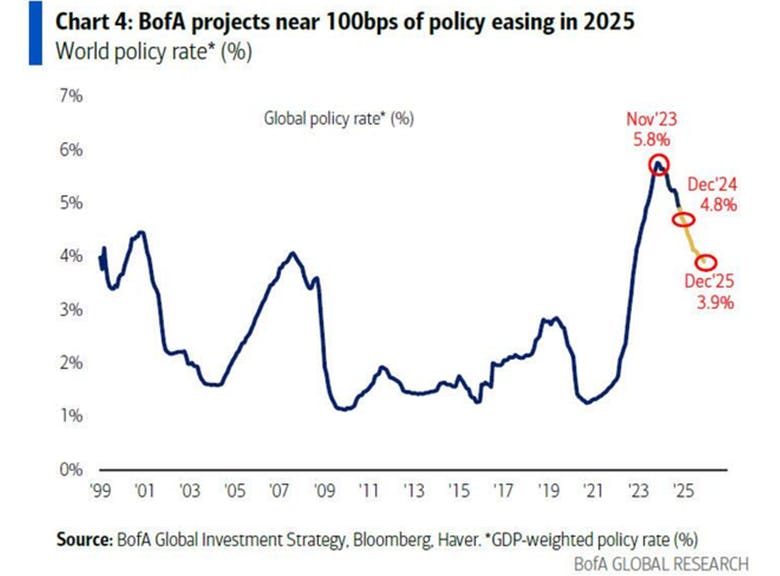
As we approach 2025, the emerging consensus is that the economic environment will be growth-oriented, especially for the US. As research from Bank of America illustrates, by the end of the year, approximately 80% of major country central banks will be in easing mode – indicating that the high inflation that has plagued the global economy in recent years is somewhat behind us. Furthermore, additional easing anticipated in the new year will also be a tailwind for the global economy.
An Improving Economic Landscape
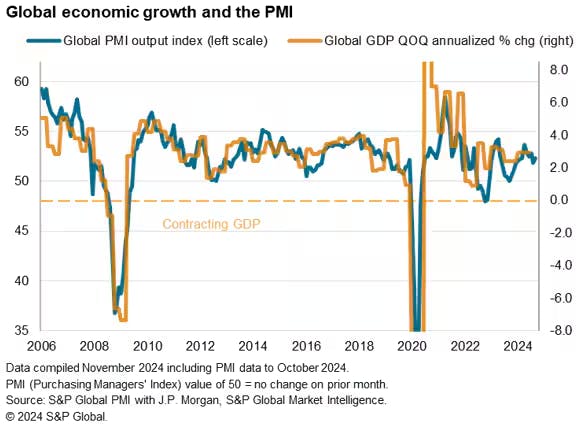
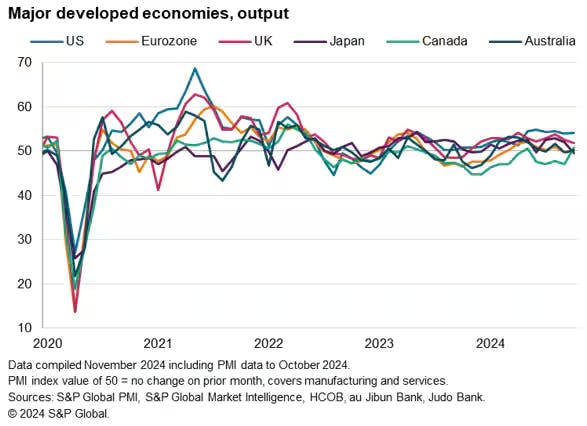
The policy easing that is occurring is taking place at an ideal time, as global growth remains stable at this point. According to S&P Global Market Intelligence's PMI surveys, global business activity grew for the twelfth consecutive month in October, with the pace of expansion improving from September's eight-month low.
The J.P. Morgan Global Composite PMI® Output Index, which tracks manufacturing and services across more than 40 economies, increased from 51.9 in September to 52.3 in October, marking its highest level since August. Among the major developed economies, the US recorded the strongest expansion for a sixth straight month, the rate of growth edging up but with growth dependent on the services economy as manufacturing output fell for a third successive month.
Looking to the US In 2025
Recently, Bank of America released its outlook for 2025. Their perspective is that US economic and earnings growth will outpace other developed economies, while US equities should start the year strong and end 2025 with the S&P 500 at 6666. While the incoming president and his administration's policy actions (i.e., tariffs, tax policy, and the regulatory environment) will shape this outlook relative to other developed economies, the US is in pole position and will likely keep said status for much of 2025.
Looking at the recent performance of US equities, things have been going well. The S&P 500 crossed 6,000 for the first time on November 11th, 2024. This is the second 1,000-point milestone in the same year, as the index hit the 5,000-point mark in February. According to research from YCharts, it took the S&P 500 just 9 months and 3 days to go from 5,000 to 6,000, the shortest amount of time ever to cross a 1,000-point threshold–and in stark contrast to the 48 years and 1 month that it took for the index to reach its first 1,000-point milestone.
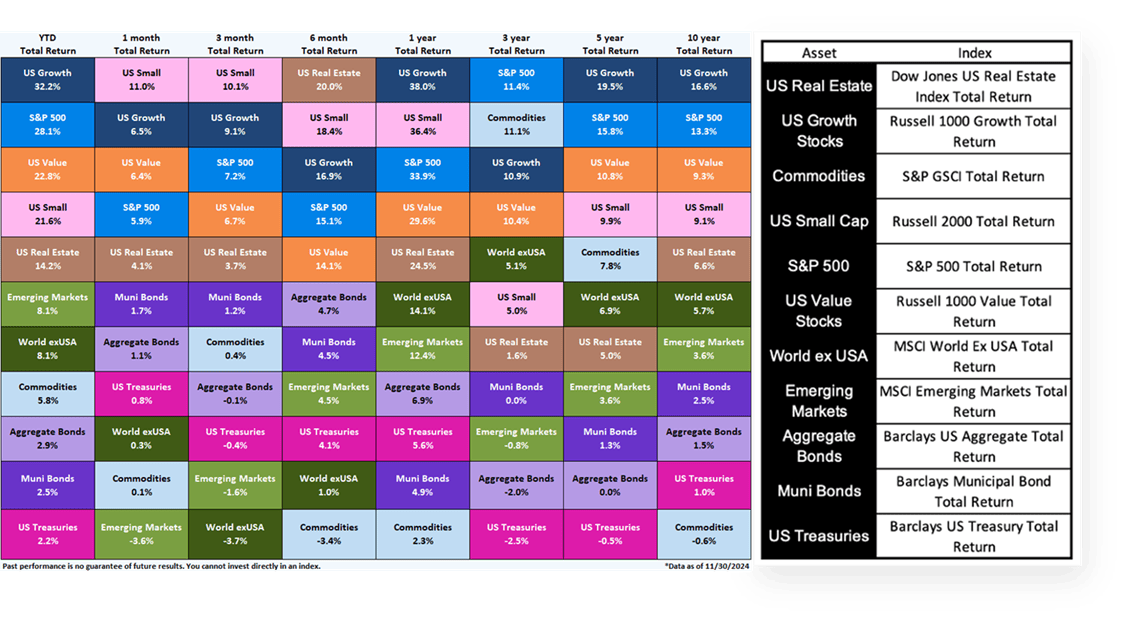
From an asset class level, the performance of US equities has been exceptional relative to other asset classes thus far in the year. As illustrated below, as of November 2024, the year-to-date performance of US equity growth, US large-cap, and US value have been compelling. As we enter into 2025, it is anticipated that US equities will continue to be the preferred asset class for investors.
Investing In US Equities ETF
For Canadian investors seeking exposure to US equities, the opportunity set is exceptionally vast, and the underlying investment strategy that may be utilized can differ. For investors seeking a factor-based approach to attain US equity, solutions such as Fidelity US Momentum Index ETF (Ticker: FCMO) allow investors to gain exposure to securities with improving fundamentals that have recently outperformed and may continue to do so over the medium term. Momentum investing is one of the more widely followed factor-based strategies. This approach is based on the premise that, when trying to predict where prices are going, it is helpful to know where they have been. Year to date, as of November 30, 2024, FCMO has returned 60%.
For investors seeking broad capitalization exposure to US equities, the BMO US All Cap Equity Fund ETF (Ticker: ZACE) facilitates this with its inclusion of large, mid-, and small-cap US equities. The ETF uses fundamental analysis to identify value, consistent growth, and timely fundamentals in the market and will actively buy and sell the underlying securities. Year to date, as of November 30, 2024, ZACE has returned 41.54%.
Finally, for investors looking purely for large-market capitalization exposure, the Mackenzie US Large Cap Equity Index ETF (Ticker: QUU) provides such a focus. QUU tracks the Solactive US Large Cap CAD Index. Year to date, as of November 30, 2024, QUU has returned 36%.
Please note this article is for information purposes only and does not in any way constitute investment advice. It is essential that you seek advice from a registered financial professional prior to making any investment decision.