
Global Core Plus Bond ETFs: A Deep Dive Into FWCP
Global Core plus bond ETFs can be a way of expanding or diversifying a fixed-income allocation in a portfolio. Here's a look at an example in the form of FWCP.
The default fixed-income allocation in the portfolio of many Canadian investors tends to be rather simple: a broad-market bond ETF passively tracking a popular benchmark index, like the FTSE Canada Universe Bond Index. This approach provides simplicity, low fees, and high-quality, offering exposure to a wide range of government and investment-grade bond issuers.
However, this approach can fall short in numerous areas, particularly when it comes to managing risk. When interest rates rise and stay elevated, these ETFs cannot tactically adjust their mix, and thus remain wholly exposed to negative market conditions. Unexpected volatility resulting from these negative market conditions, can come as a shock for investors relying on broad-market bond ETFs to reduce portfolio risk.
To remedy this, investors can consider "global core plus" bond ETFs. These active ETFs can invest in bonds globally and are quite flexible in their investment approach. They can respond to changes in the global bond markets by adjusting various levers within the portfolio.
Why consider diversifying globally and outside the core?
Unlike Canadian bond index ETFs, globally diversified core plus bond ETFs can offer a more dynamic and flexible investment approach. They can tactically shift their holdings based on market conditions, interest rate forecasts, and credit analysis, providing opportunities to generate alpha (i.e., excess returns over their benchmark) while managing risk more effectively.
Canadian bond index ETFs, while providing a solid base for domestic fixed-income exposure, are limited by their lack of diversification. Their performance is inherently tied to the Canadian bond market, which may underperform compared to global bond markets during certain periods. The emphasis on a single currency (the Canadian dollar) also exposes investors to domestic inflation and interest rate risks without the offsetting potential benefits of diversifying globally.
There's also the matter of limited representation to consider. As of March 2023, the Canadian bond market sits just at $4.9 trillion CAD in size. This leaves out all the opportunities available in the vast global bond markets, which has an estimated size of $196 trillion.
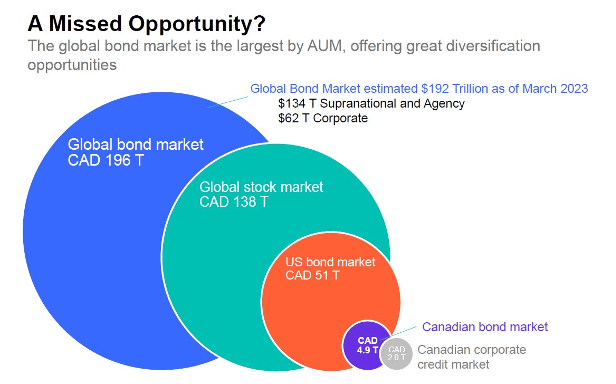
Source: Bloomberg, as of March 31, 2023.
Globally diversified core plus bond ETFs can mitigate these challenges by allocating assets across various countries, currencies, and sectors.
Moreover, many Canadian bond index ETFs and even global bond portfolios only feature allocations to higher-quality government and investment-grade issuers. The drawback of this approach is lower yield and less effective diversification. Global core plus bond ETFs on the other hand, are built around a foundation of high-quality securities but have the ability and flexibility to opportunistically go beyond their benchmark to access non-investment grade and high-yield securities. These off-benchmark securities could have low to negative correlation to the core holdings and thus improve portfolio diversification. Furthermore, they may also bring in more yield, adding to portfolio returns.
In essence, the strategy adopted by global core plus bond ETFs can help manage risk, and maximise yield, making them a potentially advantageous alternative to more limited bond index ETFs like those focused solely on the Canadian market.
An example with FWCP
An example of a core plus bond ETF is the Franklin Western Asset Core Plus Bond Active ETF (FWCP). This ETF charges a 0.60% expense ratio and is benchmarked to the popular Bloomberg U.S. Aggregate Bond Index (hedged to the Canadian dollar), or "Agg", but can depart from it in many ways.
Firstly, FWCP is able to invest up to 20% of its assets in non-U.S. dollar denominated fixed income. This adds an additional degree of diversification by granting the ETF exposure to different currency returns and interest rate regimes, many of which are less correlated to the U.S. bond market.
FWCP is able to adjust and position the duration of its bond portfolio within +/- 30% of the Agg. By doing so, the ETF can potentially avoid steeper losses due to interest rate risk or capitalize on a regime change when it comes to interest rates.
The key word to note with FWCP is "opportunistic". The ETF is free to target multiple drivers of return, like duration, yield curve, sector, country, and currency. This greatly minimizes dependence on any one strategy and can lower volatility.
In contrast, bond index ETFs are usually very constrained in terms of their composition. Often, these ETFs must maintain an intermediate duration and investment-grade credit quality, with a heavy allocation towards government issued debt.
FWCP's core plus bond strategy avoids this. While 70% of the ETF must be invested in investment-grade fixed-income, the remaining 30% can be invested in non-investment grade or unrated fixed-income. As of March 31st, 2023, the ETF had exposure to emerging market debt, high-yield credit, and non-agency mortgage-backed securities, or MBS.
Recently, this has paid off. Over the quarter ending March 31st, 2023, FWCP returned 3.75%, while the Bloomberg U.S. Aggregate Index (Hedged to CAD), returned 2.78%. Contributions to this largely stemmed from the ETFs non-U.S. dollar exposure, and allocations to agency MBS. [1]
For investors looking to diversify away from a Canadian-heavy bond allocation, FWCP offers a global core bond portfolio with opportunistic “plus” sector exposures. To reiterate, you get the lower risk of core bond holdings along with high yield exposure from non-core securities with higher risk profile.
REFERENCES
[1] Source: Franklin Templeton, FWCP returns as of May 31, 2022: YTD: 3.68%; 1 Year: -1.46%; Since Inception: -9.01%. Inception date is January 24, 2022
IMPORTANT INFORMATION
Commissions, trailing commissions, management fees, brokerage fees and expenses may be associated with investments in mutual funds and ETFs. Please read the prospectus and fund fact/ETF facts document before investing. ETFs trade like stocks, fluctuate in market value and may trade at prices above or below the ETF’s net asset value. Brokerage commissions and ETF expenses will reduce returns. Performance of an ETF may vary significantly from the performance of an index, as a result of transaction costs, expenses, and other factors. Indicated rates of return are historical annual compounded total returns for the period indicated, including changes in unit value and reinvestment distributions, and do not take into account any charges or income taxes payable by any security holder that would have reduced returns. Mutual funds and ETFs are not guaranteed. Their values change frequently. Past performance may not be repeated.
ETF units may be bought or sold throughout the day at their market price on the exchange on which they are listed. However, there can be no guarantee that an active trading market for ETF units will develop or be maintained, or that their listing will continue or remain unchanged. While the units of ETFs are tradable on secondary markets, they may not readily trade in all market conditions and may trade at significant discounts in periods of market stress.
Foreign Investment Risk. The value of foreign securities may be influenced by the policies of foreign governments and by political, economic, or social instability. There may be less information about foreign companies than North American firms and there may be lower standards of government supervision and regulation in foreign financial markets. The legal systems of some foreign countries may not adequately protect Unitholders’ rights. Some or all of these factors could make a foreign investment more or less volatile than a North American investment. If a Franklin ETF or the underlying fund in which a Franklin ETF invests holds these securities, the Franklin ETF may have difficulty enforcing legal rights in jurisdictions outside Canada.
High yield bonds are subject to greater price volatility, illiquidity, and possibility of default. Asset-backed, mortgage-backed, or mortgage-related securities are subject to prepayment and extension risks.