How to Invest in Critical Minerals via ETFs
As nations race to secure supply chains, critical minerals ETFs are emerging as a strategic way to invest in the resources powering defense, tech, and energy.

Critical minerals have become a geopolitical priority, given their essentiality to defense, technology, and energy, yet their supply chain remains heavily dominated by China, driving urgent demand for ex-China sources. As global investment accelerates to secure independent supply chains, both government and private enterprise are aligning to ensure the resources of the future are available to them.
Government Coordination & Policy
Canada, the U.S., and other North Atlantic Treaty Organization (NATO) partners increasingly view critical minerals through the lens of sovereignty, security, and strategic infrastructure. Against this backdrop, nations are coordinating their efforts to ensure ongoing access to these minerals. For Canada, the Critical Minerals Production Alliance (the Alliance), a Canada-led G7 initiative that works with trusted international partners to foster the development of secure, resilient critical minerals supply chains and to counter market concentration and manipulation, is one avenue through which the nation is ensuring its critical minerals access for the future.
Recently, the Government of Canada announced 30 new partnerships and investments under the Critical Minerals Production Alliance, which will unlock $12.1 billion in critical minerals projects with 12 allied partners. Combined with the investments and partnerships announced late last year, the Critical Minerals Production Alliance is now helping to mobilize $18.5 billion in Canadian critical-minerals projects.
Regarding critical minerals, the U.S. is taking what could be characterized as an ‘active involvement’ approach, as evidenced by its Project Vault initiative —a collaboration between the public and private sectors to fund and stockpile minerals essential for advanced manufacturing and cutting-edge technology. The U.S. government is employing various risk-reduction tools, including loan guarantees, offtake agreements, and direct equity investments in mineral development firms, to stimulate the production of lithium, copper, cobalt, rare earth elements, and more.
Investing in Critical Minerals
As the importance of critical minerals continues to rise, their investment potential is becoming increasingly apparent to investors. As governments increase their demand for critical minerals, the companies and entities capable of supplying them will continue to grow in value. For investors, now is an opportune moment to gain exposure to investment solutions that provide pure-play exposure to a broad range of critical minerals.
Global X Canada has a series of ETFs providing access to companies involved in sourcing, refining, and developing critical minerals in various ways.
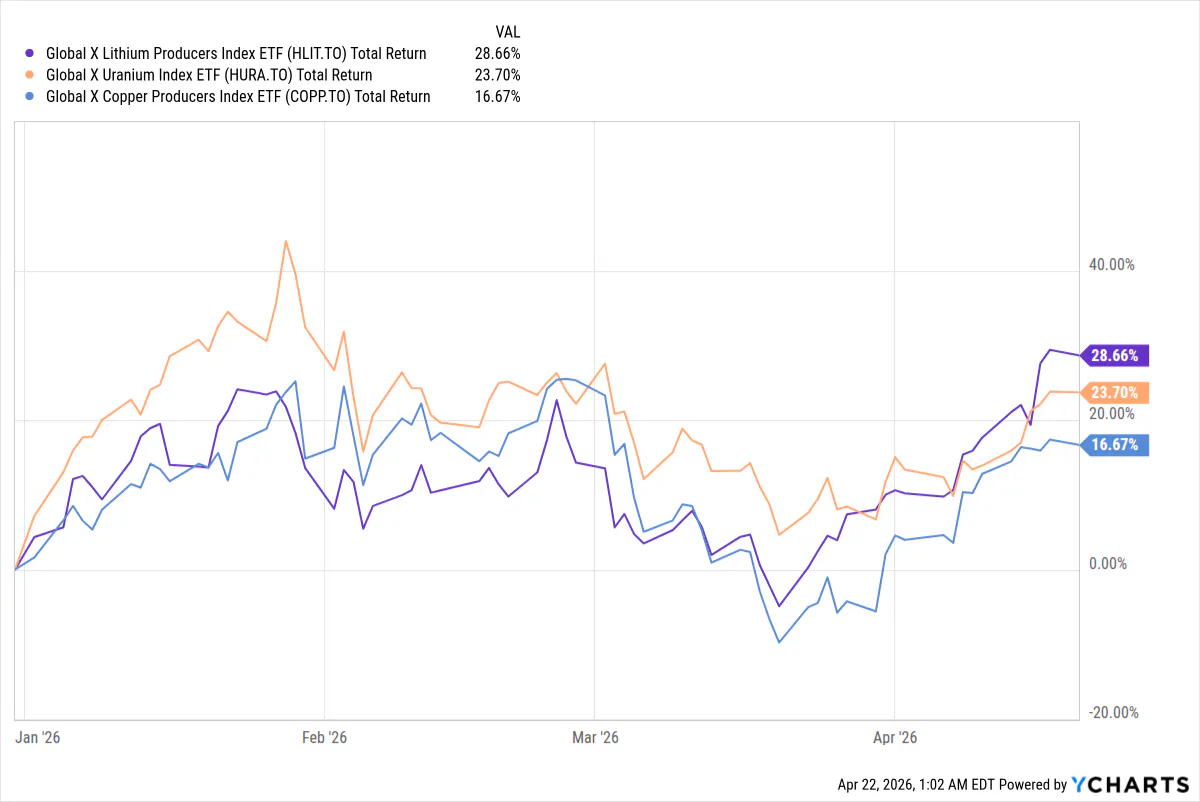
The Global X Copper Producers ETF (Ticker: COPP) provides exposure to the companies active in copper ore mining listed on select North American stock exchanges by replicating the performance of the Solactive North American Listed Copper Producers Index. The reintroduction of nuclear power as a means of powering data centers means an increasing demand for uranium, a weighty metal that can be used as an abundant source of concentrated energy for nuclear reactors.
The Global X Uranium ETF (Ticker: HURA) replicates the performance of the Solactive Global Uranium Pure-Play Index, which provides exposure to companies where a significant part of the business operations is or is expected to be related to the uranium industry.
Finally, the increasing demand for lithium for use in batteries has elevated its importance. The Global X Lithium Producers Index ETF (Ticker: HILT) provides exposure to the performance of global, publicly listed companies engaged in the mining and/or production of lithium, lithium compounds, or lithium-related components. Currently, HLIT seeks to replicate the performance of the Solactive Global Lithium Producers Index.
This article was written on April 22nd, 2026. Please note this article is for information purposes only and does not in any way constitute investment advice. It is essential that you seek advice from a registered financial professional prior to making any investment decision.