Active ETFs for the U.S. Small-Cap Rally
Small caps rebound strongly, but quality matters—here’s how ETFs can help investors target the winners in this upswing.


While the performance of U.S. large-cap equities, especially A.I. hyperscalers, has dominated the news cycle, what has quietly caught the attention of many is the recent performance of U.S. small-cap equities. Since the April 2025 market drawdown, U.S. small-cap equities, as illustrated by the Russell 2000 Index, have delivered notably strong returns, outperforming their large-cap and mid-cap counterparts.
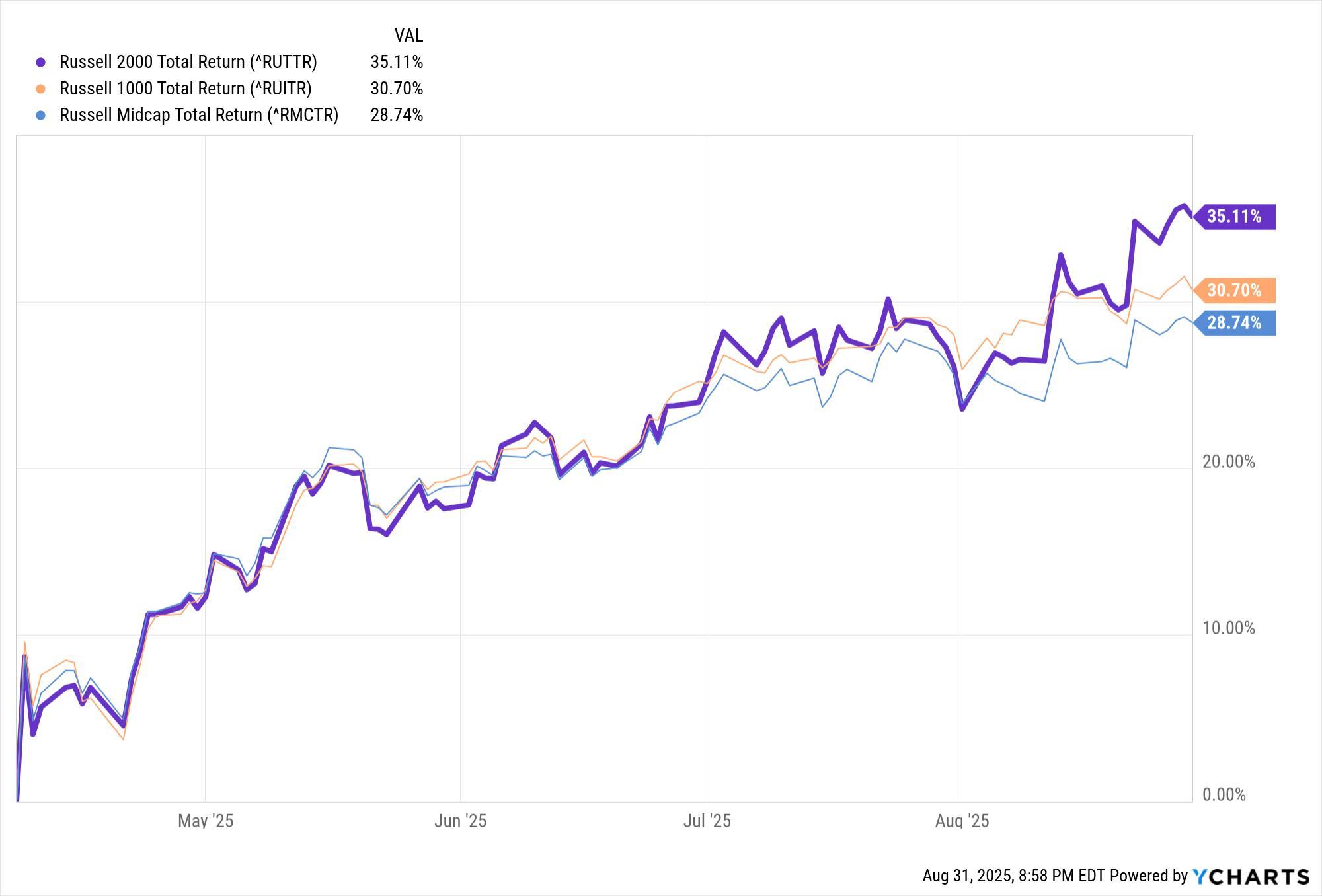
The recent strong performance of U.S. small-cap equities can be partly explained by a change in market sentiment, triggered by Federal Reserve Chair Jerome Powell's speech at Jackson Hole on August 22, where he suggested a possible interest rate cut next month. Naturally, a lower interest rate environment would impact all companies, but small-cap firms would benefit significantly, as they tend to depend on external financing to grow and expand.
Other developments, such as reducing trade uncertainty and investors wanting to reduce their exposure to AI hyperscalers, are also factors to consider. Regarding the former, approximately 80% of Russell 2000 constituent revenues are generated in the U.S., which provides small businesses with greater protection from the adverse effects of tariffs compared to larger companies with more global exposure. With the U.S. Appeals Court recently ruling that most of Donald Trump's tariffs are illegal, there is considerable uncertainty regarding how this particular matter will proceed and the impact it will have on the U.S. economy.
Not All Small-Cap Equities Are Equal
The phrase, 'a rising tide lifts all boats,’ speaks to the idea that a positive market movement will generally benefit all participants, which has been the case in this U.S. small-cap equities upswing. However, it is also important to recognize that not all boats are the same, and knowing which ones to avoid is crucial. As noted in a memo published by MSCI last year, the influx of lower-quality companies into small-cap indices has contributed to a decline in the quality of small-cap indices.
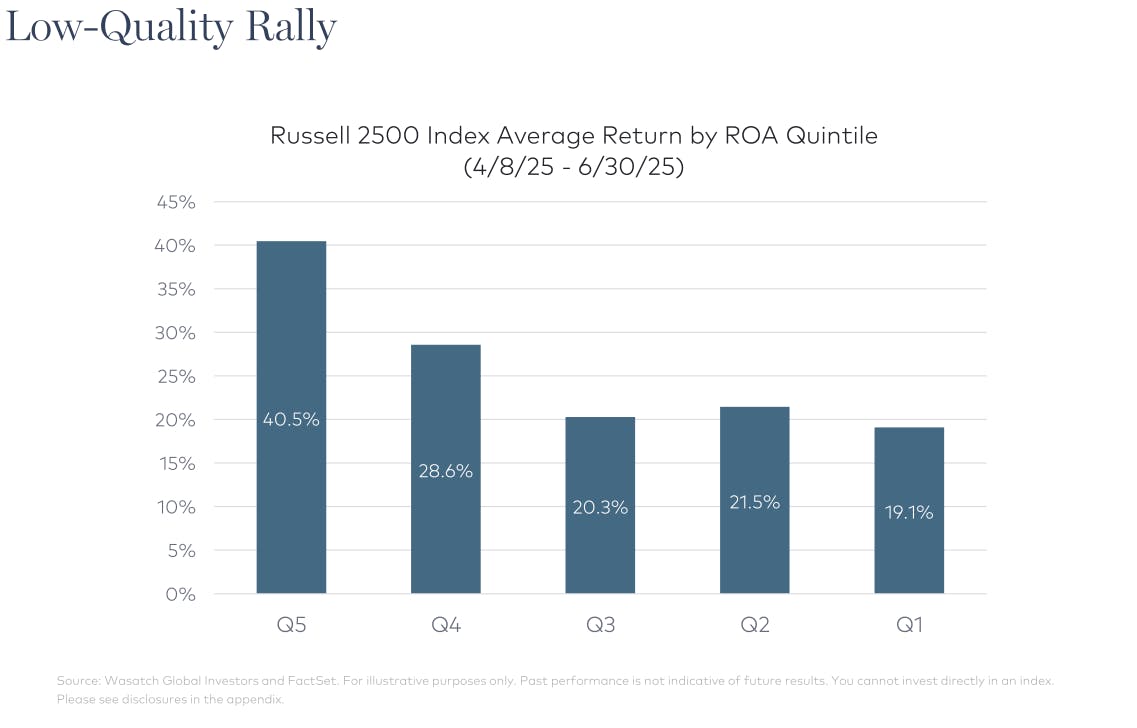
Wasatch Global Investors underscores this idea, as they assessed the recent rise of mid- and small-cap U.S. equities by analyzing the performance of the Russell 2500 Index. The companies in the index were divided into quintiles based on their return on assets (ROA) from April 8th (the market bottom) to the end of the second quarter. The ROA cut-off was around -11.
The ROA ratio shows how efficiently a company uses its assets to generate profits. It reveals what earnings are generated from invested capital. A higher ROA indicates that a company is more efficient and productive in managing its balance sheet to generate profits. A lower ROA suggests there's room for improvement. A negative ROA indicates that the company is not generating enough income to cover the cost of its assets, signaling possible financial distress or poor asset utilization.
As observed from the following chart, while there were strong returns across each group, the fifth quintile (i.e., the lowest ROA companies) was nearly twice that of the first quintile, highlighting that many low-quality stocks have benefited from the upswing.
The takeaway here is that, for investors interested in gaining exposure to the U.S small-cap equities, the best approach is a solution that actively and/or systematically focuses on higher-quality companies. High-quality stocks tend to exhibit lower drawdowns during economic contractions and greater upside when the economy expands.
Investing In U.S. Small Cap Equities
For Canadian investors interested in gaining exposure to U.S. small-cap equities in a non-passively managed fashion, the following ETFs can facilitate such an action:
The AGF U.S. Small-Mid Cap Fund (Ticker: ASMD) focuses on firms with superior growth potential and utilizes a bottom-up earnings growth momentum investment style, looking at a company’s revenue, earnings, profitability, earnings quality, and growth potential, as well as industry strength to determine inclusion within the fund.
The Manulife Multifactor U.S. Small Cap Index ETF (Ticker: MUSC) seeks to replicate the performance of the John Hancock Dimensional Small Cap Index, which targets a wide range of small-cap U.S. stocks to access the breadth of market opportunities. The index is designed to provide exposure to companies with high expected returns, based on factors such as relative price and profitability.
The TD U.S. Small-Mid-Cap Equity ETF (Ticker: TQSM) employs a quantitative equity strategy that leverages market inefficiencies in the pricing and valuation of securities to add value. The strategy aims to optimize exposure to stocks that are expected to outperform the overall market while factoring in implementation costs and seeking to avoid uncompensated risks.
Please note this article is for information purposes only and does not in any way constitute investment advice. It is essential that you seek advice from a registered financial professional prior to making any investment decision.