Best ETFs for Japanese Equity Exposure in 2026
Japanese equities are benefiting from corporate governance reforms and the policy shift under Prime Minister Sanae Takaichi, reshaping the country’s investment outlook.


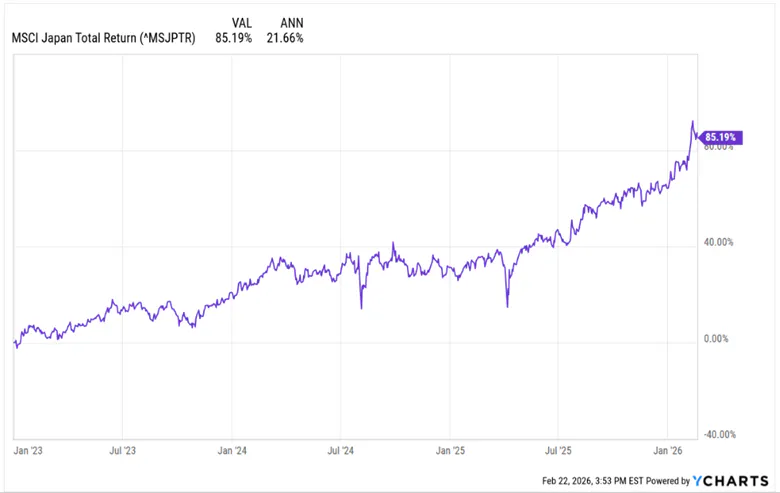
Over the past three years, investors in Japanese equities have been rewarded, as evidenced by the MSCI Japan Total Return Index's returns. The strong performance of this equity asset class stems from several corporate governance reforms enacted by the Japanese government in recent years. In January 2024, the Tokyo Stock Exchange (TSE) launched an initiative to disclose the listed companies that are making efforts to manage their businesses in a way that is mindful of market valuations, such as the Price-to-Book Value Ratio (PBR) and the cost of capital. The government also worked with the TSE to ensure as many listed companies as possible made such efforts and engaged in active dialogue with investors. Arguably, the most material change was the ending of decades-old practice of ‘cross-shareholdings’, often called strategic holdings by companies, which are widely used in Japan to cement business ties. The holdings have long been criticized by investors as an inefficient use of capital because they can cloud companies’ financial positions and shareholder structures.
The Beginning of the Takaichi Era
While the previously mentioned developments shifted the direction of Japan’s corporate and equity landscape, the nation’s first female prime minister, Sanae Takaichi, is looking to shift the economy in a whole new direction.
Prime Minister Takaichi’s ascent began when she took over the Liberal Democratic Party (LDP) leadership from her predecessor, Prime Minister Shigeru Ishiba, who resigned in October 2025. Only four months into her term, Takaichi dissolved the House of Representatives to call a snap election in February 2026 to seek a direct mandate. She won the election in a landslide, with the LDP securing 316 of 465 seats, a massive victory that gave her a two-thirds supermajority alongside coalition partners. Prime Minister Takaichi can now pursue her own political agenda.
Regarding her policy agenda, as noted in her first policy speech to the Diet (i.e., the National Legislature of Japan) in Tokyo on Feb. 20, Prime Minister Takaichi called for an end to "excessive austerity" to spur domestic investment and pledged to promote "crisis management investment" in areas contributing to economic security and "growth investment" in advanced technologies. The former refers to Japan’s need to increase its defense spending, while the latter refers to Japan’s AI-focused initiatives, such as physical AI, which refers to artificial intelligence systems that operate within and interact with the physical world, moving beyond digital-only applications to control robots, autonomous vehicles, and machinery.
Prime Minister Takaichi seeks to pursue a proactive fiscal policy and will work to make government initiatives more predictable for firms. An example of such action is her willingness to overhaul the way state budgets are drafted by promoting multi-year budgets and long-term investment funds. Presently, the government sets single-year budgets, with expenditure appropriated for one year rather than spanning several years, to ensure spending is scrutinized by parliament.
Investing in Japanese Equities
For investors looking to gain exposure to Japanese equities, the following ETF solutions can provide comprehensive exposure:
The Franklin FTSE Japan ETF (Ticker: FLJA), seeks to replicate the performance of the FTSE Japan Index. It invests, directly or indirectly, primarily in equity securities of large- and mid-capitalization Japanese issuers. FLJA is not currency hedged.
The CI Wisdom Tree Japan Equity ETF (Tickers: JAPN/JAPN.B) seeks to track the price and yield performance of the WisdomTree Japan Equity Index CAD. The Index consists of dividend-paying companies incorporated in Japan and traded on the Tokyo Stock Exchange that derive less than 80% of their revenue from sources in Japan. By excluding companies that derive 80% or more of their revenue from Japan, the index is tilted toward companies with a more significant global revenue base. JAPN is the currency-hedged version of the ETF, while JAPN.B is the unhedged version.
The BMO Japan Index (Tickers: ZJPN/ ZJPN.F) has been designed to replicate the performance of the Solactive GBS Japan Large & Mid Cap Index. The ETF invests in large and mid-cap Japanese companies. The ETF invests in and holds the constituent securities of the index in the same proportion as they are reflected in the index. ZJPN.F is the currency-hedged version of the ETF, while ZJPN is the unhedged version.
The iShares Japan Fundamental Index ETF (Ticker: CJP) has been designed to replicate the performance of the FTSE RAFI Japan Canadian Dollar Hedged Index. Under normal market conditions, CJP will primarily invest in securities of one or more iShares ETFs and/or Japanese equity securities. CJP is a currency-hedged.
This article was written on February 22nd, 2026. Please note this article is for information purposes only and does not in any way constitute investment advice. It is essential that you seek advice from a registered financial professional prior to making any investment decision.