Canadian Alternatives to Popular U.S. ETFs: How to Invest in SPY, QQQ, and More
Here’s how Canadians can invest in popular American ETFs through their domestic doppelgangers.


Sometimes, a particular product or service in another part of the world catches one’s attention and conjures the question, is there an equivalent here at home? For Canadian ETF investors, that question often arises when observing and learning about new ETF strategies launched in the U.S. While some Canadian investors may opt to buy the U.S.-listed ETF, accepting the implications of said decision, others may opt for the near equivalent or an ETF doppelganger of sorts.
Popular American ETFs And Their Canadian Equivalents
Identifying the most popular American ETFs requires knowing fund flows. Fortunately, the National Bank of Canada Financial Markets produces a monthly publication distributed by the Canadian ETF Association that provides critical insights into ETF trends occurring in the U.S. and Canada. In looking at the image below, one will see the top 15 single-long ETF Inflows – year to date as of September 2024.
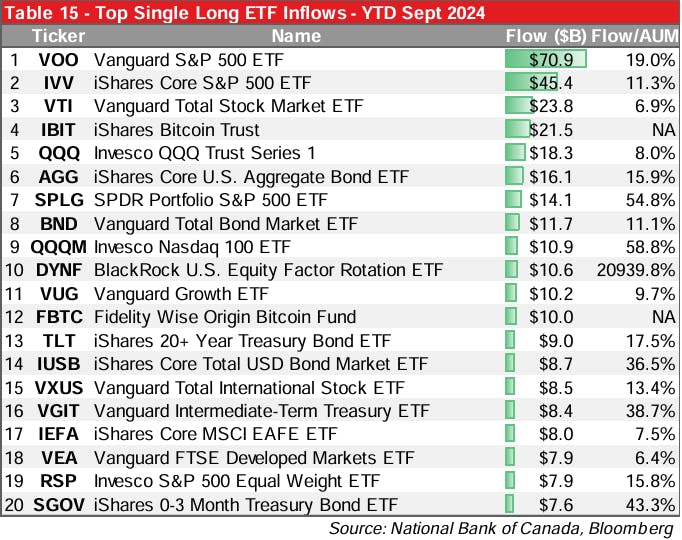
Given the global reach of fund manufacturers such as Vanguard and iShares, versions of popular U.S. ETF mandates will usually also be present on the firm’s Canadian ETF product shelf. For example, the Vanguard S&P 500 ETF (Ticker: VOO) and Vanguard Total Stock Market ETF (Ticker: VTI) Canadian equivalents would be the Vanguard S&P 500 Index ETF (Ticker: VFV) and Vanguard U.S. Total Market Index ETF (Ticker: VUN), respectively. Similarly, for iShares Core S&P 500 ETF (Ticker: IVV) and Invesco QQQ Trust Series 1 (Ticker: QQQ), their Canadian equivalents would be iShares Core S&P 500 Index ETF (Ticker: XUS) and Invesco Nasdaq 100 Index ETF (Tickers: QQC/QQC.F).
While there are instances where there are clear equivalents, there are cases of near/close equivalents. For example, from the list, the BlackRock U.S. Equity Factor Rotation ETF (Ticker: DYNF) stands out. DYNF is an actively and dynamically managed solution that utilizes a factor rotation model to provide diversified and tactical exposure to investment factors within the large and mid-cap space of the U.S. equities asset class.
Equities are selected based on financially healthy firms (quality), inexpensive stocks (value), smaller companies (size), lower-volatility stocks (minimum volatility), and trending stocks (momentum).
The AGF Systematic US Equity ETF (Ticker: QUS), arguably has a similar investment objective and approach to DYNF. QUS uses a quantitative model to evaluate securities of U.S. large- and mid-capitalization issuers, in order to construct a portfolio that aims to provide long-term capital growth while minimizing volatility. The quantitative model evaluates U.S. securities based on factors that may include growth, value, quality, risk, and other characteristics.
Although QUS’s investments are selected based on the output of a quantitative model, the portfolio incorporates constraints/controls (in relation to country, industry, group, sector and individual security concentrations) that are designed to foster portfolio diversification, liquidity and risk mitigation. An ESG negative screening approach is also applied to determine the lowest ranked securities, which is factored into the portfolio construction process.
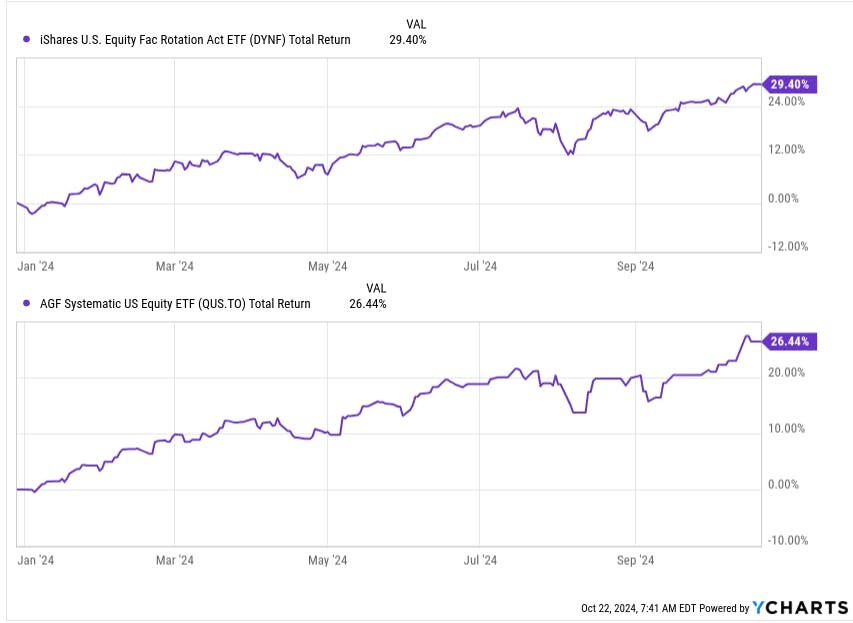
Both ETFs have performed well year-to-date, illustrating the efficacy of their respective investment strategies and the ability to balance risk management with growth opportunities successfully.
Takeaway
For Canadian investors, there are compelling Canadian-listed ETFs that provide similar – if not the same – exposures as many popular U.S.-listed ETFs. Taking time to identify these funds can be of great benefit in the long run and utilizing tools such as the CBOE ETF Screener can be a great starting point to understand the breadth of ETF offerings available within the Canadian ETF landscape.
Please note this article is for information purposes only and does not in any way constitute investment advice. It is essential that you seek advice from a registered financial professional prior to making any investment decision.