Canadian Couch Potato Model Portfolio: Is It Still Relevant in 2023?
Here's a look at a historically popular model portfolio for Canadian investors.


One of the best resources for Canadian investors over the last decade was (and still is) Canadian Couch Potato. Run by Dan Bortolotti, the blog offers Canadians a complete guide to index investing. A big part of the blog is Dan's series of "model portfolios" which provides Canadian investors with ETF picks.
Since the launch of Vanguard, iShares, and BMO's suite of asset allocation ETFs, Canadian Couch Potato's model portfolios have been drastically simplified to use these ETFs, and for good reason. Their simplicity and low fees bode well for DIY investors, who are known to over-tinker sometimes.
That being said, Canadian Couch Potato's old "three-ETF portfolio" was what got me started with investing back in the day, and I think it's still relevant today despite its greater complexity. Above all, it offers a tangible example of the benefits of passive indexing and diversification.
Let's take a look at what this portfolio entailed and if it’s worth implementing in 2023.
What is a couch potato portfolio?
When it comes to investing, laziness is actually a virtue. Sure, some of us may obsess over portfolio metrics like Sharpe ratios, drawdowns, correlations, etc, but it's worth noting that the majority of Canadian investors aren't looking to do the same.
While investing can be a good hobby for some, for others it can be a chore and a necessary evil. Sometimes, people just want to set and forget an investment portfolio for their retirement, so they can focus on the things that actually matter to them.
That is where the Canadian Couch Potato model portfolio comes in. Before the launch of asset allocation ETFs, the three-ETF version was intended as a simple, accessible, highly diversified, low-cost, and easily managed portfolio for the layperson who wanted to stay hands-off with their investment.
Consisting of just three ETFs (a global ex-Canada all-cap equity ETF, a Canadian all-cap equity ETF, and a Canadian aggregate bond ETF), the old Canadian Couch Potato portfolio represented the best of John Bogle's passive investing philosophy of "buying the haystack".
While the Canadian Couch Potato portfolio won't beat the market, it is unlikely to drastically underperform it either. It's intended to capture the long-term average market return, which combined with steady contributions can set investors up for a solid retirement. As John Bogle once said: "gunning for average is your best shot of finishing above average".
Constructing the couch potato portfolio
From my point of view, the Canadian Couch Potato portfolio had three main objectives:
- Attaining diversification among global equities (U.S., developed, and emerging) of all market cap sizes and market sectors with a Canadian home-country bias
- Ensuring a healthy allocation of aggregate Canadian bonds tailored to an individual's risk tolerance and time horizon.
- Keeping fees as low as possible, ETF turnover as little as possible, and portfolio components as minimal as possible. This meant the use of passive index ETFs.
At the time, Dan suggested the use of three ETFs, one each from Vanguard, iShares, and BMO:
- Global Ex-Canadian Equities: iShares Core MSCI All Country World ex Canada Index ETF (XAW)
- Canadian Equities: Vanguard FTSE Canada All Cap Index ETF (VCN)
- Canadian bonds: BMO Aggregate Bond Index ETF (ZAG)
For example, an 80/20 stock/bond allocation using the above might look something like 60% XAW, 20% VCN, and 20% ZAG. This would result in a 25% Canadian home-country bias on the equity side, and a weighted average expense ratio of 0.16%.
Here's how this mix, rebalanced annually, would have performed against Dan's current recommendation of the Vanguard Growth ETF Portfolio (TSX:VGRO).
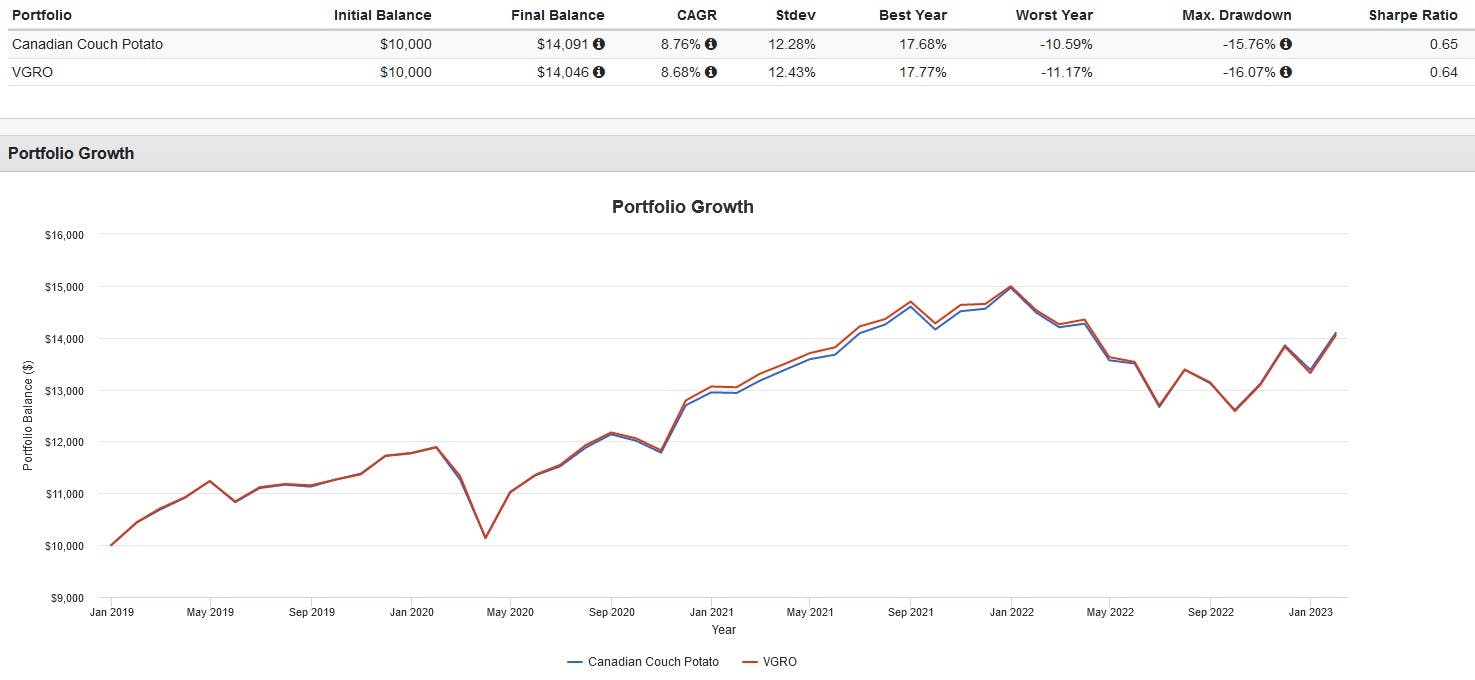
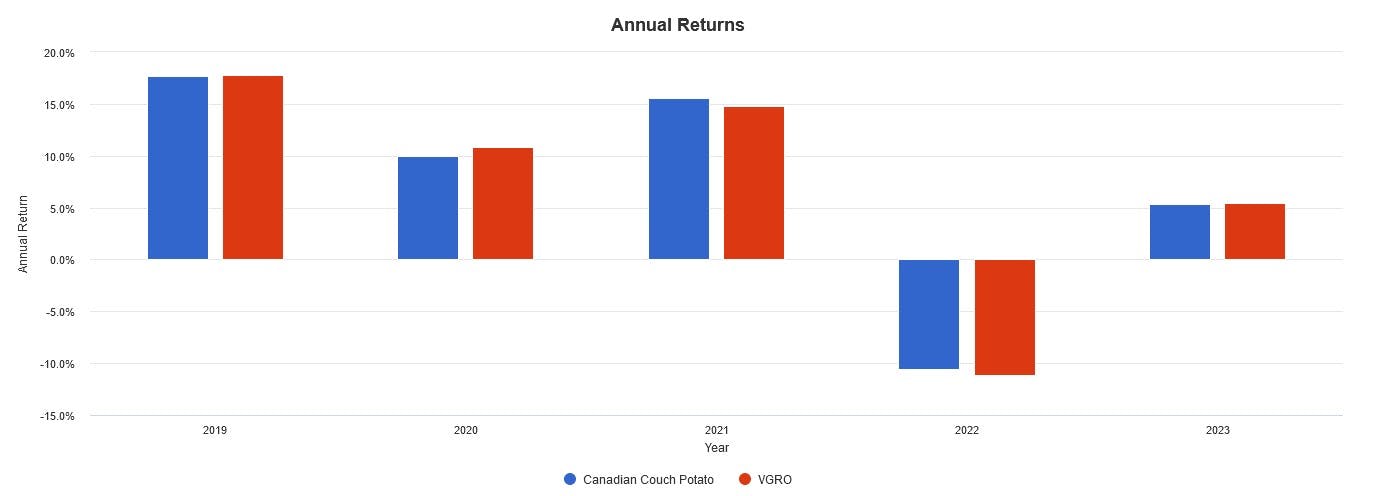
The historical returns are nearly identical. The Couch Potato Portfolio managed to squeeze out a few basis points higher in returns and is lower in volatility than VGRO, which I attribute to the former's lower cost thanks to the lack of global bond ETFs.
However, I completely understand why Dan ditched it for VGRO. Is the additional complexity of managing three ETFs worth an 8 basis point (0.08%) improvement in returns? Keep in mind that these backtests ignore trading costs like commissions and bid-ask spreads.
In my opinion, Dan is right to put simplicity first by replacing the Couch Potato Portfolio with asset allocation ETFs. With VGRO, investors are less likely to compulsively tinker, time the market, or add additional unnecessary "fad" ETFs that might be trending.
Please note this article is for information purposes only and does not in any way constitute investment advice. It is essential that you seek advice from a registered financial professional prior to making any investment decision.