Canadian ETF Comparison Series: TDOC vs. CHCL.B
Two popular Canada-listed global healthcare ETFs go head-to-head in this instalment of our Comparison Series.


The phrase ‘health is wealth’ can be viewed as a double-entendre, and in the case of this article, we’re looking at its second interpretation by analyzing two healthcare ETFs: the TD Global Healthcare Leaders Index ETF (Ticker: TDOC/TDOC.U) and CI Global Healthcare Leaders Index ETF (Ticker: CHCL.B). Both are globally focused equity solutions for investors, with AUMs of $91.9 million and $ 274.6 million, respectively, for TDOC and CHCL.B
Similar, But Not The Same: TDOC vs. CHCL.B
Both TDOC and CHCL.B are passively managed strategies replicating the performance of the Solactive Global Healthcare Leaders Index (CA NTR) and Solactive Developed Markets Healthcare 150 CAD Index (CA NTR), respectively. Though Solative is the index provider for both solutions, the strategy employed by each is slightly different. The Solactive Global Healthcare Leaders Index tracks the performance of global large and mid-capitalization issuers related to healthcare while imposing a limit of 2% on any single issuer. Constituents are required to have a free float market capitalization of at least USD 1 billion to be eligible. Conversely, the Solactive Developed Markets Healthcare 150 CAD Index tracks the performance of the largest 150 companies; constituents are selected and weighted based on free-float market capitalization.
Based on the public listing of the Solactive Global Healthcare Leaders Index, as of September 16th, there are currently 115 holdings versus the 150 for the Solactive Developed Markets Healthcare 150 CAD Index (CA NTR).
A Look At Performance
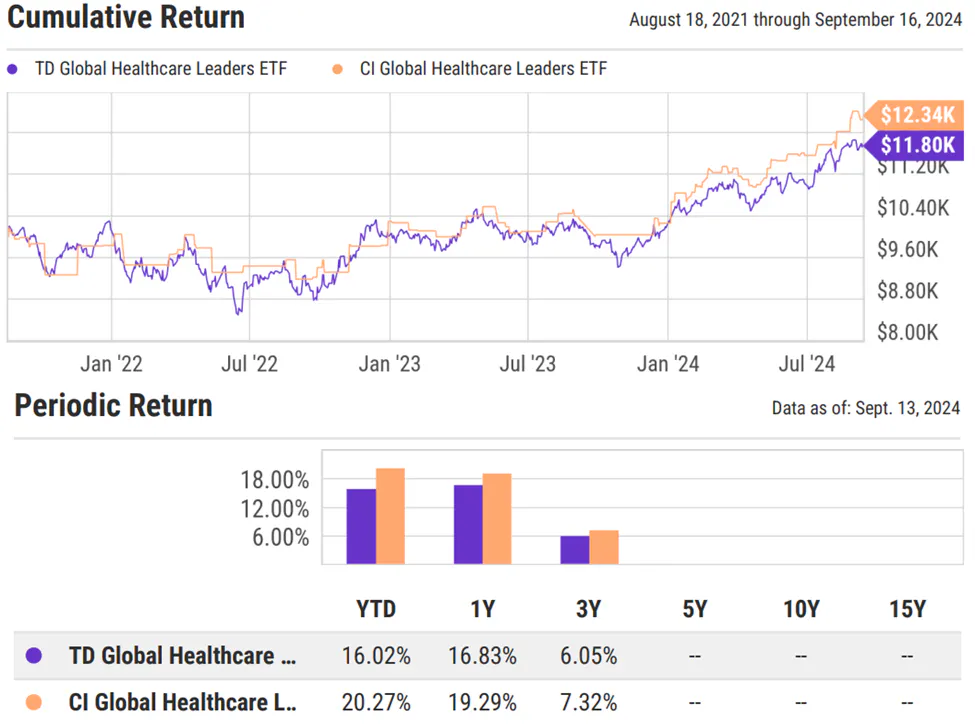
Though both funds have a 3-year performance track record, the CHCL.B ETF has exhibited performance leadership over that tenure. Year-to-date, CHCL.B has returned 20.27% versus TDOC’s 16.02%.
A Look At Composition
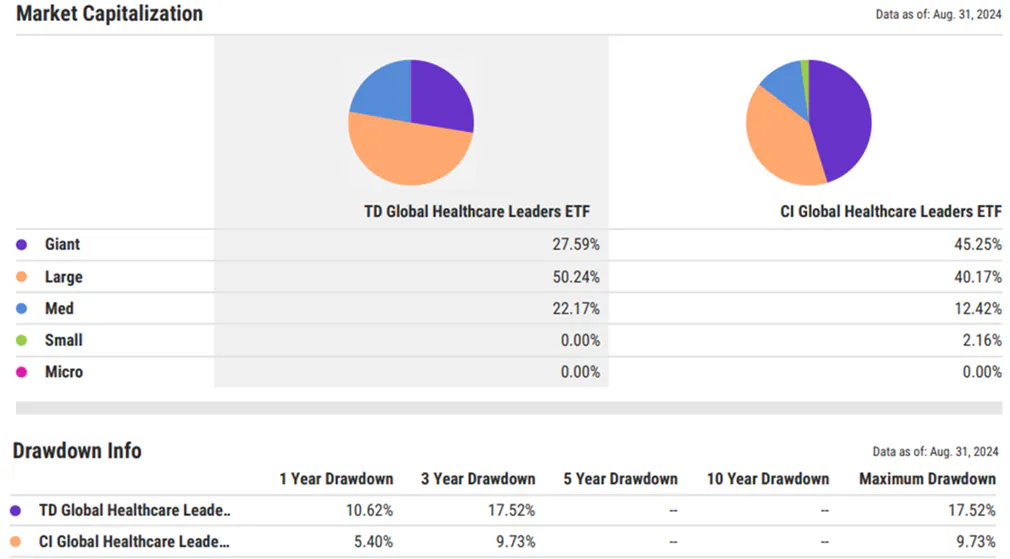
Looking at the composition of both funds, as guided by their respective index methodologies, the reason for CHCL.B’s outperformance becomes apparent. The healthcare sector is primarily driven by large, well-capitalized companies with sizable market share in their sub-industries. Thus, having predominant exposure to these businesses—in a free-floating manner—would benefit the ETF’s performance. As illustrated in the following image, CHCL.B has a greater exposure (approximately 85%) to giant and large capitalization firms than TDOC (i.e., approximately 78%). Arguably, CHCL.B’s allocation to giant and large capitalization firms provides a measure of ‘quality factor’ exposure, which would help mitigate the ETF’s drawdown potential.
Other Considerations
In contrasting both solutions, a natural criterion to examine is fees. As is well known, CLCH.B’s expense ratio (0.38%) is marginally lower than TDOC’s expense ratio of 0.39%. In looking at the tracking difference of each fund relative to their respective benchmark indices, TDOC’s is -0.52% as of August 30th, 2024, while CHCL.B is not listed presently.
The tracking difference is a key metric used to evaluate how well an ETF replicates the performance of its underlying index. It is the difference between the ETF’s return and the index’s return, which is designed to track and is typically measured over a specific period. Generally, a smaller tracking difference indicates that the ETF more accurately tracks its index. Understanding tracking difference helps investors gauge the efficiency of an ETF and make more informed investment choices.
Takeaway
At this juncture, the performance CHCL.B leads it to be the preferable mandate of the two. Furthermore, the focus on giant and large firms within the healthcare sector provides a quality aspect that is seemingly beneficial in minimizing drawdowns. Finally, though marginal, the cost of the ETF is cheaper.
Please note this article is for information purposes only and does not in any way constitute investment advice. It is essential that you seek advice from a registered financial professional prior to making any investment decision.