Canadian ETF Comparison Series: XIT vs. TEC
Two of the top Canadian-listed Technology ETFs go head-to-head in this week’s comparison piece.

The technology sector's growth in the last decade has changed the business and societal landscape globally. With many of today's leading companies being technology-focused, investors who maintain exposure to the sector are poised to benefit from developments arising from established and burgeoning firms in the industry. For investors looking to gain exposure to the technology sector, the iShares S&P/TSX Capped Information Technology Index ETF (Ticker: XIT) and TD Global Technology Leaders Index ETF (Ticker: TEC) are popular ETFs that provide turnkey exposure to the technology sector.
As of November 8th, 2024, the assets under management for the iShares S&P/TSX Capped Information Technology Index ETF and TD Global Technology Leaders Index ETF are $686.93 million and $3.187 billion, respectively.
XIT vs. TEC: Investment Strategy Comparison
Both XIT and TEC are passively managed ETFs. The former tracks the performance of the S&P/TSX Capped Information Technology Index, while the latter tracks the performance of the Solactive Global Technology Leaders Index (CA NTR). Each index's investment focus speaks to its distinct investment experience. The S&P/TSX Capped Information Technology imposes capped weights on the index constituents included in the S&P/TSX Composite that are classified in the GICS® information technology sector.
Whereas the Solactive Global Technology Leaders Index intends to track the price movement of a portfolio of companies, including traditional technology companies and companies that belong to other subsectors but are engaged in disruptive technologies. This refers to, but is not limited to, global companies involved in technology-related themes such as Cybersecurity, the Internet of Things, E-Commerce, Robotics & Automation, Artificial Intelligence, Autonomous Vehicles, and Cloud/Big Data.
Simply put, XIT is limited to Canadian listed technology firms, with a 'cap' on their allocations within the index. Conversely, TEC is more globally oriented, with broad exposure to companies involved in various technological areas.
XIT vs. TEC: Performance Comparison
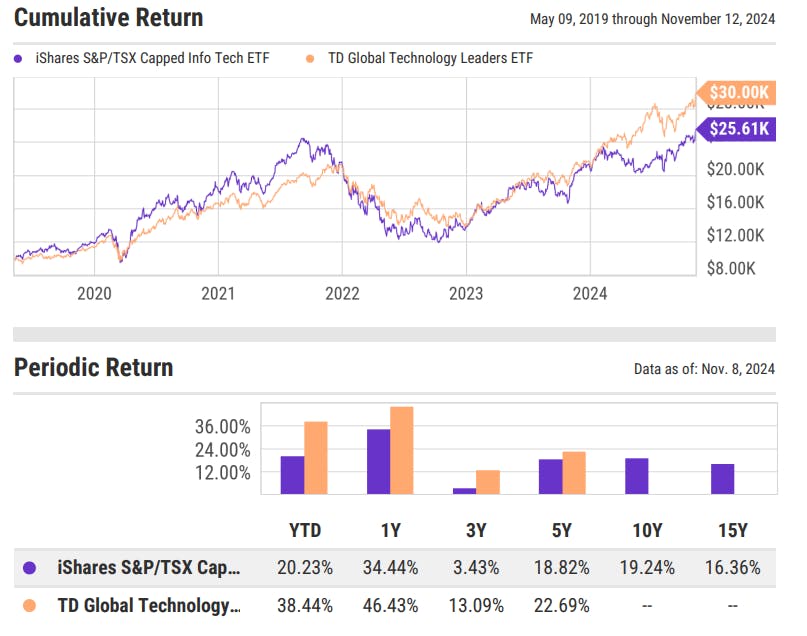
Though both funds have at least a 4-year performance track record, TEC has exhibited performance leadership over that tenure. Year-to-date, TEC has returned 38.44% versus XIT's 20.23 %.
XIT vs. TEC: Exposure Comparison
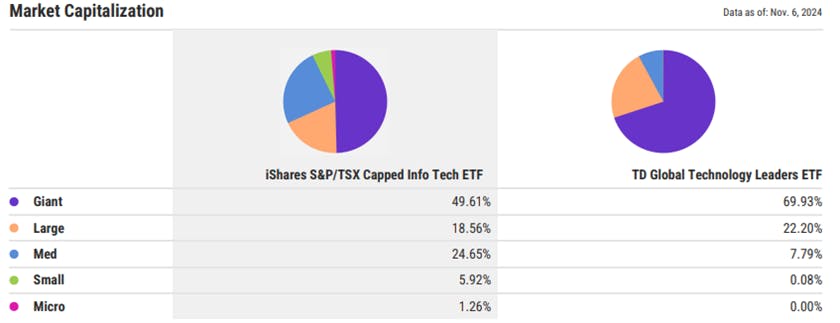
Looking at the composition of both funds, as guided by their respective index methodologies, TEC's composition is materially different than XIT's. The tech sector is primarily driven by large, well-capitalized companies with sizable market shares in their sub-industries. Thus, having predominant exposure to these businesses—in a free-floating manner—would benefit the TEC's performance. As illustrated in the following image, TEC has a greater exposure (approximately 90%) to giant and large capitalization firms than XIT (i.e., approximately 70%). Arguably, TEC's allocation to giant and large capitalization firms provides a measure of 'quality factor' exposure, which would help mitigate the ETF's drawdown potential.

XIT vs. TEC: Other Considerations
A natural criterion to examine when contrasting both ETFs is fees. TEC's expense ratio of 0.39% is materially lower than XIT's expense ratio of 0.60%. In looking at each fund's tracking difference relative to their respective benchmark indices, TEC's is -0.59% as of October 31st, 2024, while XIT's is -0.37% for the same month-end.
The tracking difference is a key metric used to evaluate how well an ETF replicates the performance of its underlying index. It is the difference between the ETF's return and the index's return, which is designed to track and is typically measured over a specific period. Generally, a smaller tracking difference indicates that the ETF more accurately tracks its index. Understanding tracking difference helps investors gauge the efficiency of an ETF and make more informed investments.
Takeaway
At this juncture, TEC's broader focus and stronger performance make it the preferable mandate of the two. Furthermore, the focus on giant and large firms within the technology sector provides a quality aspect that is seemingly beneficial in minimizing drawdowns. Finally, TEC's cost is a material differentiator.
Please note this article is for information purposes only and does not in any way constitute investment advice. It is essential that you seek advice from a registered financial professional prior to making any investment decision.