Canadian ETF Comparison Series: ZQQ, XQQ, and QQC.F
A look at Canadian-listed ETFs that provide an investment performance similar to QQQ.

The Invesco QQQ Trust, Series 1 (Ticker: QQQ) is among the most well-known ETFs globally, as it is a turnkey solution providing access to the NASDAQ-100 Index. For Canadian investors, the BMO NASDAQ 100 Equity Hedged to CAD ETF (Ticker ZQQ) and iShares NASDAQ 100 ETF (CAD-Hedged) (Ticker: XQQ) are two of the larger Canadian-listed ETFs that replicate QQQ’s investment strategy. As of October 28th, 2024, the assets under management for the BMO NASDAQ 100 Equity Hedge to CAD ETF and iShares NASDAQ 100 ETF (CAD-Hedged) are $2.086 billion and $3.148 billion, respectively.
ZQQ vs. XQQ: Investment Strategy Comparison
Both ZQQ and XQQ are passively managed solutions that track the performance of the same index; as such, there is no overt difference in their investment focus. Both investment solutions use currency hedging to minimize the impact of the USD/CAD exchange rate. From a fees perspective, they both have the same MER of 0.39%.
However, there are slight differences between the funds that can be noted. In looking at the tracking differences of each fund relative to their respective benchmark indices, ZQQ’s (i.e., -0.69%) is slightly lower than XQQ’s (i.e., -0.72%) as of September 30th, 2024. The tracking difference is a key metric used to evaluate how well an ETF replicates the performance of its underlying index. It is the difference between the ETF's return and the index's return, which is designed to track and is typically measured over a specific period. Generally, a smaller tracking difference indicates that the ETF more accurately tracks its index. Understanding tracking difference helps investors gauge the efficiency of an ETF and make more informed investment choices.
Another interesting difference between the funds is found in their respective MRFPs (i.e., XQQ and ZQQ). From 2019 to 2023, XQQ’s portfolio turnover rate (i.e.,36.02%, 46.20%, 29.23%, 39.58%, and 50.0%) was higher than ZQQ’s (32.98%, 37.74%, 25.82%, 38.13%, and 24.67%). The 2023 turnover ratio (i.e., 50.0%) for XQQ is noticeable. While a high turnover in a passive ETF is atypical, it's not necessarily negative if the strategy is well-executed and delivers value to investors. However, closer scrutiny is warranted to understand the reasons behind the higher activity level and its impact on costs and performance.
ZQQ vs. XQQ: Performance Comparison
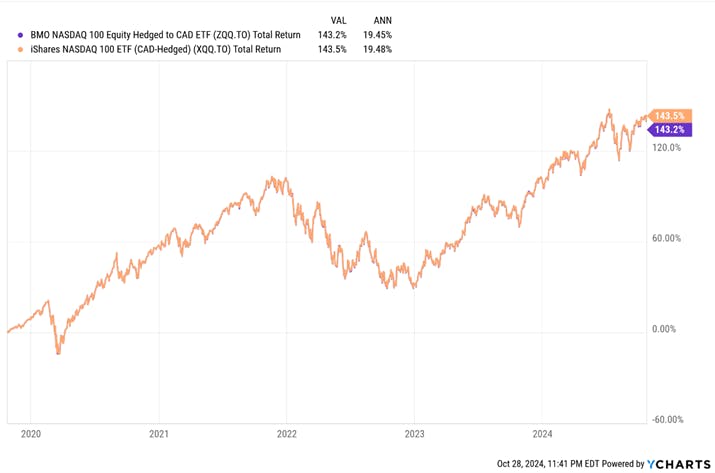
As mentioned previously, the similarities in both funds are very high, so much so that their performance is nearly identical. In looking at the 5-year performance of both funds, their returns and the investment experience they provide a virtually the same.
Another Consideration: Invesco Canada’s QQC.F
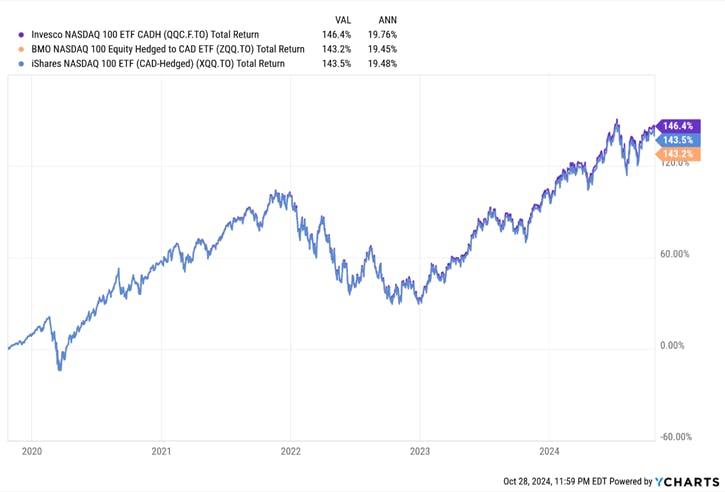
While ZQQ and XQQ are dissimilar when compared against each other. However, when they are contrasted against Invesco Canada’s Invesco NASDAQ 100 ETF Canadian Hedged (Ticker: QQC.F), there are material differences. As mentioned in a previous article, QQC.F is the Canadian equivalent of QQQ. From a fee perspective, it is lower than the previously mentioned ETFs, with a MER of 0.20%. Regarding tracking difference, QQC.F’s is -0.41% as of September 2024. From a performance standpoint, QQC.F is mostly in line, but marginally better, than the other two ETFs.
Takeaway
Though the three funds are similar, differences such as QQC.F’s lower MER and lower tracking difference are consequential considerations when investing over the long term. As such, QQC.F is likely the best solution to choose from relative to the other two ETFs.
Please note this article is for information purposes only and does not in any way constitute investment advice. It is essential that you seek advice from a registered financial professional prior to making any investment decision.