Canadian ETFs to Capitalize on U.S. Financial Sector Momentum
U.S. financial close out 2024 strong, with a compelling outlook for 2025. A look at Canadian listed ETFs that provide exposure.


2024 was an excellent year for the financial sector, as it materially outperformed the broader S&P 500 Index. Six of the largest U.S. banks contributed to the sector’s stellar performance, collectively generating $142 billion in profits in 2024, as reported by the Financial Times.
High interest rates, a strong economy, and a significant rebound in dealmaking were the identified success factors for this profit-making. These elements combined to create a favorable environment for the banks, allowing them to achieve remarkable financial results.
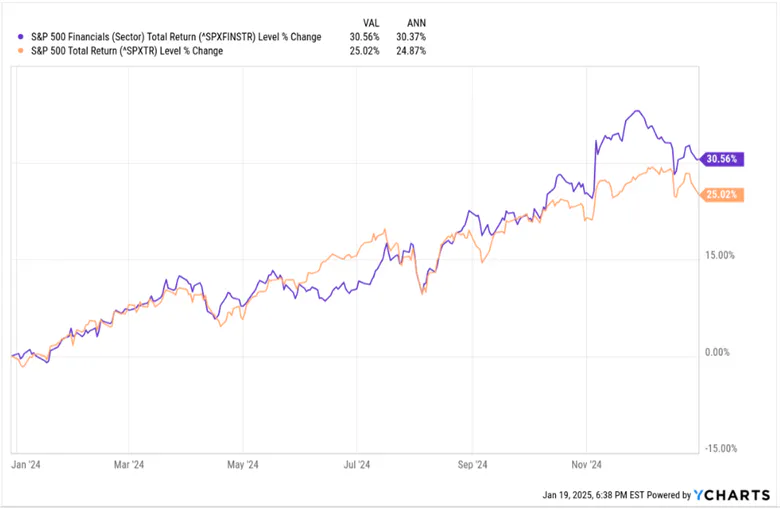
Regarding high interest rates, as reported by the Financial Times, the big six banks generated just over $250 billion in net interest income, which is generally defined as the difference between interest revenues and interest expenses.
Interest revenues are payments the bank receives from their interest-bearing assets, and interest expenses are the cost of servicing interest payments to customers on their deposits. Though interest rates have come down materially due to the actions of the Federal Reserve, banks still benefit from higher rates at the long end of the curve but have been able to take down deposit costs.
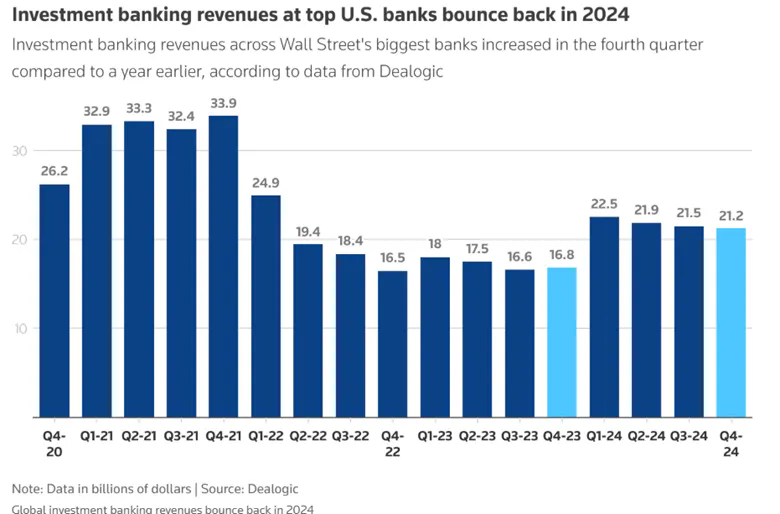
On the deal-making front, investment banking revenues improved year-over-year for the fourth quarter, rising 26%. As reported by the Financial Times, trading revenue reached $123 billion for the full year in 2024, up 10% from 2023.
Trump Era Brings Hopes for Less Banking Regulation
With the incoming Trump administration, the sentiment within Wall Street is reported to be much more confident due to the belief that there will be an easing in oversight or a relaxing of the requirements, such as the need for too-big-to-fail lenders to hold more capital to buffer themselves against economic shocks.
Furthermore, there is the potential for increased deal-making, such as mergers and acquisitions, which would allow for more investment banking or advisory fee generation for the banks. Simply put, lesser regulatory obligations for banks could enable them to either increase their risk-taking or enhance shareholder returns via buybacks or dividends, both of which would improve investor profits.
Investing in the U.S. Financial Sector with ETFs
For Canadian investors looking to gain exposure to the U.S. financial sector, there are ETF solutions that facilitate this need, providing either board or specific sector exposure.
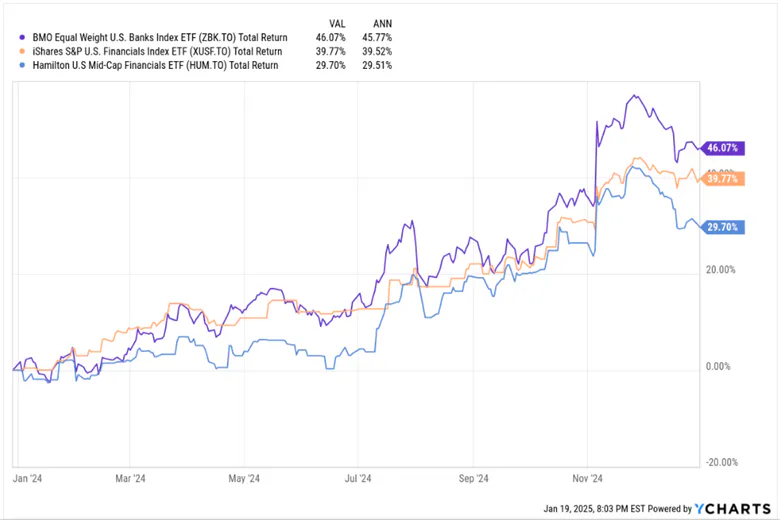
The BMO Equal Weight U.S. Bank Index ETF (Ticker: ZBK) is designed to replicate the performance of the Solactive Equal Weight US Bank Index, which consists of U.S. securities that fall within one of the following Industry groups: Finance, U.S. Banks, U.S. Commercial Banks, or U.S. Commercial Savings Institutions.
The iShares S&P U.S. Financials Index (Ticker: XUSF) is designed to replicate the performance of the S&P Financial Select Sector Index, which provides exposure to U.S. banks, insurers, and credit card companies.
The Hamilton U.S. Mid-Cap Financials ETF (Ticker: HUM) is an actively managed ETF that provides exposure to U.S.-based mid and small-cap financial services companies, including banks, wealth management, exchanges, and other financial institutions.
Comparing the U.S. Financial Sector ETFs with this Tool
Using Trackinsight’s Compare ETF Tool, you can compare up to 5 ETFs on one screen, evaluating performance, fees, risks, holdings, allocations, and more. Here’s how these U.S. Financial Sector ETFs performed in the comparison.
View ZBK vs. XUSF vs. HUM ETFs Comparison.
Please note this article is for information purposes only and does not in any way constitute investment advice. It is essential that you seek advice from a registered financial professional prior to making any investment decision.