Canadian Value ETFs Lead Amid Market Volatility
Canadian value ETFs are outperforming as energy strength and market volatility shift investor focus toward undervalued large-cap stocks.


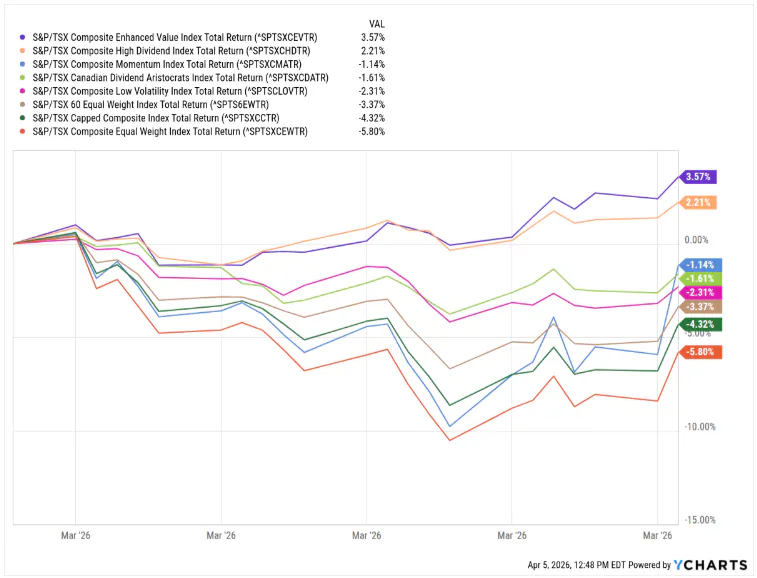
March Madness had a dual meaning this year, as the Iran conflict in the Middle East was the focal event of the month. From an equity sector viewpoint, the Energy sector was the only one to perform positively. However, from an equity factor standpoint, value outperformed all other factors (see the previous article on the S&P/TSX Composite High Dividend Index). As shown in the following chart, the S&P/TSX Composite Enhanced Value led all other equity factors for the month.
Value’s Investing Proposition
Against the backdrop of increased market uncertainty, nearly all equities have been negatively impacted. Currently, many equities are trading below their intrinsic value. This is best illustrated by comparing the year-to-date performance of the MSCI Canada Value Index with that of the MSCI Canada Index. Although the MSCI Canada Index outperformed the MSCI Canada Value Index throughout January 2026, concerns about renewed tariff threats from the Trump Administration led to increased volatility and a brief decline, allowing the MSCI Canada Value Index to outperform its parent index. Since the MSCI Canada Value Index has minimal exposure to the information technology sector but is heavily weighted towards the Financial and Energy sectors, the index was marginally impacted during February, when the SaaS Apocalypse (i.e., Software Stock Selloff) occurred, and benefited from the run-up in Energy during the Iran Conflict in March.
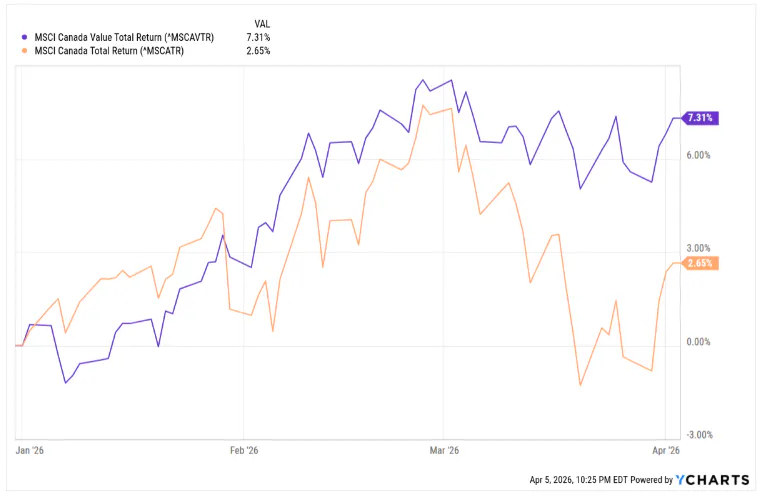
Given the current market conditions, the strong performance of the value equity factor may be attributed to equities in which the investment factor has a predisposition towards and to investors seeking to acquire valuable assets when they are temporarily undervalued and holding them until they reach their full potential.
Gaining Exposure to Canadian Value
For investors interested in value-focused investment solutions, the following ETFs provide exposure to large-cap Canadian equities and reflect the value factor in their investment strategies.
The Fidelity Canadian Value Index (Ticker: FCCV) seeks to replicate the performance of the Fidelity Canada Canadian Value Index. This Fidelity ETF invests primarily in equity securities of large- and mid-cap Canadian companies with attractive valuations.
The iShares Canadian Value Index (Ticker: XCV) seeks to replicate the performance of the Dow Jones Canada Select Value Index, which aims to provide an accurate, balanced, and comprehensive portrait of Canadian value stocks. The index is constructed using a methodology that intends to correctly identify large-cap and mid-cap value stocks, while excluding stocks that do not clearly or consistently exhibit the traits of this category.
The BMO MSCI Canada Value Index (Ticker: ZVC) seeks to replicate the performance of the MSCI Canada Enhanced Value Capped Index, which tracks Canadian large and mid-cap stocks with high-value characteristics—specifically, low price-to-book, low price-to-forward earnings, and low enterprise value-to-cash flow. It applies a 10% cap on individual security weights at each semi-annual rebalance to minimize concentration.
This article was written on April 5th, 2026. Please note this article is for information purposes only and does not in any way constitute investment advice. It is essential that you seek advice from a registered financial professional prior to making any investment decision.