How Canadians Can Generate Income with these Covered Call ETFs
A look at Canadian Covered Call ETFs that have attractive distribution yields.


Income generation is always top-of-mind for most investors. Regardless of the macroeconomic environment, knowing that one’s investment portfolio produces income instils a sense of calm and confidence. Within the Canadian ETF landscape, covered-call strategies have grown in popularity in recent years because they aim to deliver above-average income while also participating in some price appreciation.
Covered Call ETF Explained & The Canadian Landscape
A covered call ETF holds a portfolio of stocks and also sells (or “writes”) call options on some or all of those stocks. A call option gives the buyer the right, but not the obligation, to purchase the stock at a set price before a certain date. When the ETF sells these call options, it collects a premium (income), which can add to the returns of the ETF. However, if the stock price rises above the strike price of the option, the ETF may have to sell the stock at that set price, potentially limiting gains.
The strategy aims to generate extra income from the call premiums, which can be beneficial in markets with little price movement (sideways markets). However, in strong bull markets, this strategy may underperform because the ETF might miss out on bigger stock price gains due to the options it sells. It’s a trade-off between receiving a steady income and having less potential for significant price appreciation.
As mentioned, Canada has an extensive offering of covered call ETF solutions across differing fund manufacturers. Utilizing the CBOE ETF Screener to quantify the popularity of these solutions, there are over 120 covered call ETF strategies, with Harvest ETFs (38), BMO (28), Evolve ETFs (25), Global X (21), Purpose ETFs (19), and Hamilton ETFs (16) being among the leading issuers.
Covered Call ETFs With High Yields
For income-focused investors, an ETF’s distribution yield is often a data point that catches their eye. In general, yield is a backwards-looking annual percentage used to express an investor’s potential income earned from the investment. Though a fund’s distribution yield should not be the sole reason one invests in a fund – as factors beyond investment income may contribute (positively or negatively) to an ETF’s displayed yield – for the sake of observation and comparison, it will be the primary factor when looking at Canadian covered call ETFs with the highest distribution yield.
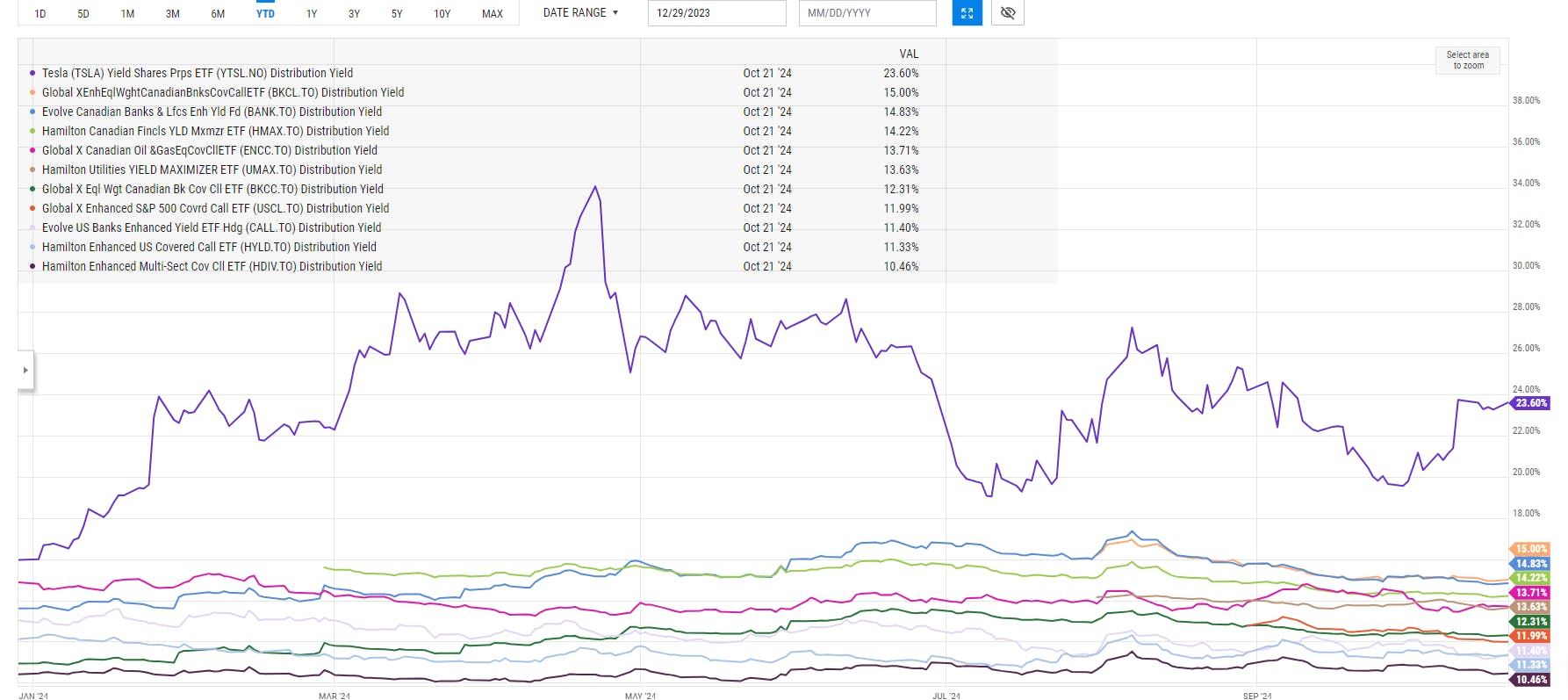
Among the covered call ETF strategies, Purpose ETF’s Tesla Yield Share (Ticker: YTSL) has a distribution yield of over 20.00% (as of October 21). The single-stock ETF is a part of Purpose’s Yield Share ETF suite, which has covered call strategies on many notable companies.
Global X has four ETFs with high distribution yields: the Global X Enhanced Equal Weight Canadian Banks Covered Call ETF (Ticker: BKCL) (15.00%), the Global X Canadian Oil and Gas Equity Covered Call ETF (Ticker: ENCC) (13.71%), the Global X Equal Weight Canadian Bank Covered Call ETF (Ticker: BKCC) (12.31%), and the Global X Enhanced S&P 500 Covered Call ETF (Ticker: USCL) (Ticker: 11.99%) as of October 21, 2024. Given the significance of the financial and energy sectors within the Canadian economy, having them as underlying exposure provides a level of surety. Canadian banks continue to be very well-capitalized and prudently managed while growing their dividend modestly over the years.
Rounding out the group are ETFs from Hamilton ETFs (i.e., HMAX: 14.22%, UMAX: 13.63%, HYLD: 11.33%, and HDIV: 10.46%) and Evolve ETFs (i.e., BANK: 14.83% and CALL: 11.40%). As documented previously, Hamilton ETFs have a growing suite, Hamilton ETFs Yield Maximizer™ ETFs, that provide broad exposure to specific market sectors. While as mentioned earlier, Evolve’s highest-yielding ETFs are focused on the financial services sector.
Conclusion
Covered call ETFs can be a good option for investors looking to hedge against volatility and generate income. If one is seeking to maximize yield while keeping long-term exposure to a specific market exposure, covered call ETFs are worthy of consideration for inclusion in one’s portfolio.
Please note this article is for information purposes only and does not in any way constitute investment advice. It is essential that you seek advice from a registered financial professional prior to making any investment decision.