Chinese Stocks on the Rebound? Here Are Two ETFs to Ride the Wave
How the People's Bank of China's recent economic policy announcement impacts Chinese equities and what it means for Canadian ETF investors.


In an unexpected move, the People's Bank of China (PBOC) unveiled a surprise stimulus package to spur its economy to achieve its intended growth target of 5%. As announced by PBOC Governor Pan Gongsheng, the economic package aims to support the property market by lowering borrowing costs on as much as $5.3 trillion in mortgages and easing rules for second-home purchases. Additionally, the reserve requirement will be lowered by 50 basis points, with Governor Gongsheng indicating the possibility of another 0.25 to 0.5 basis points by the end of the year. Given that China's economic growth has slowed, dragged down by the real estate slump and low consumer confidence, these initiatives are welcomed news.
The PBOC is considering injecting up to 1 trillion yuan ($142 billion) of capital into its biggest state banks to increase their capacity to support the struggling economy. China's major financial institutions face increased regulatory expectations to support economic recovery efforts. These expectations include providing more favorable lending terms to borrowers with higher risk profiles. Among the targeted recipients are real estate developers, homeowners, and local government financing vehicles experiencing financial constraints. The aim is to stimulate economic activity through increased access to credit.
How Chinese Stocks are doing
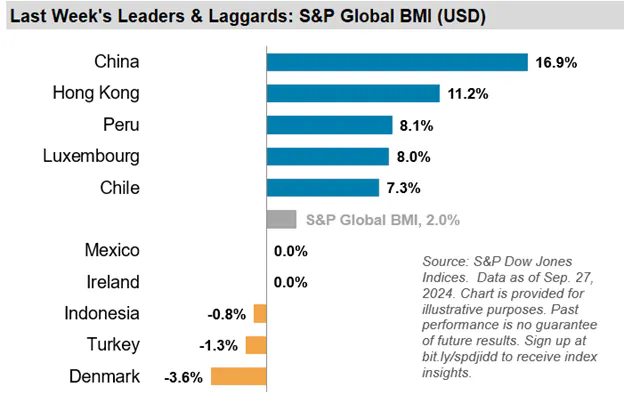
As illustrated in the following chart, Chinese equities have been underperforming for a prolonged period. The impetus for Chinese equity underperformance has been a property crisis, with the China Evergrande Group being a company that exemplified the country's real estate boom and bust. The property market crisis ultimately diminished consumer confidence and adversely impacted the Chinese economy, leading investors to limit or eliminate their equity exposure to the world's second-largest economy. However, the PBOC's announcement has shifted market sentiment, as Chinese equities rallied 17% to end last week (September 27, 2024).
How Emerging Markets Stocks are Doing
China's role within the emerging markets landscape and asset class is unquestionable, as evidenced by its approximate 25% allocation within the MSCI Emerging Market Index. However, this sizable allocation has impacted performance in recent years, as evidenced by the widening performance differential between the MSCI Emerging Market Index ex-China and its parent index. While China's equity underperformance has weighed on the MSCI Emerging Market Index, smaller national equity exposures, such as Malaysia and Peru have been additive to the index's performance. Furthermore, the rise of India as an alternative to China for global manufacturing has lifted the nation's economic output and raised its awareness among investors.
If the PBOC's stimulus package works, it will initiate further interest in China and the Emerging Markets equity class.
Investing in Chinese Stocks with ETFs
For investors seeking to gain exposure to Chinese equities against the backdrop of the PBOC's announcement, the iShares China Index ETF (Ticker: XCH) provides exposure to the 50 largest Chinese companies, by market cap, in a single fund, by replicating the performance of the FTSE China 50 Index. For investors looking to have broad exposure to the emerging markets equity landscape, which will include China, the iShares MSCI Emerging Markets Index ETF (Ticker: XEM) provides exposure to equities of large and mid-sized companies in emerging markets countries by replicating the performance of the MSCI Emerging Markets Index.
Please note this article is for information purposes only and does not in any way constitute investment advice. It is essential that you seek advice from a registered financial professional prior to making any investment decision.