CLO ETFs Explained: How They Work and Why Flows Are Rising
With record flows into CLO ETFs, here is what makes the structure tick, and why income investors are paying attention.


Collateralized Loan Obligation (CLO) ETFs have drawn strong interest among income-oriented investors in recent years, given the underlying asset class’s ability to offer higher yields than many traditional fixed-income options, while providing limited interest-rate risk.
How CLOs Are Created & Managed
CLOs are structures that pool many underlying floating-rate corporate loans. CLOs then issue securities backed by those loans, dividing them into tranches with varying levels of seniority. Higher-rated tranches (like AAA) have the lowest risk, receive payments first, and offer lower returns. Conversely, lower-rated or equity tranches take on more risk - they absorb losses first if loans default but offer higher potential returns. Payments from the underlying loans are distributed to investors in order of seniority: senior tranches are paid first, and junior tranches are paid last. This structure helps protect senior investors from losses.
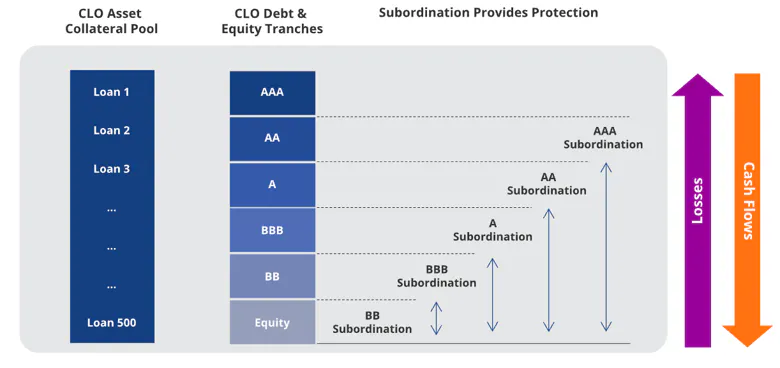
CLOs and the Floating Rate Feature
Floating-rate loans as the underlying securities held by CLOs are advantageous because they adjust at a set premium over a short-term market rate. That floating feature is key to why the loans, and the CLO securities backed by them, do not carry significant interest-rate risk. When market interest rates rise, the interest rates on these loans rise as well, keeping their market prices relatively stable. In contrast, traditional fixed-rate bonds fall in price when market interest rates rise.
Rising Interest in CLO ETFS
In both the U.S. and Canada, CLO ETFs have become more common in recent years as ETF offerings have multiplied. A recent TD Securities ETF Strategy report notes that U.S.-listed CLO ETFs attracted a record US $3.3 billion in September 2026, following noteworthy inflows of US $2.5 billion and US $2.6 billion in July and August, respectively. The increased flows are driven by the changing interest rate environment and the asset class's inherent floating-rate adjustment.
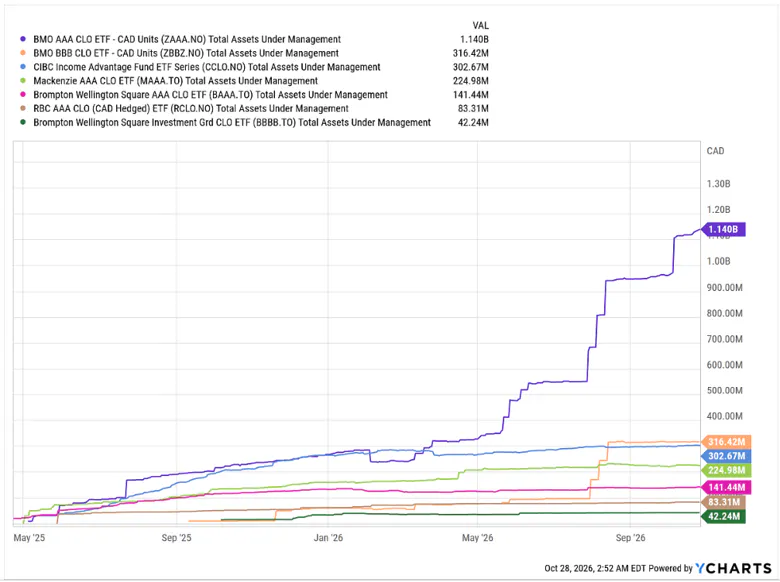
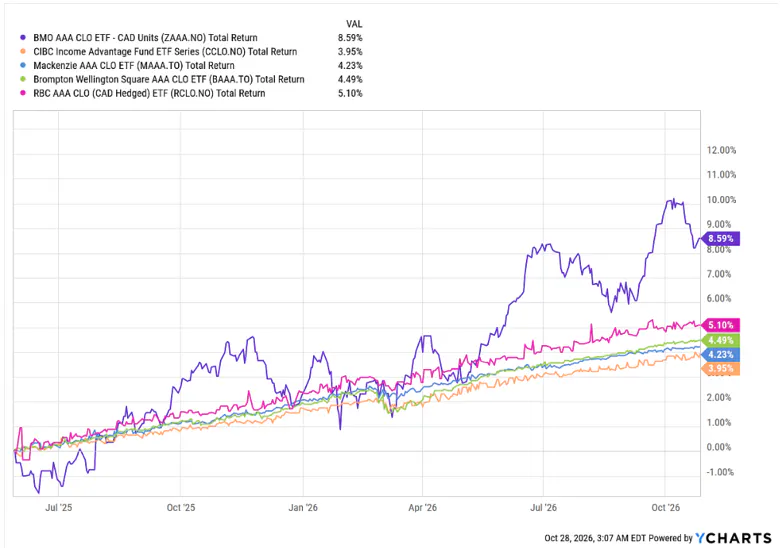
In the Canadian ETF landscape, though several ETF manufacturers have launched solutions in the category, BMO’s AAA CLO ETF (Ticker: ZAAA) has gathered significant assets and, thus far, demonstrated compelling total return performance relative to its peers. However, it is fair to note that in comparison to its category peers, ZAAA has exhibited a volatile investment experience for the period in focus.
Other ETFs in the category include the BMO BBB CLO ETF (Ticker: ZBBZ), CIBC Income Advantage ETF (Ticker: CCLO), Mackenzie AAA CLO ETF (Ticker: MAAA), Brompton Wellington Square AAA CLO ETF (Ticker: BAAA), Brompton Wellington Square Investment Grade CLO ETF (Ticker: BBBB), and RBC AAA CLO ETF (Ticker: RCLO).
The Value Proposition of CLO ETFs
For Canadian investors looking to diversify their fixed-income exposure, CLO ETFs are turnkey solutions that provide distinct exposure to an asset class often used by institutional and qualified investors. In utilizing these solutions, investors have the potential to benefit in several ways:
Potential for higher yields
CLOs have traditionally offered higher yields than other investments with the same credit rating.
Lower interest-rate sensitivity
Since the underlying loans have floating interest rates, CLO securities generally have short durations and are less likely to experience significant price changes solely because market rates move. This can help when rates rise, as conventional fixed-rate bonds often lose value, but it can be less advantageous when rates fall, when fixed-rate bonds often gain value.
Active oversight
CLOs are actively managed, allowing managers to respond to shifts in economic and market conditions. Many CLO ETFs are also actively managed, aiming to select managers, deals, and securities that balance income, liquidity, and protection against losses. Active management may help managers avoid overvalued areas of the market, anticipate potential price declines, and adjust as conditions evolve.
Built-in credit safeguards
In addition to diversification, CLOs often have structural credit protections that can help contain risk and safeguard investors if credit stress increases.
This article was written on October 28th, 2026. Please note this article is for information purposes only and does not in any way constitute investment advice. It is essential that you seek advice from a registered financial professional prior to making any investment decision.