Cracks in Growth Put Value ETFs Back in Focus
Growth has led for years, but fragility in the U.S. economy revives the case for value. Explore ETFs offering exposure to undervalued large caps.


Discussion about investment style leadership, specifically value versus growth, sometimes arises when there are signs of a shift in the investment landscape.
However, the dominance of growth investing in the U.S., especially after the Great Financial Crisis, has quelled any talk of a style leadership change in the near future.
While growth-focused strategies have often resulted in investors being heavily concentrated in mega cap stocks, which carries concentration risk, the ethos of value investing – identifying stocks with a lower price relative to their intrinsic value – is still crucial in today’s market environment.
Looking at Investment Experience
When evaluating any investment, many investors mainly focus on total return performance. However, in a market environment that is highly sensitive to interest rates and economic policy surprises, mitigating losses has also become a crucial concern for investors.
In 2022, when persistent inflation led to interest rate hikes, U.S. growth stocks declined much more than value stocks.
Additionally, the recent equity market sell-offs saw growth stocks fall significantly further than value stocks.
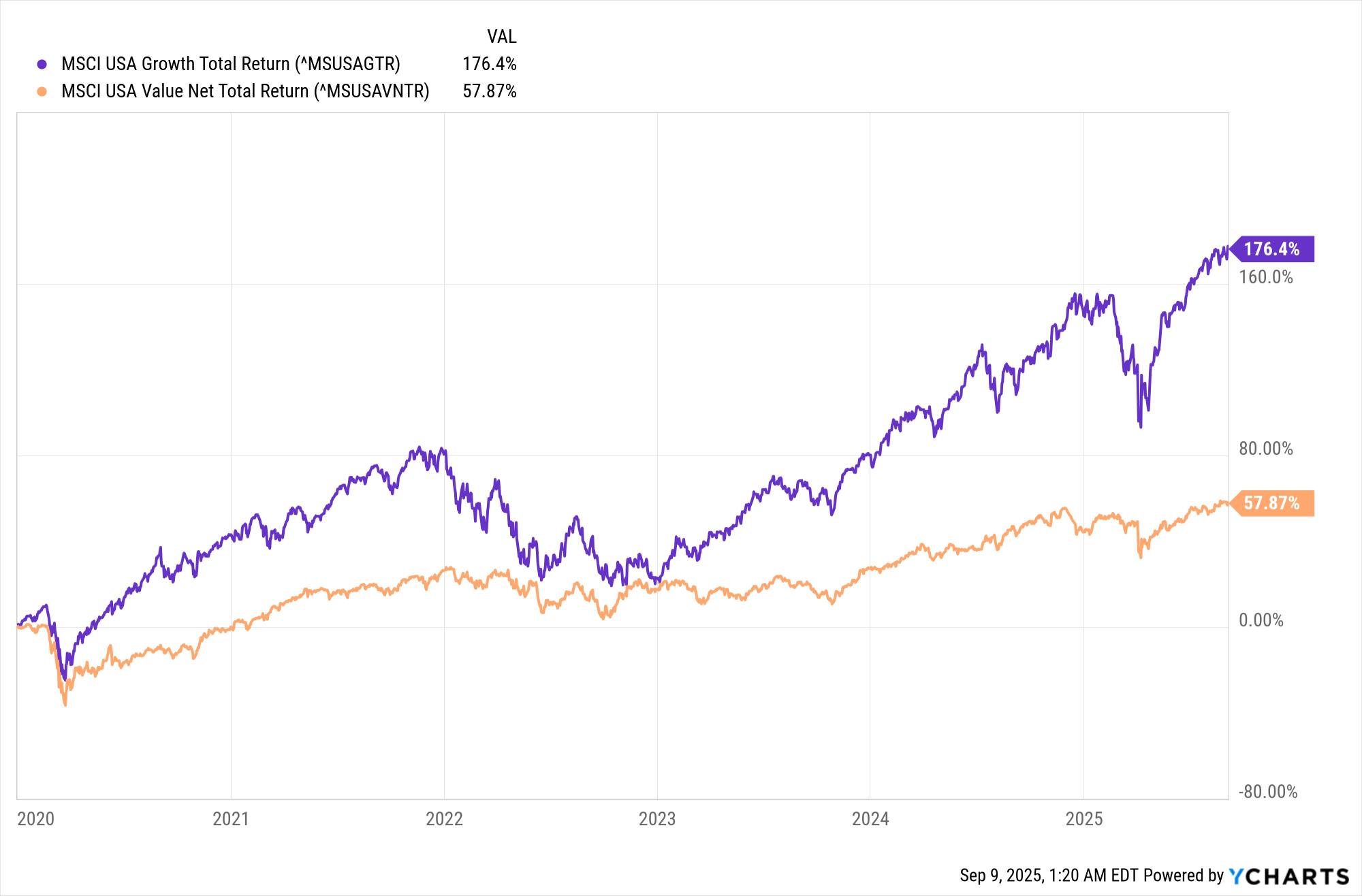
Although the current AI hype is supporting U.S. equity markets, a high degree of uncertainty and fragility remains in the U.S. economy, as evidenced by weakened job growth and a rise in unemployment to a four-year high of 4.3% as of August 2025.
Many investors expect the Federal Reserve to cut rates at the next FOMC meeting, a move that could lift equities. However, higher tariffs driving up consumer costs, tighter immigration rules straining the labor market, and rising electricity prices linked to AI adoption may all weigh on the U.S. economy if they persist.
In the current market environment, value investing can still be of benefit to investors.
In large-cap equities, value investors focus on established companies with strong market capitalizations that trade below their intrinsic value. When the market eventually recognizes their financial strength and growth potential, these firms often deliver a resurgence in returns.
Investing in Value via ETFs
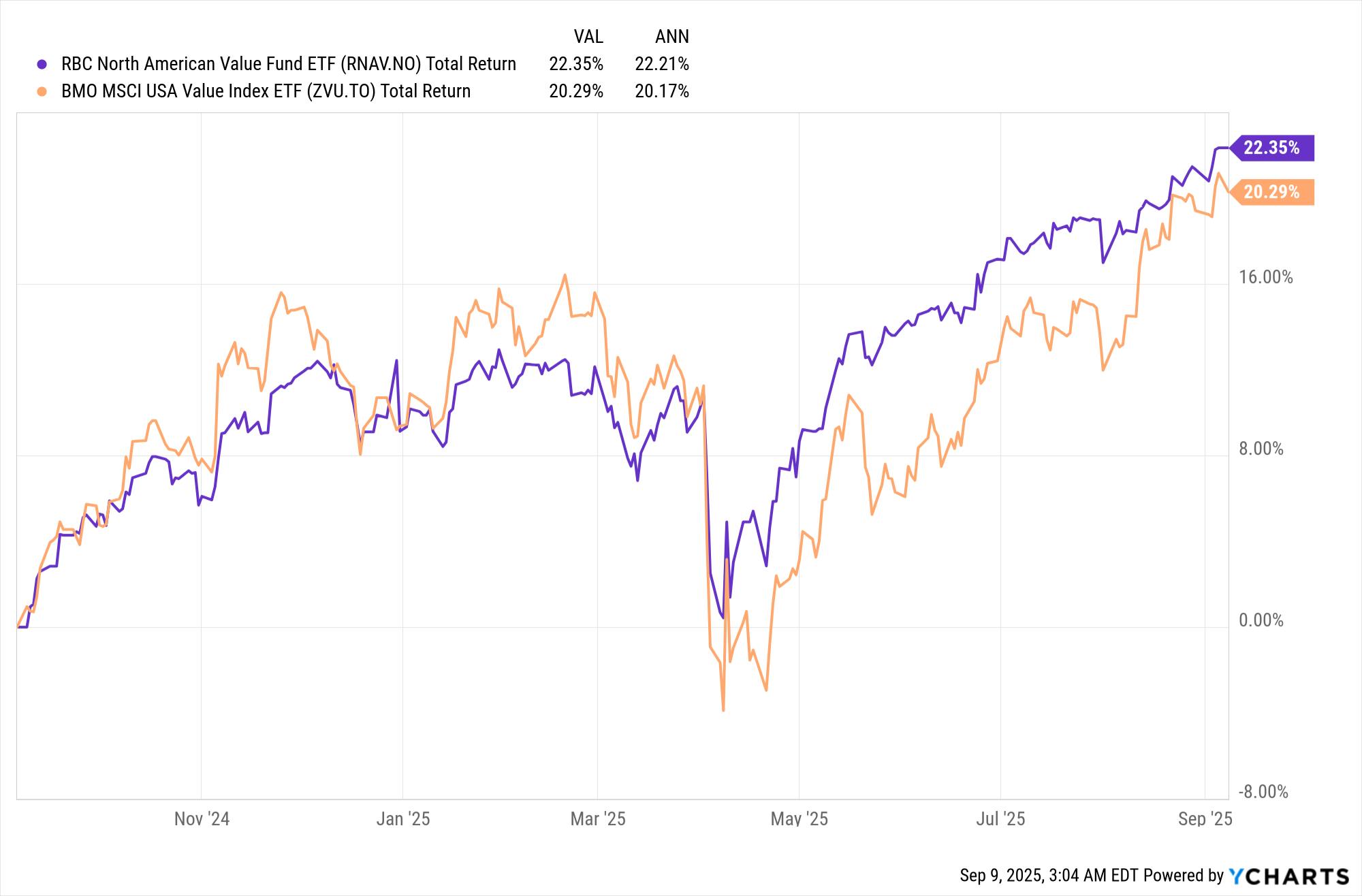
For investors seeking exposure to value-focused investment solutions, the RBC North American Value Fund (Ticker: RNAV) and the BMO MSCI USA Value Index ETF (Ticker: ZVU) offer an opportunity to benefit from an active/systematic investing approach.
RNAV invests in both Canadian and U.S. equities that are believed to be undervalued, offering long-term growth opportunities. To select securities for the fund, the managers use a bottom-up stock selection process to find quality companies that are undervalued based on criteria such as assets, earnings, and cash flow.
They also review economic, industry, and company-specific information to evaluate the company's prospects and consider global macro factors, such as the pace and quality of global economic growth.
ZVU is designed to replicate the performance of the MSCI USA Enhanced Value Capped Index, which reflects U.S. companies that have higher value characteristics based on price-to-book value, price-to-forward earnings, and enterprise value-to cash flow from operations.
MSCI USA Enhanced Value Capped Index is based on the MSCI USA Index, which includes large and mid-capitalization stocks across the U.S. The index aims to capture the performance of securities that exhibit higher value characteristics relative to their peers within the corresponding GICS sector.
The index identifies stocks with high value scores based on three fundamental variables: price-to-book value, price-to-forward earnings, and enterprise value-to-cash flow from operations. Issuer weights are capped at 10%. The Index is rebalanced semi-annually.
Please note this article is for information purposes only and does not in any way constitute investment advice. It is essential that you seek advice from a registered financial professional prior to making any investment decision.