Defense Spending and Trade Reform Could Fuel These ETFs
Canada’s Bill C-5 clears trade barriers, boosting manufacturing ETFs.


Against the backdrop of trade negotiations with the U.S., the recently elected Mark Carney government announced the passage of a bill that will strengthen the Canadian economy. On Thursday, June 26th, Bill C-5, the One Canadian Economy Act, received Royal Assent. The bill is the realization of Prime Minister Carney’s campaign promise to promote free trade in Canada by Canada Day, by introducing legislation to eliminate all federal barriers to interprovincial trade and labor mobility, and to remove all federal exceptions under the Canadian Free Trade Agreement.
As stated in the bill’s press release, the One Canadian Economy Act serves a two-fold purpose:
- Expedite nation-building projects (Building Canada Act): Streamline federal review and approval processes to increase regulatory certainty, attract capital, strengthen industries, and enhance sovereignty and resilience while protecting the environment and respecting Indigenous rights.
- Remove federal barriers to internal trade and labour mobility (the Free Trade and Labour Mobility in Canada Act): Accept comparable provincial or territorial regulations, where they exist, as meeting federal requirements for the movement of goods, services, and labour within Canada. This will enable more goods, services, workers, and businesses to move freely across provinces and territories.
In summary, the bill aims to promote economic development and growth within Canada. As noted by Statistics Canada, approximately $532 billion worth of goods and services were traded across provincial and territorial borders in 2023, accounting for 18.1% of Canada's gross domestic product (GDP).
Revitalizing Canadian Manufacturing
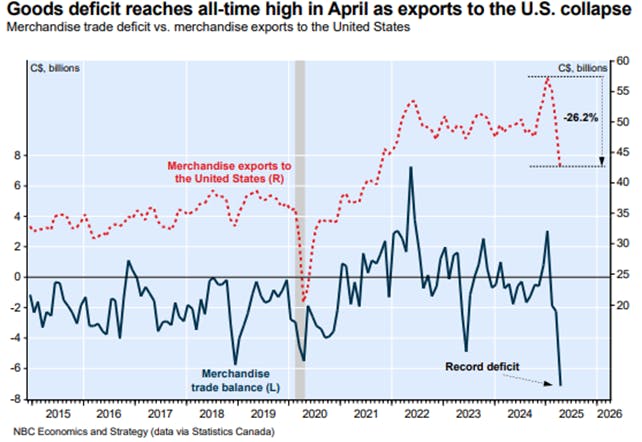
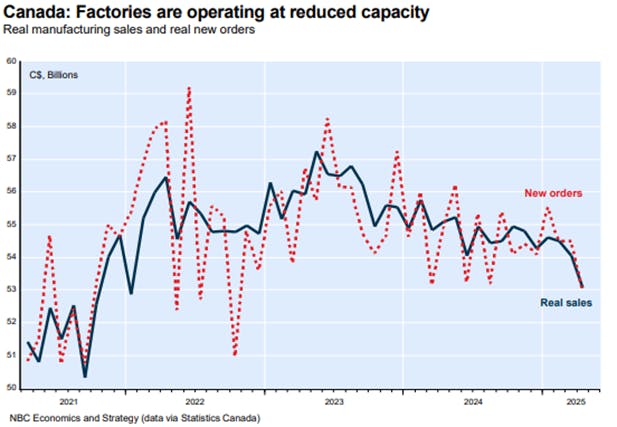
The manufacturing industry is a vital part of Canada’s internal trade, accounting for one-third (33.3%) of the total trade between provinces and territories in 2021, according to Statistics Canada. However, less than one-fifth (18.6%) of the industry’s output was used domestically, highlighting the significance of U.S. trade to the sector. The importance of the U.S. economy to Canadian manufacturing was emphasized in a recent National Bank of Canada Financial Markets memo, which noted that merchandise exports to the U.S. have declined by approximately 26% over the past three months. Due to this weakness, the manufacturing sector experienced a third consecutive decline in real sales in April, and new orders, following the same trend, show no signs of short-term recovery. Both indicators were at their lowest levels since 2022 in April.
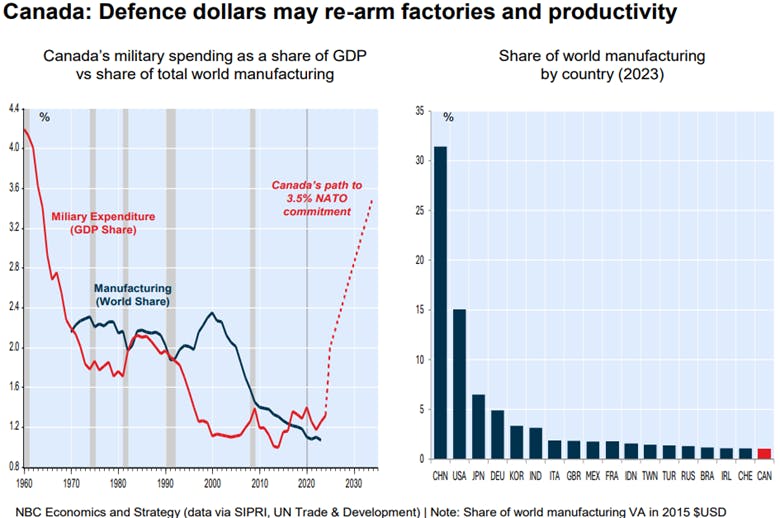
Recently, Prime Minister Carney has committed Canada to a substantial increase in military spending, as North Atlantic Treaty Organisation (NATO) members have agreed to invest 5% of Gross Domestic Product (GDP) annually on core defence requirements and defence- and security-related expenditure by 2035. For Canada, this amount would be approximately $150 billion annually on defence-related priorities.
The rise in defense spending, along with efforts to reduce the country’s internal trade barriers, could bolster the manufacturing sector. As noted in a recent National Bank of Canada Financial Markets memo, Canada’s global manufacturing presence has been steadily declining since military spending last reached the 2.0% level. The new NATO requirements will necessitate a major shift for Canada to reindustrialize, leveraging an underused energy advantage to revive manufacturing. A recent example where the prospect of increased defense spending boosted a nation’s economic outlook is Germany, where a newly elected government enacted a fiscal plan allowing defense spending in excess of 1% of GDP to become exempt from the debt brake, Germany’s constitutional limit on structural deficits.
Investing in Manufacturing
For Canadian investors seeking exposure to the Canadian manufacturing sector, both the iShares S&P/TSX Capped Materials Index ETF (Ticker: XMA), and BMO Equal Weight Industrials Index ETF (Ticker: ZIN) are options that offer such exposure.
As a baseline, understanding the sector exposures that these solutions offer is important. The Materials Sector includes companies that manufacture chemicals, construction materials, forest products, glass, paper, and related packaging products, as well as metals, minerals, and mining companies, including steel producers. The Industrials Sector comprises manufacturers and distributors of capital goods such as aerospace & defense, building products, electrical equipment, machinery, and companies that offer construction & engineering services. It also includes providers of commercial & professional services, including printing, environmental and facilities services, office services & supplies, security & alarm services, human resource & employment services, research & consulting services. Additionally, it covers companies that provide transportation services.
Given the above, XMA aims to replicate the performance of the S&P/TSX Capped Materials Index. Conversely, ZIN aims to replicate the performance of the Solactive Equal Weight Canada Industrials Index.
Please note this article is for information purposes only and does not in any way constitute investment advice. It is essential that you seek advice from a registered financial professional prior to making any investment decision.