Diverging Policies and Declining Rates
The global policy rate environment is poised to change, as the US may cut rates in the near future.


Diverging policy rate actions are beginning to occur across developed economies, in the US the Federal Reserve has signalled its intention to cut rates in 2024, while in Canada and Europe, the stated plan by the respective Central Banks is to keep rates unchanged. So, what implications will this have on the bond market and how can investors navigate this new paradigm?
Overview
Over the past three years, central banks globally have hiked interest rates to curb the debilitating effects of inflation on their respective economies. While the actions taken by central banks are not coordinated, their synchronicity has created a unified, global policy rate environment of higher for longer interest rates. But things are seemingly about to change, as indications suggest that the US interest rate environment might start to decline in 2024, potentially ending the previously observed alignment in interest rate policies among developed economies, especially as the European Central Bank commits to keeping rates high despite reduced inflation while the Bank of Canada has indicated their willingness to raise the policy rate further if needed.
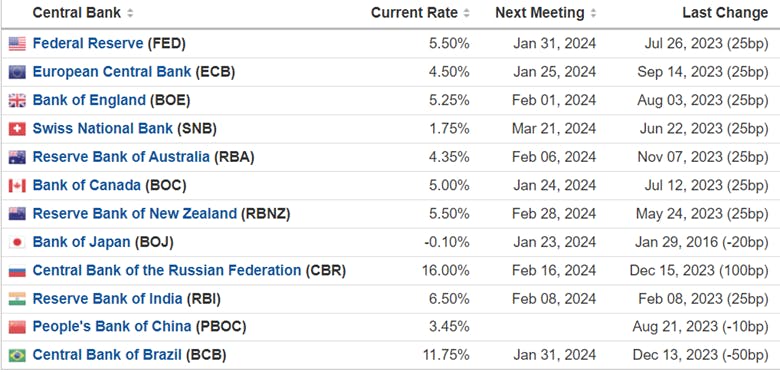
Source: Investing.com
The case for buying bonds
The precipitous climb in interest rates over the past three years, approximately, has set the stage for the environment we are currently in. Though bond markets ended 2023 in positive territory, in taking a wider view, there is currently a drawdown among the major bond indices.
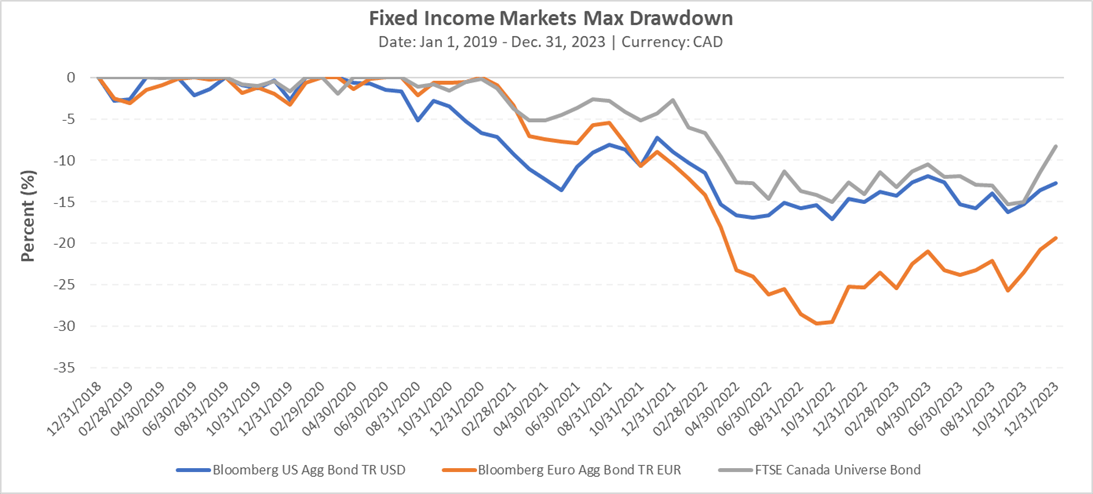
In the current elevated interest rate environment, many investors and savers have become enamored with the yields being quoted on cash-like instruments, in truth, there is no certainty they will remain at this or a similar level for the next 5 to 10 years. Conversely, if investors were to buy bonds now – they would be able to lock in this level of yield generation for a much longer period. While locking in a high yield is one rationale, the other consideration is capital appreciation. Given the inverse relationship between bond yields and price, buying bonds now could be highly profitable, particularly when interest rates are being cut. Specifically, in the case of US fixed income, the projection is that US interest rates will be on a downward trajectory going forward.
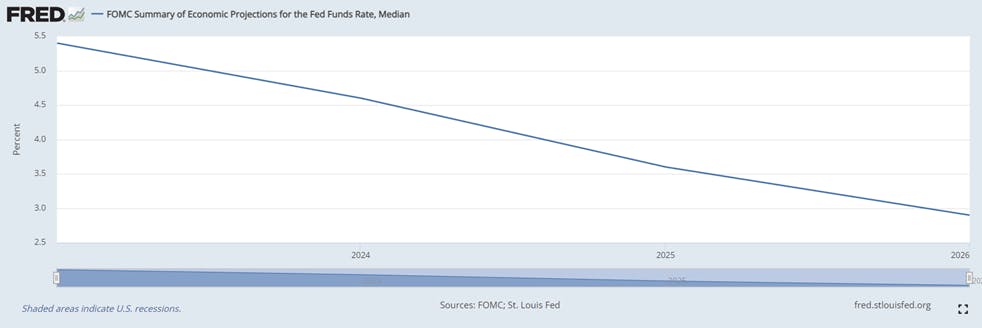
If the policy actions of central banks globally begin to diverge, with the US Federal Reserve being among the first to cut interest rates, now may be an opportune time to look at having exposure to US fixed income and beneficially participate from the price appreciation that is expected to occur. For investors interested in gaining exposure to US fixed income, the following ETF solutions are worth consideration.
Mackenzie U.S. Aggregate Bond ETF (Ticker: QUB) is a low-cost solution that provides exposure to U.S. investment grade bonds. The fund seeks to replicate the performance of the Solactive US Aggregate Bond Hedged to CAD Index and foreign currency exposure is hedged back to the Canadian dollar.
BMO Mid-Term US IG Corp Bond ETF (Ticker: ZIC) is tailored to replicate the performance of the Bloomberg U.S. Investment Grade 5-10-Year Corporate Bond Index and is intended for investors seeking regular income.
Dynamic Active U.S. Investment Grade Bond ETF (Ticker: DXBU) is an actively managed solution that provides broad exposure to the US investment grade bond market. The manager utilizes active management security section, credit risk, and interest rate positioning.
Please note this article is for information purposes only and does not in any way constitute investment advice. It is essential that you seek advice from a registered financial professional prior to making any investment decision.