Diversification Wins: Global ETFs Shine in First Half of 2025
Despite a volatile start, U.S. equities posted gains in H1 2025, but international markets and sector diversification proved even more rewarding.


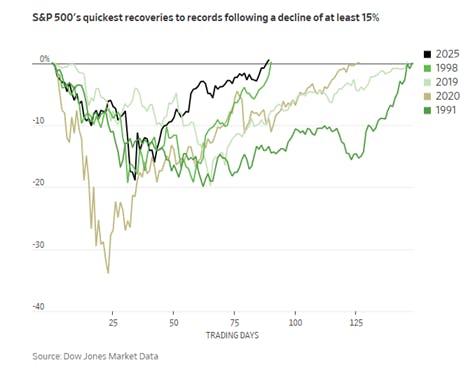
In describing U.S. equities' investment experience during the first half of the year, words like uncertain, tumultuous, and volatile come to mind; however, the asset class finished the period with a positive return (i.e., 6.20%), a result many might have considered unlikely months earlier. While the uncertainty in U.S. equities originated from the Trump Administration’s change in trade policy, as shown in the chart that follows, the impact was relatively short-lived, and the subsequent recovery was comparatively swift.
Looking Below The Surface
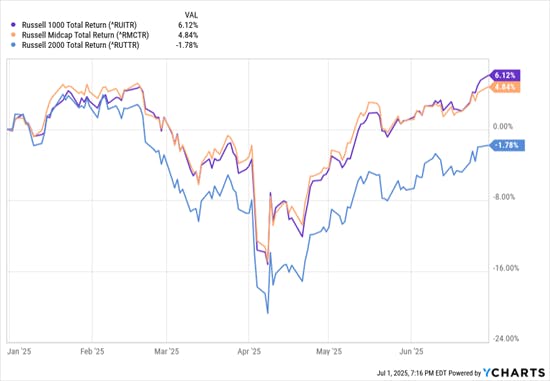
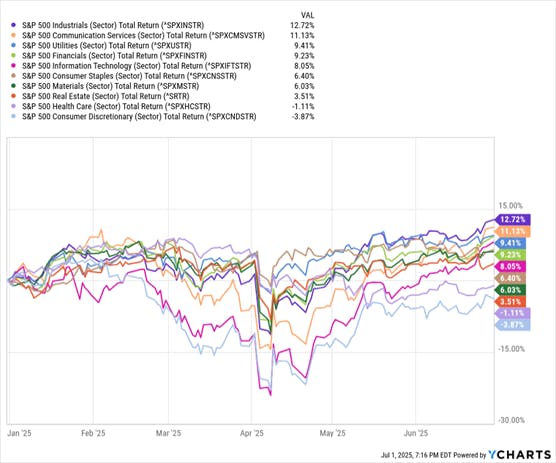
Looking at the U.S. equity landscape for the first half of the year, the performance of large-cap Industrials and Communication Services was the main driver of top-line growth. As shown in the following charts, the performance of U.S. large-cap companies (i.e., Russell 1000) surpassed that of mid-cap (i.e., Russell Midcap) and small-cap (i.e., Russell 200) equities. From a sector perspective, as mentioned above, industrials and communications led, while the remaining sectors, excluding Health Care and Consumer Discretionary, delivered strong returns.
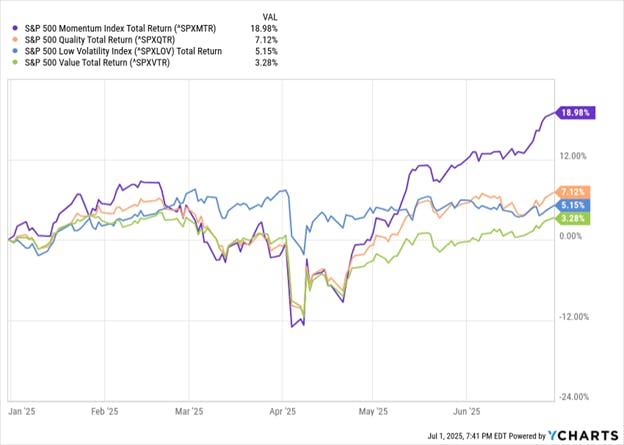
When analyzing investment factors, momentum remains the top performer, surpassing all others, especially low volatility. As a reminder, momentum factor investing aims to identify stocks with strong recent performance by focusing on companies that have experienced significant price gains over the past 6-12 months. This strategy bets on the continuation of returns, based on the pattern that high returns are often followed by even higher returns, and low returns tend to be followed by even lower returns.
Looking Across the Asset Class Landscape
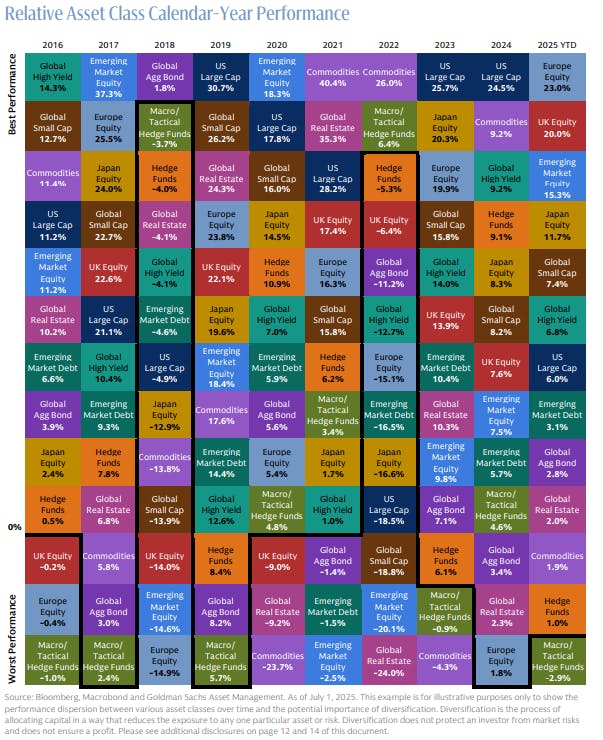
A theme that was evident during the first half of the year was the pivot towards non-U.S. equities, which benefited the European and international equities asset class immensely. As observed from the chart below, U.S. equity returns for the first half of the year pale in comparison to those of European, U.K., Emerging Markets, and Japanese equities.
Considerations For the Second Half of 2025
As we move into the second half of 2025, uncertainty continues to weigh on investors' minds, as the current U.S. administration’s trade policy agenda remains largely unclear. Tariffs remain a central part of U.S. policy, and their inflationary impact, as reflected in higher consumer prices, will be felt in the near term, posing ongoing downside risks to consumer spending and U.S. economic growth.
On the fiscal front, the passage of President Trump’s ‘Big, Beautiful Bill’ raises concerns about fiscal sustainability, as it includes extensions of expiring tax cuts, enacts new tax cuts, and reduces spending. Overall, the bill is expected to increase the fiscal deficit and keep federal debt as a share of GDP on an upward trajectory.
Taking Action
As shown during the first half of the year, adopting a diversified approach to equity investing proved successful; investors who broadened their equity market exposure beyond the U.S. benefited greatly. Given the ongoing uncertainty, such an approach can still be beneficial in the second half of 2025, especially considering tariffs, U.S. debt dynamics, and the high concentration of the U.S. equity market.
For investors looking to take a European or international investing approach, the following ETFs are worth considering:
The CI Europe-Hedged Equity Index ETF (Tickers: EHE/EHE.B) tracks the price and yield performance of the WisdomTree Europe CAD-Hedged Equity Index, which reflects European dividend-paying companies in the WisdomTree International Equity Index that are domiciled in Europe and are traded in Euros, have at least $1 billion market capitalization, and derive at least 50% of their revenue in the latest fiscal year from countries outside of Europe. The fund's top holdings include LVMH Moet Hennessy Louis Vuitton SE, Siemens AG, and ASML Holding.
The RBC Quant European Dividend Leaders ETF (Tickers: RPD/RPDH/RPD.U) provides investors with exposure to high-quality European firms that are consistent and growing dividend payers. The fund's managers utilize a quantitative multi-factor approach to gauge a company's financial strength, with the aim of creating a diversified portfolio capable of providing regular income from dividends and that has the potential for long-term capital growth. The fund's top holdings include Roche Holding, Novartis AG, and ASML Holding.
The iShares International Fundamental Index ETF (Ticker: CIE) seeks to replicate the performance of the FTSE RAFI Developed ex US 1000 Index, which reflects companies based on fundamental factors, including dividends, free cash flow, sales, and book value. The index’s methodology seeks to avoid overweighting overvalued stocks and underweighting undervalued stocks. Notable companies held within the fund include Shell, Toyota, and Nestle.
The Dynamic Active International ETF (Ticker: DXIF) is an actively managed solution providing access to companies outside North America (i.e., U.S. and Canada). The fund has a high active share; as such, it has a low correlation with any benchmark index. Notable holdings within the fund include the London Stock Exchange Group PLC, Airbus SE, and Adidas AG.
Please note this article is for information purposes only and does not in any way constitute investment advice. It is essential that you seek advice from a registered financial professional prior to making any investment decision.