Dividend Investing in Canada: Trends, Leaders, and ETF Picks
Canadian dividend growth remains strong, with ETFs like CDZ, RCD, and TBNK offering exposure to top-paying firms and stable income.


The importance and impact of dividends when investing over a long-time horizon has been well-established, so much so that some investors take a ‘dividend-focused’ approach to their equity investing. Companies that have issued and raised their dividend payouts have historically provided greater total returns with less volatility, making this approach to dividend investing the most common. Late last year, S&P Global Market Intelligence issued its annual dividend forecast overview for the S&P/TSX 60 Index, providing insight into the Canadian dividend landscape heading into the new year.
Canadian Dividend Overview
As stated in the report, S&P/TSX 60 dividends were forecasted to reach US$65.6 billion in 2024, resulting in 4.9% annual growth and adding up to 90% of all dividends from public operating companies in Canada. Notably, the index constituents’ dividends account for almost 90% of all Canadian dividends, with the 10 largest dividend-paying companies generating 57% of S&P/TSX 60 dividends. For 2025, nine of them are expected to grow their distributions.
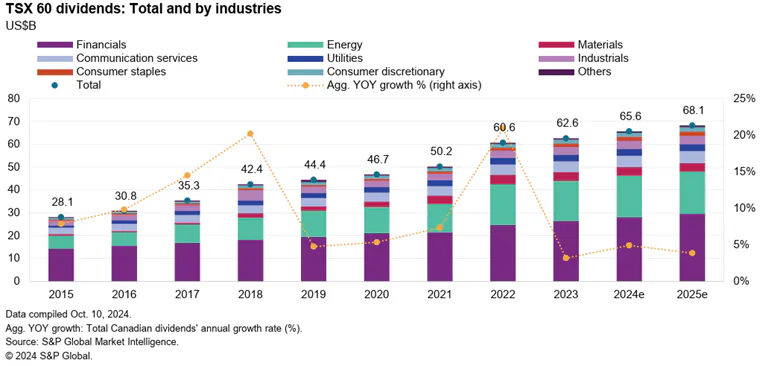
As gleaned from the chart, the financial and energy sectors are the two most significant contributors to Canada’s dividend landscape. Also observable from the chart is the material growth (i.e., 20.9%) that occurred from 2021 to 2022 due to large special dividend distributions from Canadian Natural Resources Ltd. and Tourmaline Oil Corp. as a result of increased commodity prices and oil production-derived revenue. In subsequent years, the annual aggregated dividend growth has trended around 4.0%.
A Look At Dividend Leaders
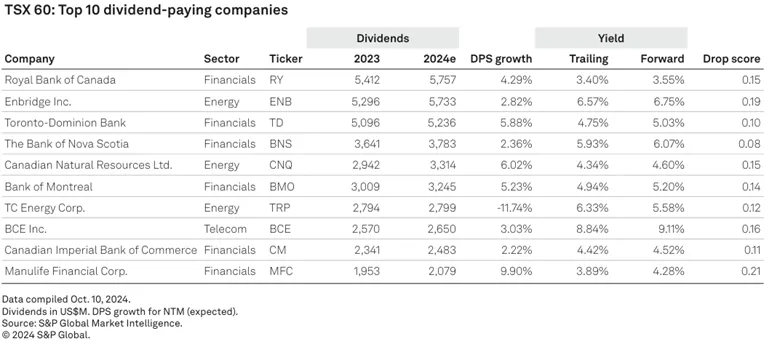
As mentioned earlier, the 10 largest dividend-paying companies generate 57% of S&P/TSX 60 dividends. In 2024, these firms were estimated to have paid approximately US$37.07 billion in dividends. Many of these firms are familiar names to Canadian investors, reflecting their seminal role within the broader economy.
According to S&P Global Market Intelligence, Canadian dividends are expected to return a median forward yield of 3%. However, the following table shows that the largest dividend-paying companies offer an above-average yield.
Investing in Dividend Growth Focused Firms
For Canadian investors focused on Canadian dividend growth-focused firms, there are several ETF solutions that they can utilize to meet this investment criteria, namely:
The iShares S&P/TSX Canadian Dividend Aristocrats Index ETF (Ticker: CDZ), which replicates the S&P/TSX Canadian Dividend Aristocrats Index. The index is designed to measure the performance of companies included in the S&P Canada BMI that have followed a policy of stable or increased dividends every year for at least five years.
Through this solution, investors are exposed to a portfolio of high-quality Canadian dividend-paying companies while earning regular dividend income.
The RBC Quant Canadian Dividend Leaders ETF (Ticker: RCD) employs a rules-based, multi-factor investment approach to create a diversified portfolio of high-quality Canadian equity securities that are expected to provide regular income from dividends and have the potential for long-term capital growth.
Given that Canadian banks are among the largest dividend payers, the TD Canadian Bank Dividend Index ETF (Ticker: TBNK) reflects the performance of the Solactive Canadian Bank Dividend Index. This index uses a rules-based weighting methodology that ranks its holdings based on dividend growth and gives more weight to issuers with higher dividend growth.
The BMO Canadian Dividend ETF (Ticker: ZDV) provides exposure to a yield-weighted portfolio of Canadian dividend-paying stocks. The fund utilizes a rules-based methodology that considers the three-year dividend growth rate, yield, and payout ratio to invest in Canadian equities.
Please note this article is for information purposes only and does not in any way constitute investment advice. It is essential that you seek advice from a registered financial professional prior to making any investment decision.