ETF Comparison: VDY vs XEI
Sector exposure, diversification, and tracking efficiency separate these two dividend ETF heavyweights.

It is often said, ‘comparison is the thief of joy’, but in the realm of investing, comparison is fundamental to understanding, insight, and action. In the ever-expanding ETF landscape, comparing ETFs is not done solely to assess performance, but to understand differences in composition, exposures, and the efficacy of the underlying investment strategy. Recently, the ETF Market Canada platform, powered by Cboe Canada, launched an ETF Comparison tool that enables investors to compare different ETF offerings. The result? A more comprehensive understanding of the solutions in focus.
ETF Comparison: VDY vs. XEI
For income investors, dividends are a proven way to generate wealth over time, which explains the popularity of turnkey dividend ETFs such as the Vanguard FTSE Canadian High Dividend Yield Index ETF (Ticker: VDY) and the iShares Core S&P/TSX Composite High Dividend Index ETF (Ticker: XEI) for their high-dividend focus. However, although both solutions share a similar focus, there are seminal differences between the ETFs. Using the ETF Market comparison tool, investors can gain both qualitative and quantitative insights into how the funds differ.
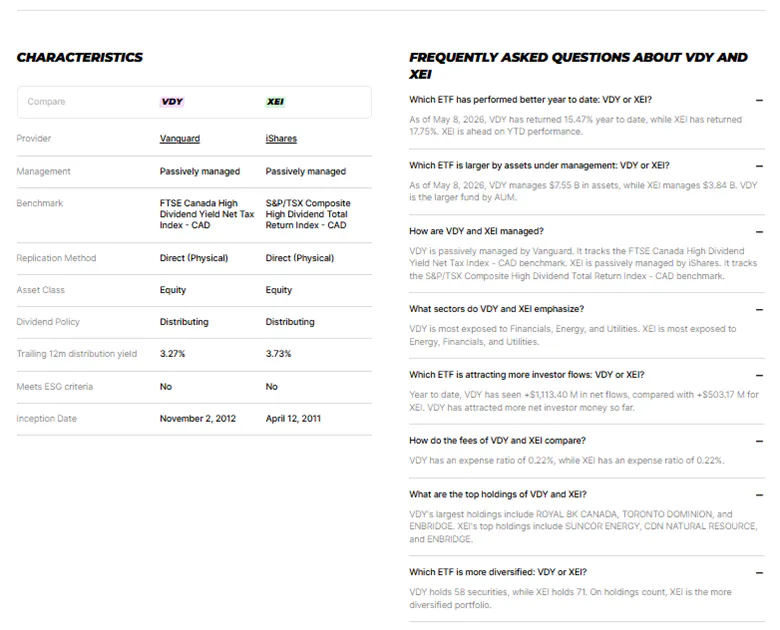
The ETF Market comparison tool provides baseline information, including fund characteristics and a daily-updated Frequently Asked Questions section, allowing users to access foundational information for the funds in question. As shown in the following image, both solutions are passively managed; however, XEI has a slightly higher trailing 12-month distribution yield.
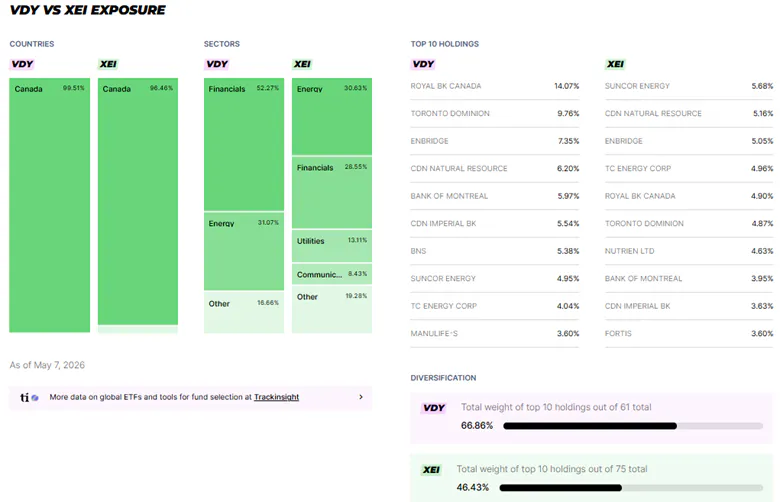
The difference between the two funds becomes more evident when looking below the surface: their respective exposures are similar, albeit with different allocations. The ETF Market comparison tool illustrates the sector exposure for each fund, with VDY having a predominant tilt (i.e., greater than 50%) towards Financials and approximately one-third (i.e., 31.07%) towards Energy. Conversely, XEI provides a slightly more balanced profile, with Energy (30.63%) and Financials (28.55%) sharing the fund’s primary exposure, with Utilities (13.11%) and Communication Services (8.43%) also being material exposures.
The difference in allocation is reflected in the diversification rating of each fund, with XEI being less concentrated than VDY.
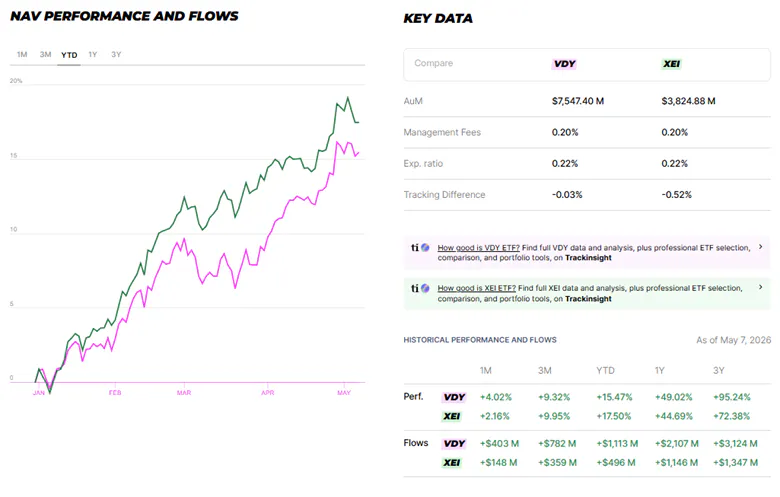
Year-to-date, XEI's performance has outpaced VDY's, as the former’s slightly more balanced sector approach has allowed the solution to benefit from both the Energy and Utility sectors' strong performance in March 2026, when all other sectors were negative, and from the reversal in April 2026. However, beyond the year-to-date performance, VDY has delivered stronger returns over both 1-year and 3-year time frames and has consistently attracted strong fund flows.
As noted in the key data section, both funds have similar expense ratios. Regarding tracking difference, which is simply the annualized difference in returns between the ETF and its benchmark - a positive tracking difference means the ETF outperformed its index, while a negative value indicates underperformance – VDY’s is materially lower than XEI’s.
Takeaway
While both funds share the same objective, VDY has delivered better long-term performance. Although the mandate is tilted towards Financials and Energy, these sectors are composed of firms known for their consistent dividend payments, enabling the mandate to fulfil its income focus cost-effectively.
This article was written on May 20th, 2026. Please note this article is for information purposes only and does not in any way constitute investment advice. It is essential that you seek advice from a registered financial professional prior to making any investment decision.