ETF Comparison: XEQT vs. VEQT
A side-by-side comparison of XEQT and VEQT, Canada's two leading all-equity portfolio ETFs.

Asset allocation ETFs have grown in popularity in recent years due to their ease of use and inherent value proposition, namely a diversified solution with low fees. However, in recent years, the all-equity portfolio ETF has risen in popularity among Canadian investors as a pathway of least resistance to broadly participate in equity markets and benefit from their growth.
ETF Comparison: XEQT vs. VEQT
In the Canadian equity ETF landscape, the iShares Core Equity ETF (Ticker: XEQT) and the Vanguard All-Equity ETF Portfolio (Ticker: VEQT) are prominent all-equity portfolio ETF solutions that provide global exposure. While both ETFs share a similar objective, there are nuanced differences between them. Using Cboe Canada’s ETF Market comparison tool, investors can gain both qualitative and quantitative insights into how the funds differ.
Both XEQT and VEQT follow a strategic allocation, ensuring each portfolio maintains a predefined level of equity market exposure. For XEQT, the allocation is 25% Canadian Equities, 45% U.S. Equities, 25% International Equities, and 5% Emerging Market Equities. Conversely, VEQT’s allocation is 45.3% U.S. Equities, 29.6% Canadian Equities, 17.9% International Equities, and 7.1% Emerging Market Equities. Both funds utilize their own product offerings as building blocks for their respective portfolios.
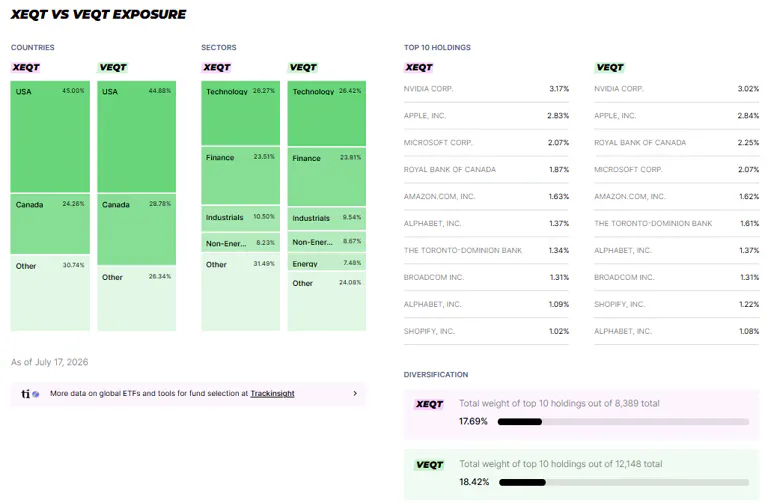
In looking at the composition of both ETFs, they are very similar, as evidenced by their holding exposure.
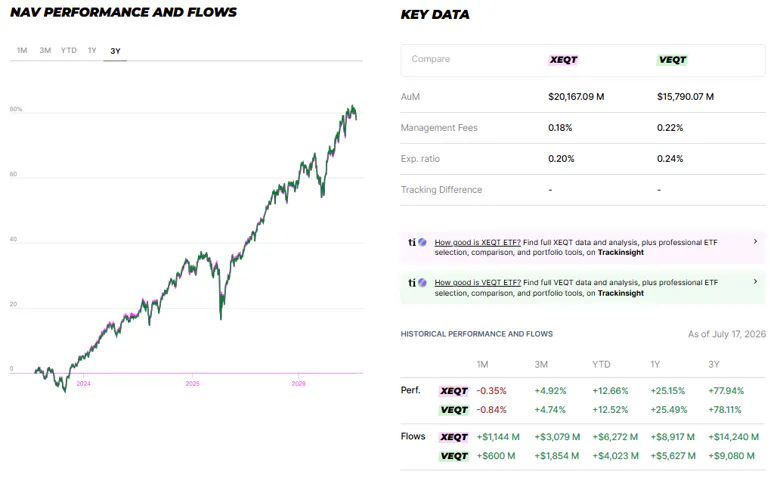
Maintaining a competitive and compelling fee has been paramount for ETF manufacturers offering all-equity portfolio ETFs; as such, the fees for both solutions are the same. On November 18, 2025, Vanguard reduced the management fee for VEQT from 0.22% to 0.17%. In turn, on December 18, 2025, the management fee for XEQT was reduced from 0.18% to 0.17%. A material difference between the ETFs is their distribution frequency, with XEQT providing a quarterly distribution, whereas VEQT provides an annual distribution.
The long-term performance (i.e., 1 year and above) of both portfolios has been similar, with VEQT edging out XEQT. However, for shorter time periods (i.e., Year-to-date and lower), XEQT has fared better. Regarding fund flows, XEQT has garnered more over the stated time frames and has the bigger AUM.
Takeaway
Given the similarities in holdings and performance, along with the fee-consciousness and competitiveness of the fund manufacturers, choosing between the two funds is largely a matter of preference. As mentioned earlier, XEQT has a quarterly distribution, which may be a determining factor for some ETF investors. Alternatively, some investors may lean toward one fund manager (i.e., Vanguard vs. BlackRock), which may tip the scales. But based on the observable facts, both funds have rewarded investors over time.
This article was written on July 21st, 2026. Please note this article is for information purposes only and does not in any way constitute investment advice. It is essential that you seek advice from a registered financial professional prior to making any investment decision.