ETFs in 2025: Year In Review
In a year shaped by macro uncertainty, diversified exposure across global equities, precious metals, and small caps delivered compelling results for ETF investors.


Two words arguably defined the investment landscape of 2025: ‘uncertainty’ and ‘diversification’. Amid global trade upheaval triggered by the Trump Administration’s tariff policy, macroeconomic uncertainty was a persistent concern throughout the first half of the year, prompting many investors to seek safety in non-U.S. equities and other asset classes. Across the equity landscape for the year, both non-U.S. developed markets and emerging markets performed exceptionally well, with Canadian equities among the top-performing equity-market asset classes.
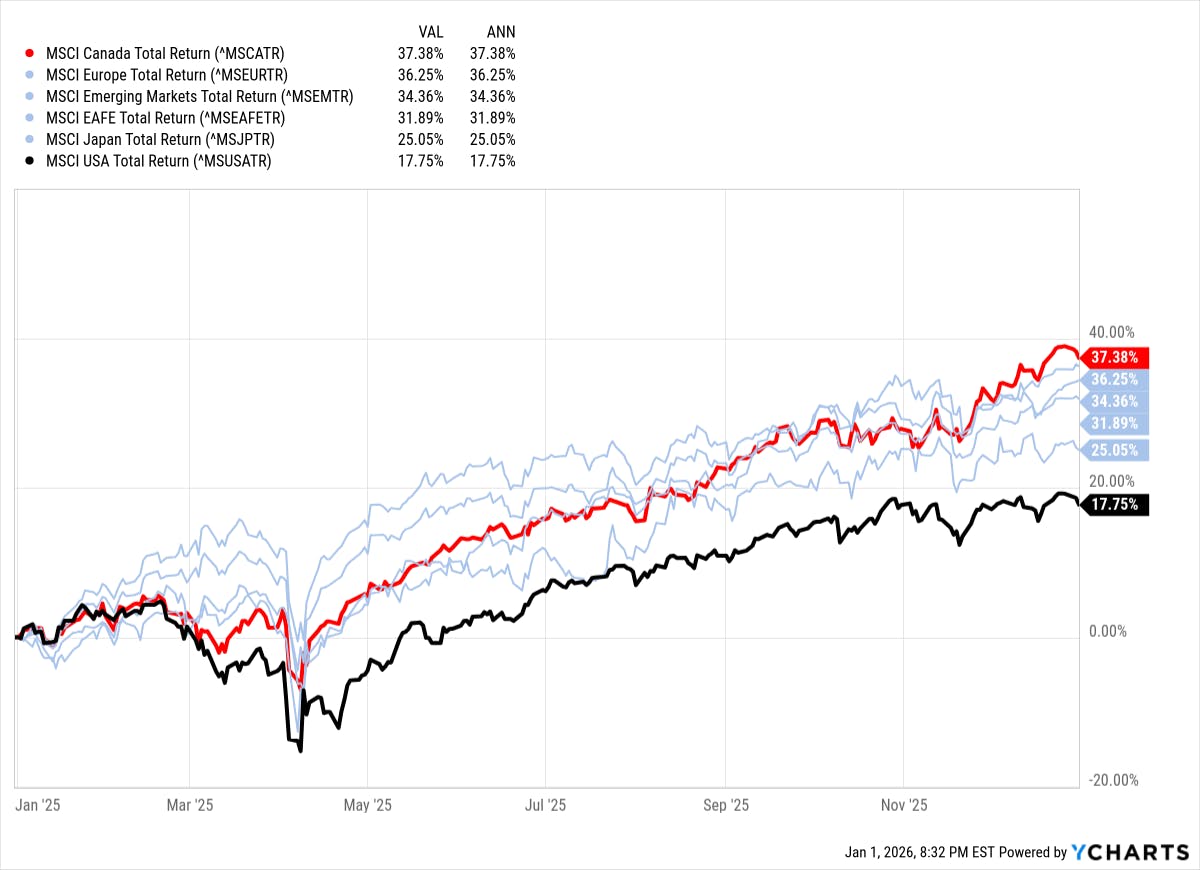
For Canadian investors interested in ETFs that provide exposure to specific equity markets, solutions such as the Fidelity All-Canadian Equity ETF (Ticker: FCCA), the CI Canadian Equity Index ETF (Ticker: CCDN), and the iShares Canadian Fundamental Index ETF (Ticker: CRQ) offer comprehensive exposure to Canadian equities.
For those seeking European exposure, the Invesco S&P European 350 Equal Weight Index ETF (Ticker: EQE/EQE.F), RBC Quant European Dividend Leaders ETF (Tickers: RPD/RPD.U/RPDH), and CI Europe Hedged Equity Index ETF (Tickers: EHE/EHE.B) are worth consideration.
Finally, for those interested in Emerging Market equities, the RBC Emerging Markets Dividend Fund ETF (Ticker: REMD), the BMO MSCI Emerging Markets Index ETF (Ticker: ZEM), and the iShares Emerging Markets Fundamental Index ETF (Ticker: CWO) provide this exposure.
A Strong Year for Metals
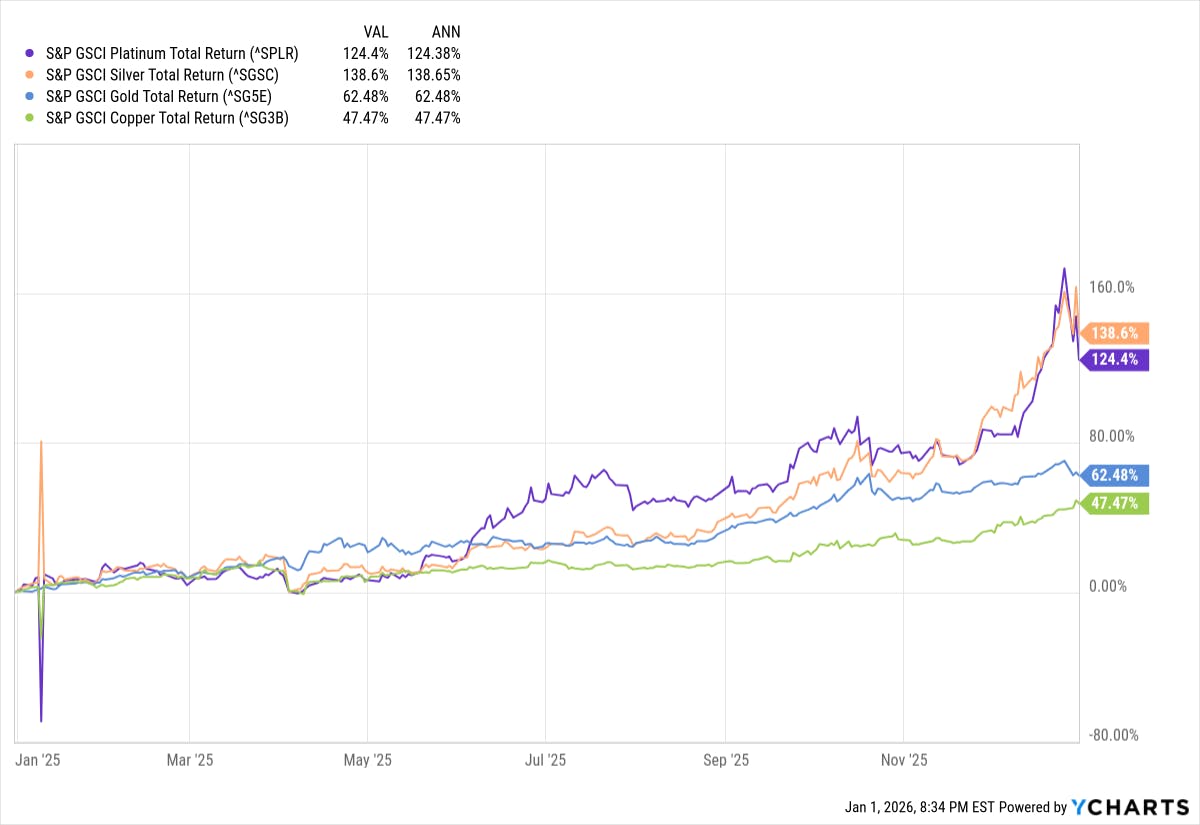
Amid uncertainty in the broader economic environment, investors sought safety in hard assets, driving the remarkable performance of precious metals this year. Gold is up over 70% for the year, and both silver and platinum have provided triple-digit returns. The investment attributes of previous metals, namely, inflation-hedging and purchasing power preservation, were top-of-mind for investors who sought a defensive positioning within their portfolio. Amid growing demand for critical minerals, copper's significance has risen due to its strategic importance for energy security and technological advancement.
For investors interested in ETFs that facilitate gold exposure, the Global X Gold Producers Index ETF (Ticker: GLDX), BMO Equal Weight Global Gold Index ETF (Ticker: ZGD), Harvest Global Gold Giants Index ETF (Ticker: HGGG), and iShares S&P/TSX Global Gold Index (Ticker: XGD) can provide this exposure.
For those seeking silver exposure, the Purpose Silver Bullion ETF (Tickers: SBT/SBT.U/SBT.B) and the iShares Silver Bullion ETF (Tickers: SVR/SVR.C) offer it. For investors seeking copper exposure, the Global X Copper Producers Index ETF (Ticker: COPP) and the Global X Copper Producers Equity Covered Call ETF (Ticker: CPCC) offer this. Finally, for broad exposure to precious metals, the RBC Global Precious Metal Fund ETF (Ticker: RGPM) is worth considering.
Small, but Strong
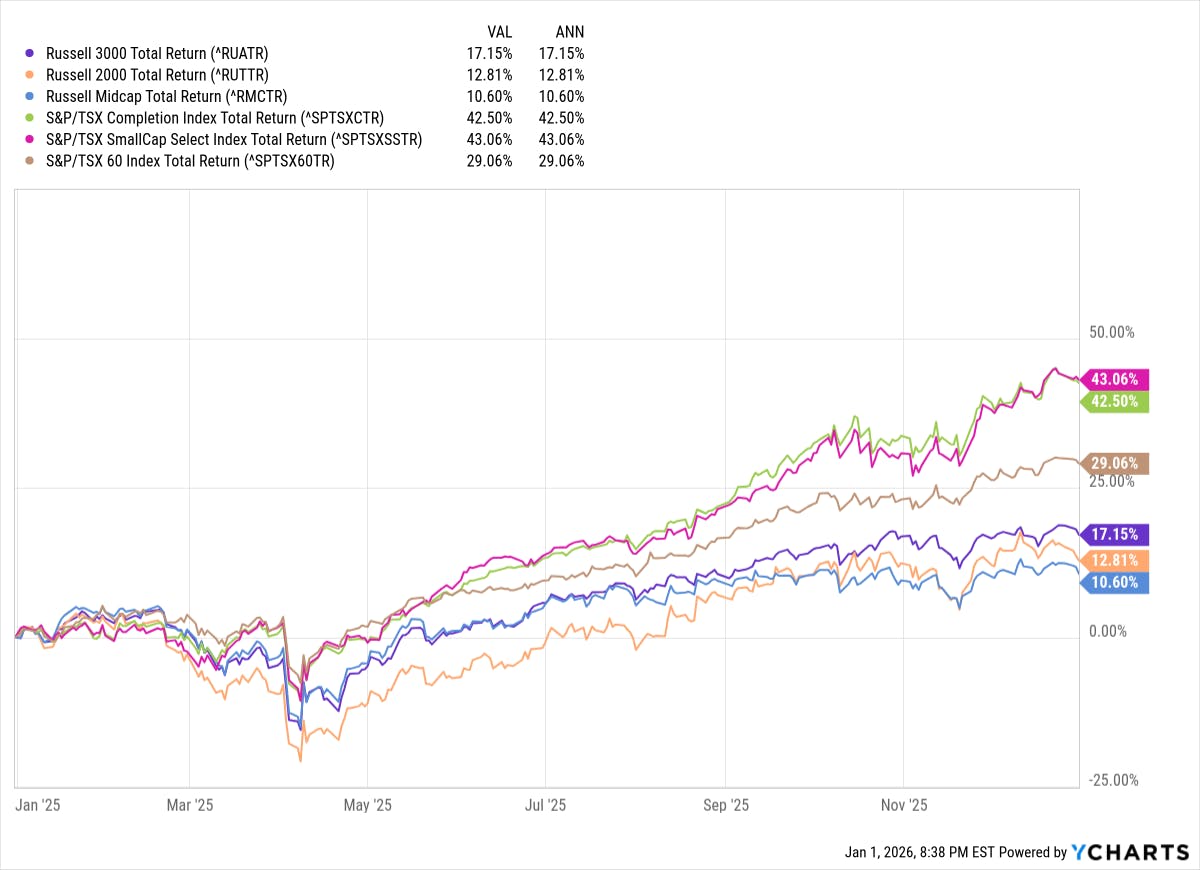
The performance of small-cap equities was compelling this year, within both the U.S. and Canadian equity markets. Against a backdrop of lower interest rates, small-cap firms have benefited significantly, as they tend to rely on external financing to grow. Another consideration regarding the strong performance of small-cap equities is the market they serve; that is, small-cap firms may have a strong local/domestic customer base, which helps minimize the adverse effects of the current tariff environment.
For investors seeking exposure to Canadian small-cap equities, the iShares S&P/TSX Small Cap Index ETF (Ticker: XCS) and the Manulife Multifactor Canadian SMID Cap Index ETF (Ticker: MCSM) offer this exposure. Regarding U.S. small-cap equities, the Global X Enhanced Russell 2000 Covered Call ETF (Ticker: RSCL), the iShares US Small Cap Index ETF (Ticker: XSU), and AGF U.S. Small-Mid Cap Fund ETF (Ticker: ASMD) are worth consideration.
2025: Continued Growth in the Canada ETF Landscape
2025 was a milestone year for Canadian ETFs, with accumulated net inflows of $ 122 billion. Of this amount, equity ETFs saw the largest inflow of $59 billion, followed by fixed-income ETFs ($30 billion), asset-allocation ETFs ($22.7 billion), and cash & money-market ETFs ($6.6 billion).
Regarding new products coming to market, 374 ETFs launched in 2025, a 62% year-over-year increase. Of these new offerings, the majority were equity-focused (234), with fixed income (70), alternatives (44), and asset allocation (16) being the remainder.
A noteworthy observation for 2025 was the rise in single-stock ETFs, with 80 of such ETFs launched within the year, bringing the overall category total to 105. For individuals interested in gaining turnkey exposure to notable companies, these solutions enable it seamlessly. The strong inflows to asset allocation ETFs are also notable, as last year’s total was $10.9 billion. The growth in this category can be attributed to increased interest in all-equity and growth portfolios, as investors sought to participate in the strong performance of U.S. and non-U.S. equity markets.
Finally, regarding active versus passive ETFs, inflows to both were $6.1 billion for the year. It is worth noting that active ETFs only account for 33% of the AUM of the Canadian ETF market, while passive ETFs account for 67%. However, 67% of new ETFs launched in 2025 were active ETFs, indicating increasing interest in active strategies. The trend is likely to continue in 2026 with more ETF series of active mutual funds entering the ETF space.
Takeaway
As mentioned at the outset, uncertainty was an underlying theme throughout the year. However, there was also ample opportunity across the investment landscape. By maintaining diversified exposure within one’s portfolio, investors can tailor their exposure to different asset classes, making them less susceptible to a market downturn in any one particular investment space while still participating in and benefiting from growth in other areas.
With the continued proliferation of ETFs and the turnkey access they provide to various asset classes and investment strategies, investors can increasingly act more dynamically on developments occurring within the market, ensuring they can beneficially participate in the opportunities that arise.
Please note this article is for information purposes only and does not in any way constitute investment advice. It is essential that you seek advice from a registered financial professional prior to making any investment decision.