ETFs Set to Benefit from Growing Rental Housing Demand
Rental demand is reshaping Canada’s housing market—ETFs with residential REIT exposure offer investors a way to ride the trend.


The state of Canada’s housing market is one of the more significant hurdles affecting the nation’s economy, with home affordability worsening in recent years due to rising home prices and higher mortgage rates. Regarding the former, increasing the housing supply could help alleviate price pressure. However, as noted in a recent Canadian Mortgage and Housing Corporation (CMHC) memo, overall housing starts in Canada were flat in the first half of 2025 compared to 2024, with Vancouver experiencing a slowdown in housing construction compared to 2024 and Toronto on track for its lowest annual housing starts total in 30 years. For other major cities, namely Calgary, Edmonton, Montréal, and Ottawa, housing starts were mainly driven by rental apartment construction.
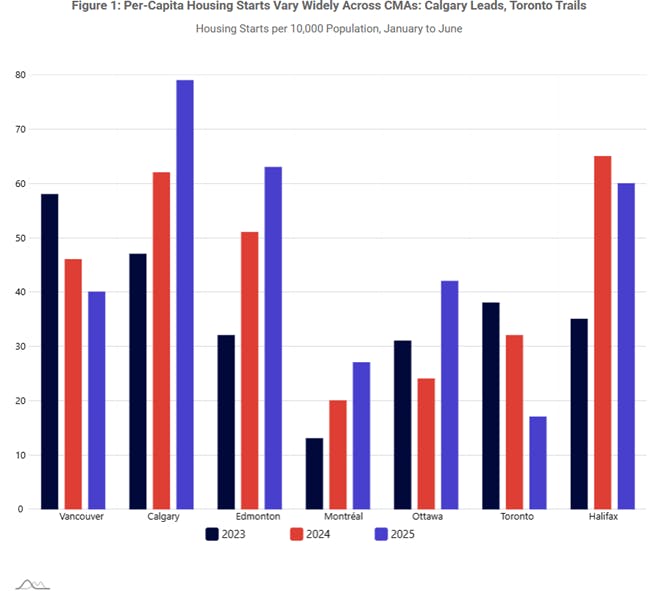
The Pivot Towards Rental
As outlined in the CMHC's Fall 2025 Housing Supply report, apartment construction (including both condominium and rental) continued to be the main form of new housing, comprising 70% of starts. The increase in rental housing starts in the first half of 2025 was mainly driven by record immigration levels and strong rent growth expectations during the planning phase, despite recent slowdowns in immigration. Furthermore, some developers who traditionally focused on condominiums have shifted towards purpose-built rentals, attracted by the lack of pre-sale requirements, which has become an increasing challenge in the condominium market.
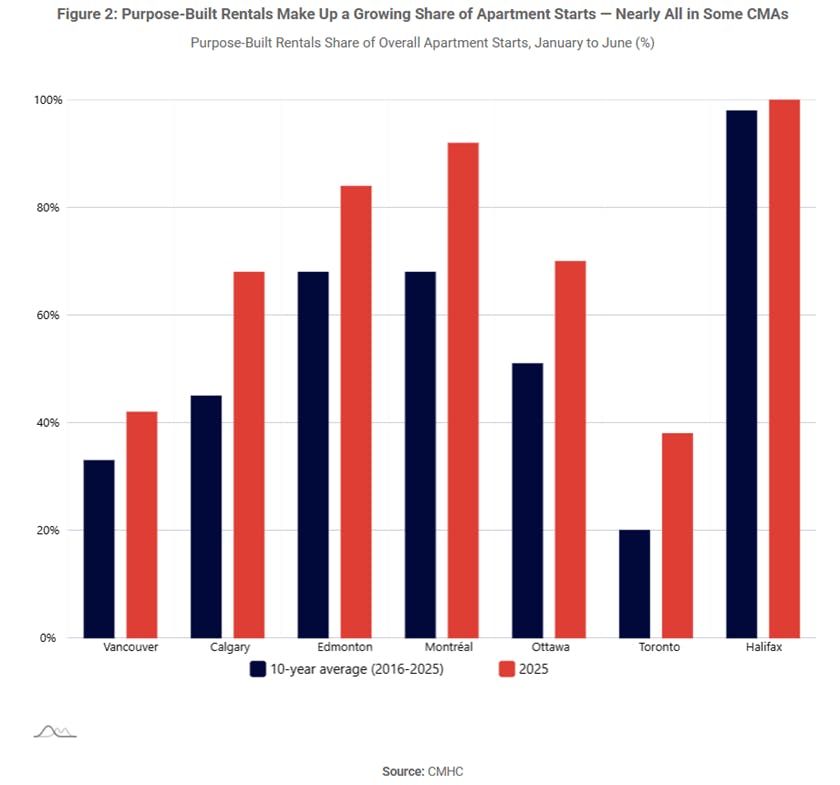
Rent for Occupied Units Still Strong
The slowdown in immigration has impacted the rental market, with provinces such as British Columbia, Ontario, and Nova Scotia experiencing a decline in advertised rents due to the cap on international students. These provinces all saw declines in work and study permit holders in Q1 2025, while growth in the number of non-permanent residents slowed in Quebec and Alberta. Another factor poised to affect the rental market is the state of Canada's labour market, as Statistics Canada recently reported that the unemployment rate stood at 7.1% as of August 2025. Employment fell for both men and women across several industries, with the most significant employment declines occurring in Ontario, British Columbia, and Alberta.
Despite changes in Canada's demographic and labour conditions, on average, rents for occupied units have increased when compared year-over-year as of Q1 2025. According to Statistics Canada’s Labour Force Survey data, the average rent for 2-bedroom occupied units in the largest cities was higher in Q1 2025 compared to the same period a year earlier. This is primarily due to more tenants paying higher rents at turnover in recent years, thereby increasing overall rent growth. In markets with low turnover and strict rent regulations, rents often rise sharply when units become available. In turn, landlords adjust rents to match current market rates, which are typically higher than the regulated rents of previous leases.
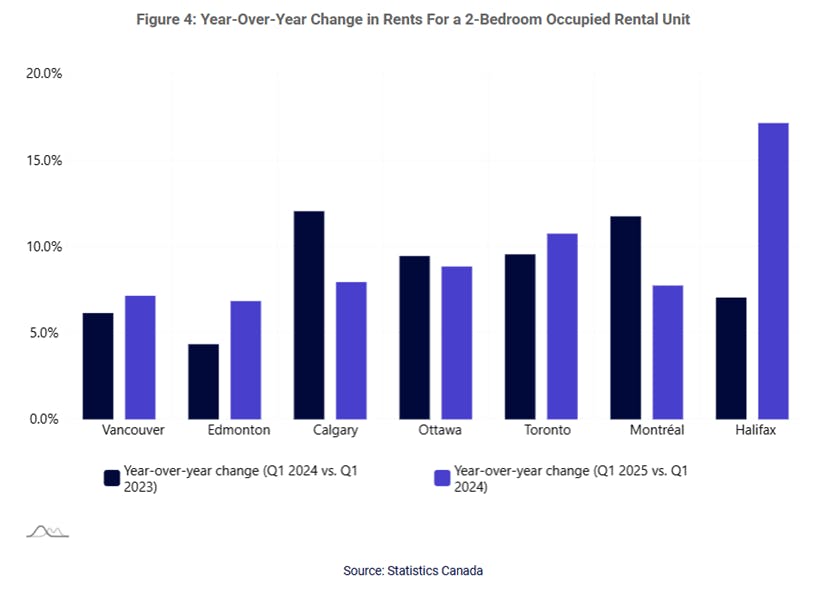
A 'rising tide effect' is also occurring in the rental market, where strong growth in average turnover rent has narrowed the rent gap between older and newer buildings across major cities. When older units became available, landlords are now able to charge rents closer to that of newly built units. As a result, tenants are remaining in their current units for longer; however, when they do move, the rent for the previously occupied unit increases substantially.
Investing in Real Estate via ETFs
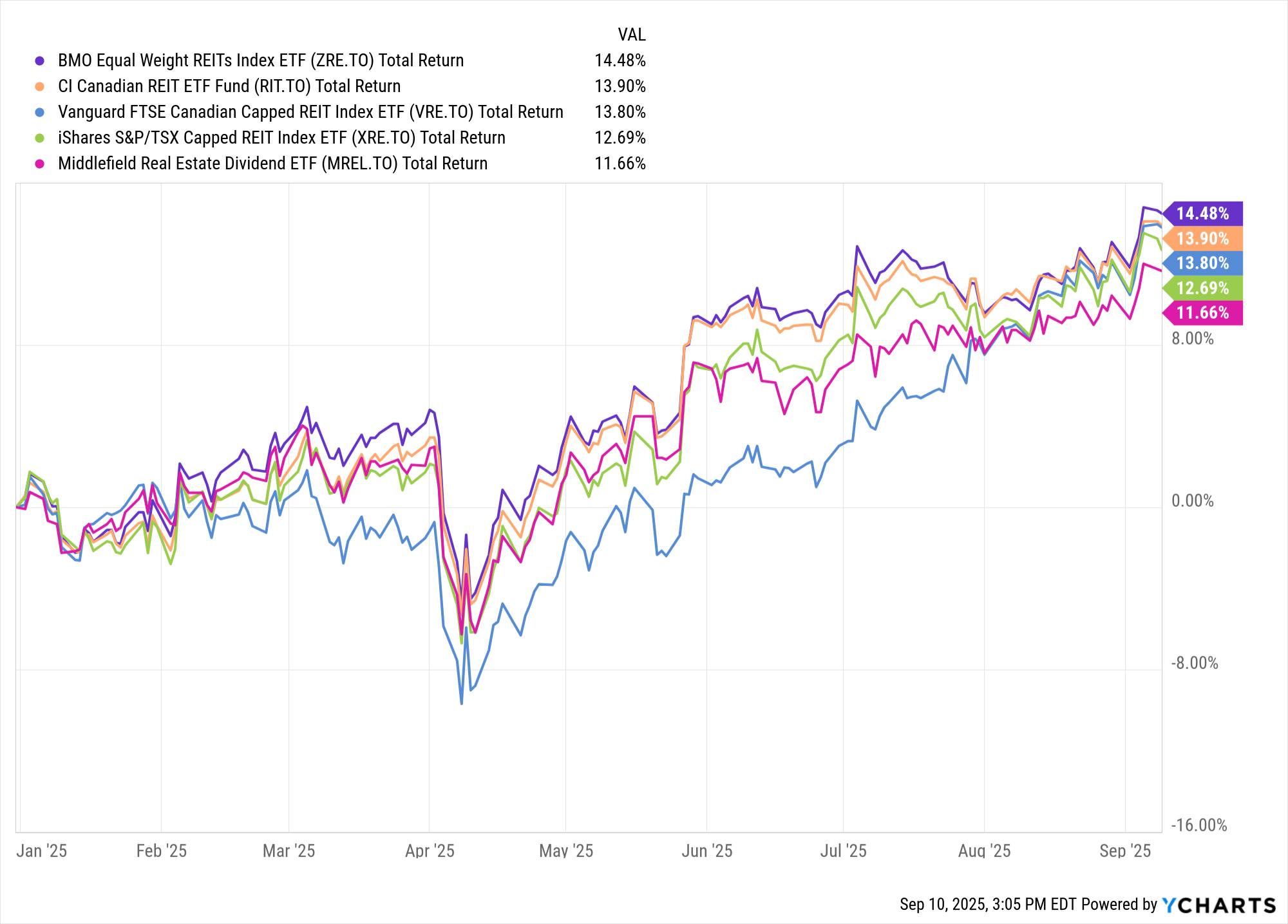
While Canadian investors can gain exposure to residential real estate via individual REITs, a more turnkey approach would be to utilize an ETF, which allows for more comprehensive exposure to the sector. While there are no stand-alone Canadian ETFs focused solely on residential REITs, there are real estate ETF offerings that have material exposure to the particular sector, namely:
The CI Canadian REIT ETF (Ticker: RIT), an actively managed fund consisting of Canadian real estate investment trusts, real estate operating corporations, and entities involved in real estate-related services. As of July 2025, the fund’s residential real estate exposure is approximately 24%.
The Vanguard FTSE Canadian Capped REIT Index ETF (Ticker: VRE) tracks the performance of a broad Canadian real estate equity index that measures the investment return of publicly traded securities in the Canadian real estate sector. Currently, this Vanguard ETF seeks to track the FTSE Canada All Cap Real Estate Capped 25% Index. As of July 2025, the fund’s residential real estate exposure is approximately 15%.
The iShares S&P/TSX Capped REIT Index ETF (Ticker: XRE) seeks to replicate the performance of the S&P/TSX Capped REIT Index, providing broad exposure to the S&P/TSX Capped REIT Index. As of September 9th, 2025, the fund’s residential real estate exposure is approximately 27%.
The Middlefield Real Estate Dividend ETF (Ticker: MREL), actively managed solution that provides diversified exposure to commercial real estate companies operating in the industrial, data center, retail, healthcare, cell tower, office, and residential sectors. As of June 30th, 2025, the fund’s residential real estate exposure is approximately 30%.
The BMO Equal Weight REITs Index ETF (Ticker: ZRE), which seeks to replicate the performance of the Solactive Equal Weight Canada REIT Index, which allocates securities according to a fixed weight rather than market capitalization weight. As of September 8th, 2025, the fund’s residential real estate exposure is approximately 30%.
Please note this article is for information purposes only and does not in any way constitute investment advice. It is essential that you seek advice from a registered financial professional prior to making any investment decision.