ETFs to Navigate Canada’s Evolving Housing Landscape
The demand for multi-family residential housing remains strong, as it is the most immediate avenue through which Canadian housing is being meaningfully addressed.


Housing availability has been top of mind for many Canadians in recent years, but the situation has hit a new seminal point, as the housing supply deficit hit a new record in 2024-Q1. Against this backdrop, the Government of Canada recently announced new measures to rectify this imbalance. However, they are long-tenured in implementation; thus, their ability to alleviate the current housing situation is unlikely.
This article will examine Canada's housing deficit, the actions being taken by the Federal Government, and a perspective on what it means for current real estate investment solutions.
Canada's Housing Crisis: Government's Ambitious Plan Under Scrutiny
Recently, the Federal Government of Canada unveiled the 'Solving the housing crisis: Canada's Housing Plan'. This comprehensive strategy aims to build 3.87 million new homes by 2031. Notably, this includes a minimum of 2 million net new homes, in addition to the Canada Mortgage and Housing Corporation's (CMHC) forecast of 1.87 million being built by 2031.
This commitment by the government seeks to address the Canadian housing deficit. While the plan's objective is commendable, its feasibility is in question. The National Bank of Canada recently released two short-form economic analysis reports (i.e., Canada: The daunting task of building nearly 4 million homes and Canada: Housing supply deficit hit new record in 2024Q1) that explains the depth of Canada's housing deficit and the efficacy of the government's plan.
Canada's Housing Challenge: Labor Shortage and Low Housing Starts
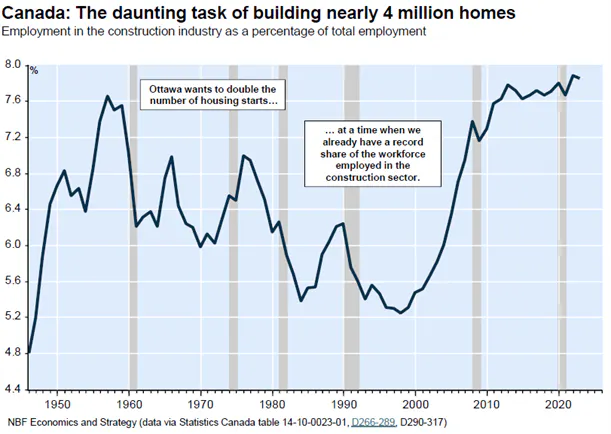
As detailed in the first report, for 3.87 million new homes to be built by 2031, that would mean an average annual cadence of 550,000 housing starts per year, about double the record high of 270,000 units in 2021. But the construction of homes has other infrastructure requirements - roads, sewers, hospitals, schools, etc. – for which more construction workers will be required, more than we have currently.
Presently, approximately 8% of the Canadian workforce is employed in construction, more than at any time since 1946. The takeaway here is that building approximately 4 million homes by 2031 will require increased labour capacity, which does not seem to be available at this immediate juncture or in the near future.
The second report highlights the depth of the housing crisis. As stated in the report, the CMHC recently reported that Canada's working-age population grew by 300,000 during the first quarter of 2024; simultaneously, housing starts were considered to be flat during this period, with only 61,000 units on record. This means there is currently only 1 housing start for every 4.9 people entering the working-age population, compared to a historical average of 1.8.
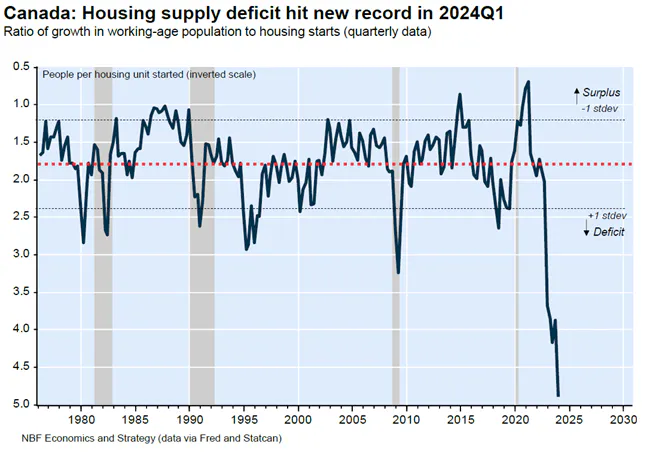
Based on observable data within these reports, the takeaway is that executing the Canadian government's housing plan will be daunting, given external market variables.
CMHC's National Outlook and New Developments
CMHC's 2024 Housing Market Outlook, explores the latest trends in Canada's housing market, covering new homes, resales, and rentals. As detailed in the report, the current 'higher for longer' interest rate environment has increased the difficulty for potential homebuyers, resulting in declining homeownership demand and weaker house price growth. Conversely, higher interest rates made it challenging for builders and developers to get financing. This immediately slowed the construction of smaller buildings, such as single-detached homes.
With Canada's economy exhibiting weakness in 2024, the CMHC expects lower housing starts throughout the year, with a slight improvement forecasted over the next 2 years. As a result, there will be increased demand for rental housing in the present, because the cost of homeownership will lead households to stay in rental housing. In turn, rents for available units will rise, and vacancy rates will fall.
To alleviate pressure on the rental market, the Federal government announced a national "renter bill of rights" in the recent budget, requiring apartment operators to disclose the previous rent history on apartment listings. The objective is to slow rental housing demand and curb rent increases. Given the current state of the housing market, the regulations are unlikely to have a material impact, given the market's current imbalance.
Investing in residential real estate with ETFs
While the Federal government is taking the necessary actions to rectify the housing market, the demand for multi-family residential housing – for rent - remains strong, as it is the most immediate avenue through which Canadian housing is being meaningfully addressed at this point in time.
For ETF investors seeking solutions that have material exposure to residential real estate, the following solutions are worth consideration:
Vanguard FTSE Canadian Capped REIT Index ETF (Ticker: VRE)
This Vanguard ETF tracks the performance of a broad Canadian real estate equity index that measures the investment return of publicly traded securities in the Canadian real estate sector. Currently, this Vanguard ETF seeks to track the FTSE Canada All Cap Real Estate Capped 25% Index.
As of March 31st, 2024, the fund's residential REIT exposure is 17.69%.
Purpose Real Estate Income Fund (Ticker: PHR)
This Purpose ETF is an actively managed solution that invests in real estate-focused equities within North America. In evaluating investments for inclusion within the fund, the manager utilizes a fundamental investment approach, which is augmented by drawing on macroeconomic factors and trends in addition to company-specific growth, equity, and value factors.
As of May 31st, 2024, the fund's multi-family residential exposure is 27.72% and single-family residential REIT exposure is 9.56%.
iShares S&P/TSX Capped REIT Index ETF (Ticker: XRE)
This iShares ETF seeks to replicate the performance of the S&P/TSX Capped REIT Index, providing broad exposure to the S&P/TSX Capped REIT Index.
As of May 2nd, 2024, the fund's multi-family residential REIT exposure is 30.12%.
Middlefield Real Estate Dividend ETF (Ticker: MREL)
This Middlefield ETF is an actively managed solution that provides diversified exposure to commercial real estate companies operating in the industrial, data center, retail, healthcare, cell tower, office and residential sectors.
As of March 31st, 2024, the fund's multi-family residential REIT exposure was 25.00% and single-family residential REIT exposure was 3.90%.
Please note this article is for information purposes only and does not in any way constitute investment advice. It is essential that you seek advice from a registered financial professional prior to making any investment decision.