Factor Investing in Focus: What ETFs Say About Market Direction
Low Volatility protects, Momentum soars—but 2025's surprise twist is crushing Quality stocks. Here’s how to pivot.


While investment factors such as Value, Momentum, Low/Minimum Volatility, and Quality are used to identify stocks with specific characteristics, these factors also offer insight into the market's leanings at a given time.
As has been well documented, against the backdrop of elevated market uncertainty, the Low/Minimum Volatility factor is well suited to mitigate losses that may occur during a drawdown.
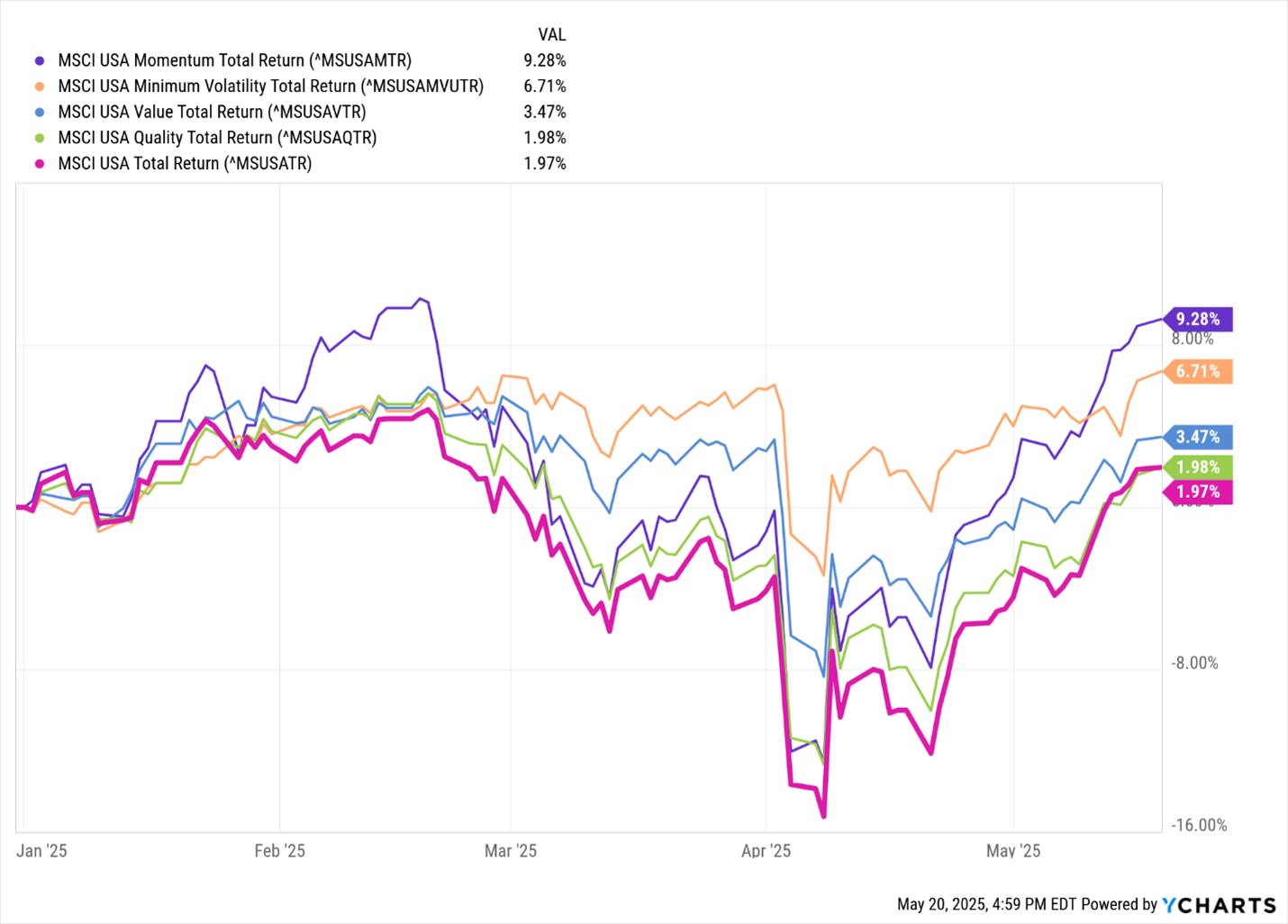
As observed in the following chart, the efficacy of the Low/Minimum investment factor is demonstrated, as the factor ‘lost less’ relative to the other factor indices and the market index, during the drawdown period.
However, what is also noticeable from the chart is that the Momentum factor has the best year-to-date performance of the group, while the Quality factor has the worst.
Quality Factor Reality Check
Naturally, most investors might reason that the quality factor index’s exposure to firms with strong profitability and balance sheets makes it resistant to a drawdown.
While many of these firms have solid fundamentals, it is important to note that no firm is immune to the effects of a drawdown during periods of elevated uncertainty.
Quality equities have performed strongly in recent years, as the MSCI USA Quality Total Return Index has outperformed the MSCI USA Total Return Index over the past two years (i.e., 2023-2024).
However, entering 2025, the level of price appreciation that existed for many firms, particularly those involved in artificial intelligence, began to come into question, which was then further impacted by the ‘DeepSeek Surprise’ and what it would mean going forward.
The subsequent tariff war initiated by the Trump Administration led to a ‘risk-off’ environment, adversely impacting all stocks. During selloffs, the top performers usually experience the most significant decline.
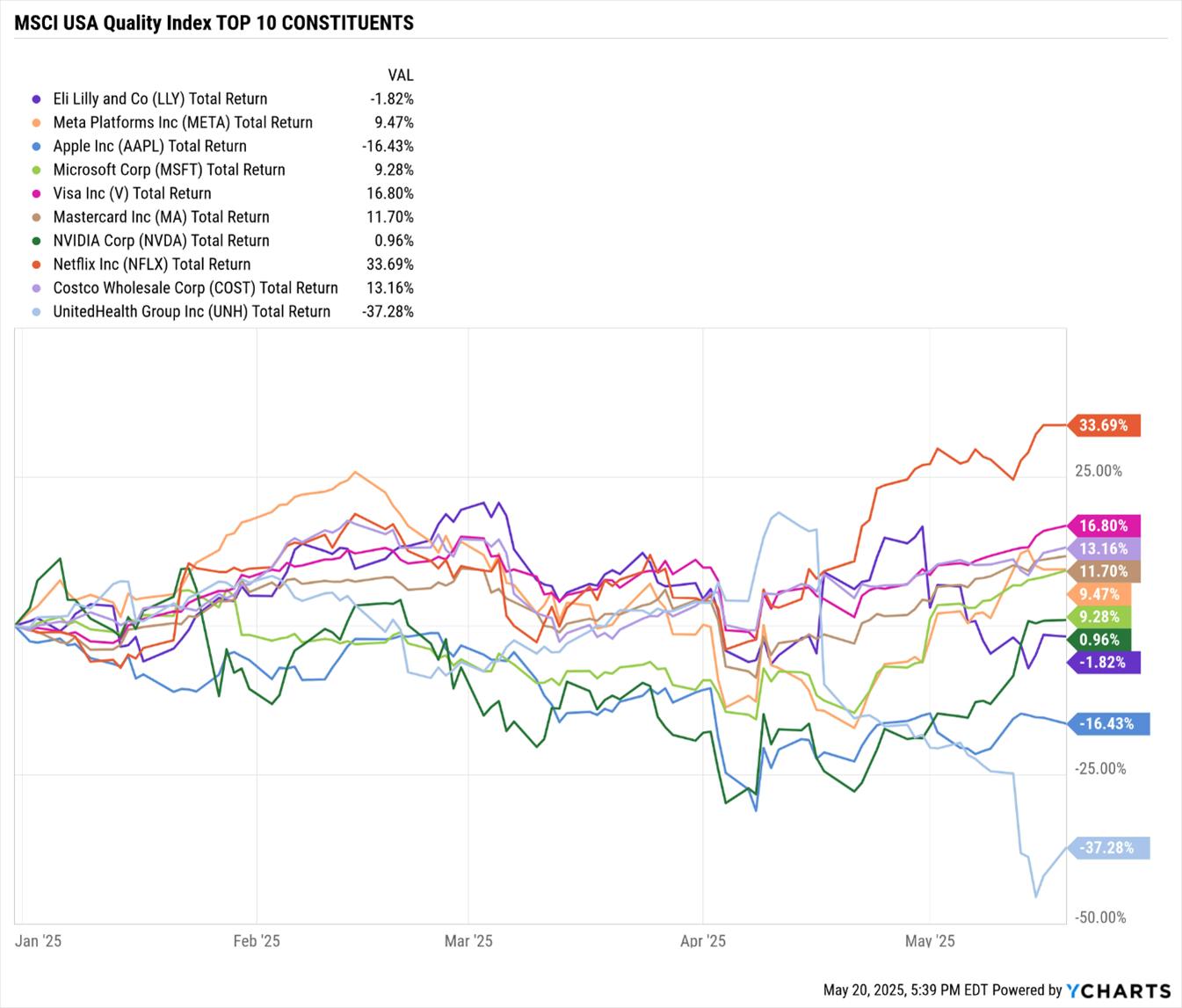
In examining the top 10 constituents of the MSCI USA Quality Total Return Index, while most companies have posted impressive year-to-date returns, there are noticeable instances of underperformance (i.e., UnitedHealth Group: -37.28% and Apple: -16.43%), which are affecting the index’s overall performance.
Beyond the U.S.: Momentum Factor Stays Strong
Momentum factor investing aims to capture stocks with strong recent performance by identifying companies with high price gains over the past 6-12 months.
The momentum factor, therefore, bets on return continuation, relying on the regularity that high returns are typically followed by high returns and that low returns are generally followed by low returns.
The success of the momentum factor has roots in behavioural finance theories – that is, investors will tend to buy stocks whose price is going up, leading to further upward pressure on the stock’s price.
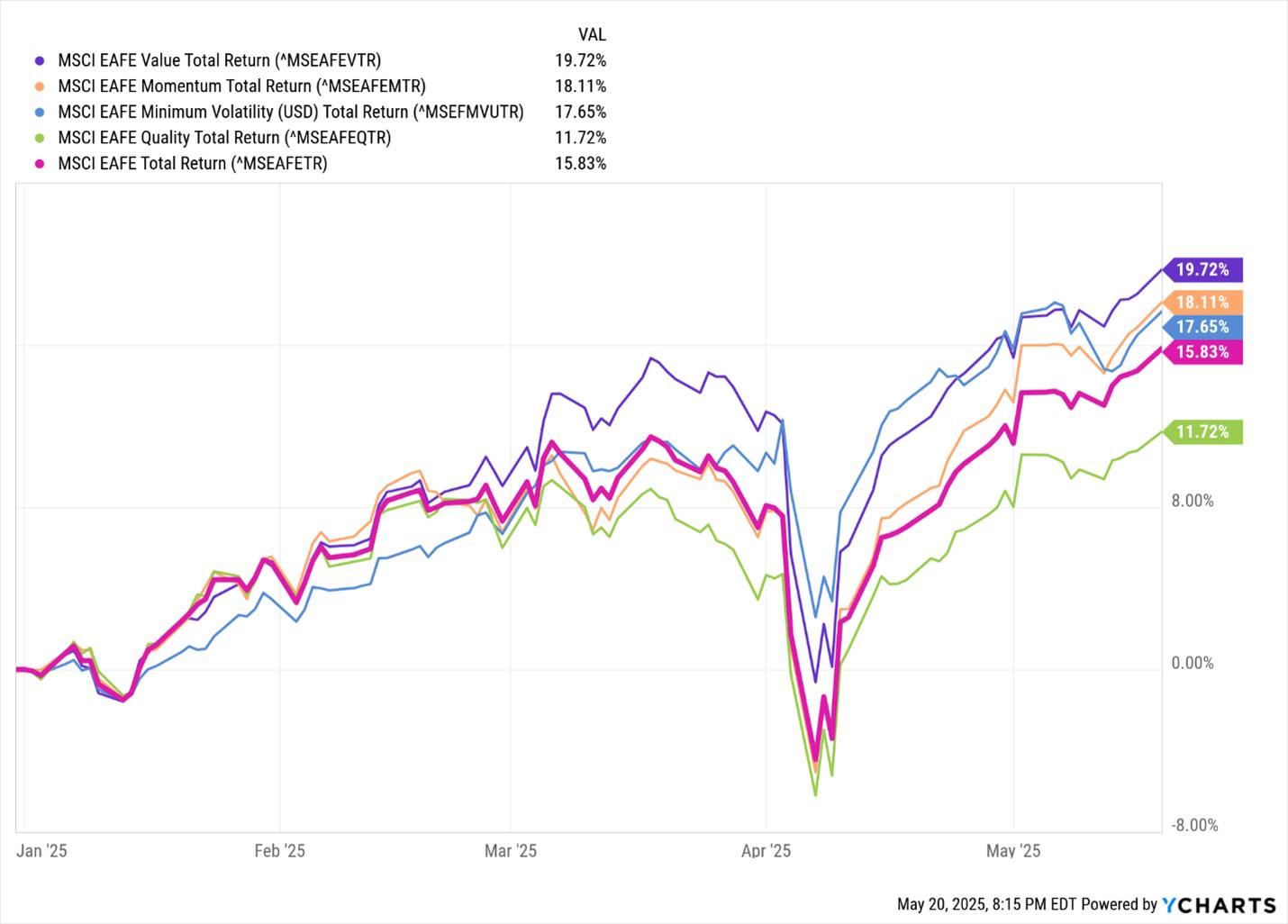
The momentum factor's strong performance thus far in 2025 is not limited to the US equity market; it has also performed well in non-US markets. The MSCI EAFE Momentum Total Return Index has performed well, with the MSCI EAFE Value Total Return Index being the only factor to outperform it.
2 International Momentum ETFs for Canadian Portfolios
For Canadian investors looking to gain international momentum exposure, the Fidelity International Momentum Index ETF (Ticker: FCIM) and CI First Asset Morningstar International Momentum Index ETF (Tickers: ZXM/ZXM.B) are worthy solutions.
FCIM seeks to replicate the performance of the Fidelity Canada International Momentum Index, which invests primarily in equity securities of large and mid-capitalization foreign companies that have their principal business activities or interests outside of Canada or the U.S. that exhibit positive momentum signals.
ZXM/ZXM.B replicates the performance of the Morningstar Developed Markets ex-North America Target Momentum Index. The fund invests in equity securities of the largest and most liquid issuers from countries classified by Morningstar as developed markets, excluding the U.S. and Canada, based on proprietary research generated by Morningstar, and is designed to provide diversified exposure to issuers from developed markets, excluding the U.S. and Canada, which have demonstrated, among other things, positive momentum in earnings and price.
Please note this article is for information purposes only and does not in any way constitute investment advice. It is essential that you seek advice from a registered financial professional prior to making any investment decision.