How All-Equity Portfolio ETFs Reduce U.S. Concentration Risk
As U.S. equity volatility rises amid AI disruption and labor market stress, all-equity portfolio ETFs offer a simple way to diversify equity risk beyond the U.S. without leaving stocks.


When diversification is discussed, it is often framed as cross-asset diversification, that is, allocating across different asset classes, such as equities, bonds, and alternatives, to reduce portfolio risk. However, in-asset-class diversification also plays a pivotal role in achieving a balanced portfolio. In 2025, amid rising U.S. policy uncertainty stemming from the Trump Administration’s trade actions, many investors pivoted to non-U.S. equities as a form of safety, using all-equity portfolio ETFs to gain broad market exposure. As noted in TD Securities' year-end review, asset allocation ETFs gathered $22.7 billion in new assets, mainly in all-equity portfolios, driven by strong equity market performance.
Employing broad equity exposure amid U.S. uncertainty
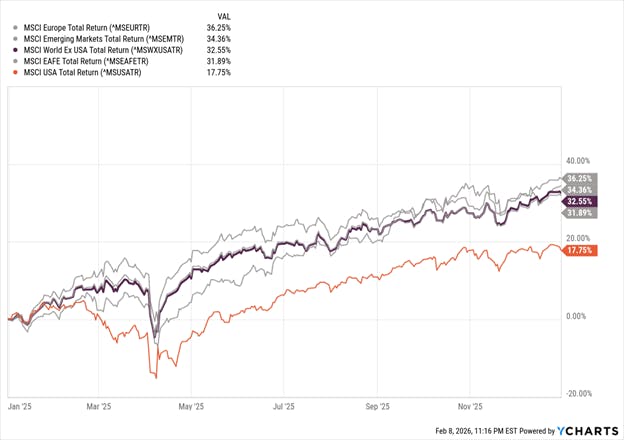
Year to date, U.S. equities have continued to underperform non-U.S. equities. Furthermore, there have been notable periods of elevated market volatility in the U.S. equities asset class, driven by concerns about the disruptive effects of artificial intelligence and the weakening of the U.S. job market.
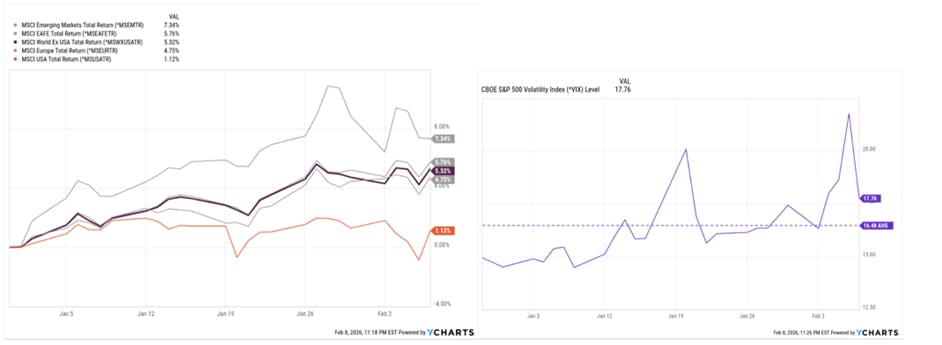
The most recent downturn in U.S. equities (as of February 6th) can be attributed to growing fears that AI advances will render many Software-as-a-Service (SaaS) firms obsolete, given AI platforms' ability to provide automation tools that can usurp the value proposition of many software companies. This idea was made manifest when AI firm Anthropic released a productivity tool for in-house lawyers, sending the stocks of software and publishing firms lower. While the panic selling was relatively short-lived, it once again underscores how the theme of AI advancement strongly influences U.S. equity markets at this juncture.
Regarding the job market, a recent report from Challenger, Gray & Christmas, states that US companies announced the largest number of job cuts for any January since the depths of the Great Recession in 2009. In January, companies announced 108,435 job cuts, a 118% increase from a year earlier. The report also showed hiring intentions slid 13% from a year earlier to 5,306—marking the weakest total for any January in the firm’s records over the past 17 years. Almost half of the job cuts announced in January were tied to three companies—Amazon, United Parcel Service, and Dow Chemical. Understandably, increasing unemployment will have reverberations on the U.S. economy, affecting consumer spending and other sectors.
Furthermore, while the recent US jobs report touted that 130,000 jobs were added in January 2026, there was a material revision in the reported number of jobs created in 2025: it was initially believed that 584,000 jobs were created last year, but it turned out to be 181,000. That's the weakest annual job growth since 2003, outside of a recession.
Taking a diversified equity approach
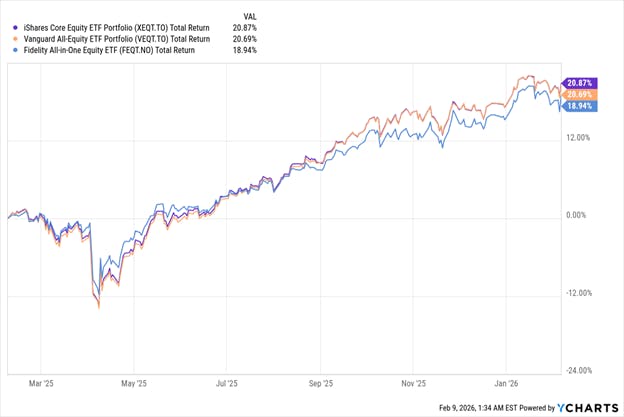
Given the strong long-term performance track record of U.S. equities as an asset class, maintaining exposure is paramount. However, complementing that exposure with other equity asset classes could be a beneficial course of action at this time. For Canadian investors interested in such an approach, all-equity portfolio ETFs, such as the iShares Core Equity ETF Portfolio (Ticker: XEQT), Fidelity All-in-One Equity (Ticker: FEQT), and Vanguard All-Equity ETF Portfolio (Ticker: VEQT), offer turnkey, diversified equity exposure.
XEQT seeks to provide long-term capital growth by investing primarily in one or more exchange-traded funds managed by BlackRock Canada and is managed in accordance with a long-term strategic asset allocation; the current target weight for each asset class is 25% Canadian equities, 45% U.S. equities, and 25% International Developed Market equities.
FEQT follows a neutral mix guideline of approximately 97% global equity securities and approximately 3% cryptocurrencies. The portfolio will be rebalanced annually. Additionally, if the portfolio deviates from its neutral mix by more than 5% between annual rebalances, the portfolio will also be rebalanced.
VEQT seeks long-term capital growth by primarily investing in equity securities. The sub-advisor will strive to maintain a long-term strategic asset allocation of 100% equity securities. The portfolio asset mix may be reconstituted and rebalanced from time to time at the sub-advisor's discretion.
Please note this article is for information purposes only and does not in any way constitute investment advice. It is essential that you seek advice from a registered financial professional prior to making any investment decision.