How to Invest in Liquid Alternatives Using ETFs
Liquid alts could help diversify an investment portfolio via their low correlation to stocks and bonds.


Traditionally, portfolio management consisted of allocating three types of assets: stocks, bonds, and cash. For example, the popular 60/40 portfolio, long considered a "balanced" blend of risk and return is comprised of just stocks and bonds. For many decades, a 60/40 portfolio provided great returns while mitigating volatility and drawdowns.
Fast-forward to 2022, where a rare combination of high inflation and rapidly rising interest rates caused even short-duration bonds to tank in unison with stocks. Case in point, the 60/40 stocks/bonds Vanguard Balanced ETF Portfolio (VBAL) has suffered as much as the 100% stocks Vanguard All-Equity ETF Portfolio (VEQT) since the start of 2022.
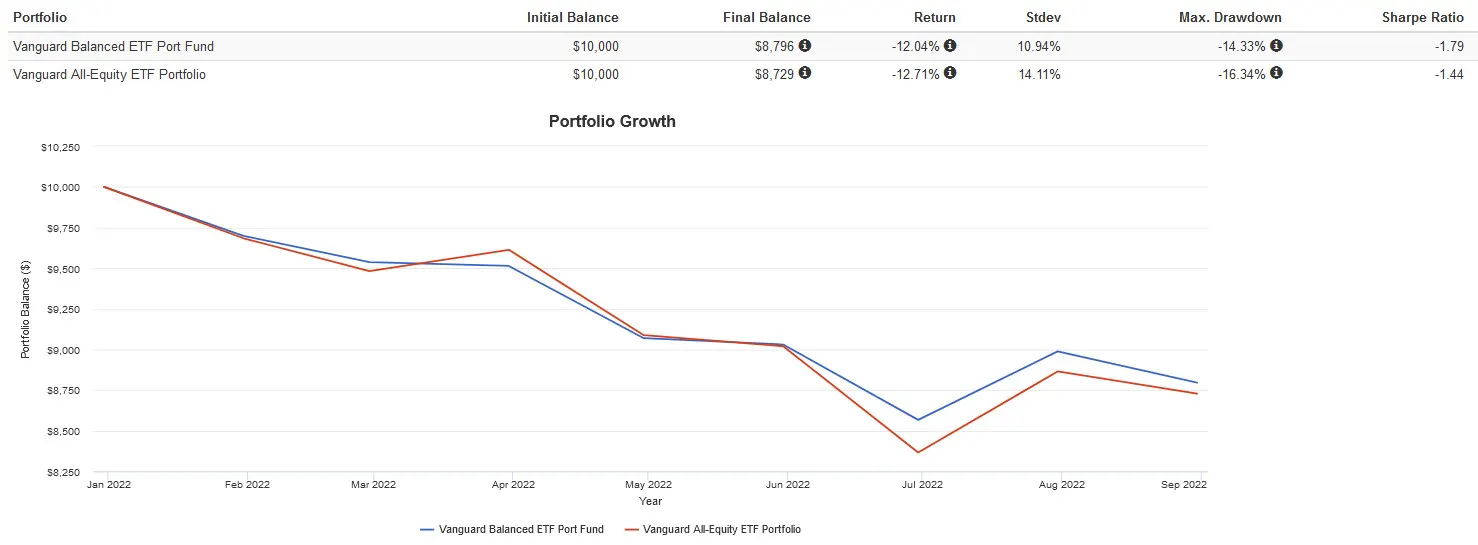
The issue here is with bonds. In an era of falling interest rates and low inflation, bonds held a negative correlation with stocks. When markets crashed, bonds provided protection, with government bonds like Treasurys soaring in value (the flight to safety effect). Moreover, longer-duration bonds experienced a 40-year bull market as interest rates steadily fell, which had the effect of boosting their prices.
Not so in 2022, where the precise opposite has occurred. Stocks are in a bear market, bonds are tanking, and cash is getting eroded away by inflation. As a result, more and more investors are turning to alternatives, in particular, liquid alternatives ("liquid alts”) to diversify their portfolios. Let's take a look at how they work and some ETFs that use this strategy.
What is a Liquid Alt?
Liquid alternatives (as suggested by their name) have two traits:
- They hold alternative investments outside of stocks, bonds, and cash. These can include precious metals, commodities, private equity, venture capital, and derivatives like futures, swaps, and options on those assets.
- They are liquid, meaning that they can be bought and sold easily on a daily basis without an excessively wide bid-ask spread.
An easy way to think about liquid alternatives is as a hedge fund in an accessible, low-cost format. Like hedge funds, most liquid alternatives aim to provide positive absolute returns in all market conditions. They do not attempt to match or beat an index. Rather, their goal is to protect against downside risk and ensure a steadier sequence of returns.
Central to this is ensuring a low correlation with both stocks and bonds. In line with modern portfolio theory, a diversified portfolio of stocks, bonds, and liquid alternatives all with low correlation to one another provides a better overall risk-adjusted return. That is, the portfolio earns commensurately more return for less risk compared to a single asset.
To achieve this, liquid alternatives can use a wide range of hedge-fund strategies. Common ones include long-short equity, market neutral, event-driven, relative value, systematic trend following, and global macro. However, unlike hedge funds, liquid alternatives are not limited to sophisticated investors with a high net worth, nor do they charge a higher fee structure like the common "2% and 20%" approach.
Liquid Alternative ETFs
A great example of a liquid alternative ETF is the NBI Liquid Alternatives ETF (NALT) by the National Bank of Canada. NBI employs a quantitative systematic global macro strategy to select its underlying investments. Currently, its portfolio consists of 22 futures contracts that can go long or short on various asset classes, which include:
- U.S. government bonds;
- Foreign currencies;
- Metal commodities;
- Agricultural commodities;
- Energy commodities.
The fund has grown quickly and currently sports $356 million in assets under management (AUM), making it one of the most popular Canadian ETFs in its category. NALT also charges a decently low expense ratio of 0.69%, which is far lower than equivalent managed futures funds from the U.S. ETF industry.
NALT has performed well since inception, returning 10.43% in 2020, 6.51% in 2021, and 12.05% in 2022. However, this information is useless in isolation, as we need to assess how NALT contributes to a diversified portfolio. Below, I've plotted a backtest of three portfolios from 2019 (when NALT debuted) to the present:
- 100% in stocks via the Vanguard FTSE Global All Cap Ex Canada Index ETF (VXC).
- 60/40 in stocks and bonds via VXC and the BMO Mid Federal Bond Index ETF (ZFM).
- 60/20/20 in stocks, bonds, and alternatives via VXC, ZFM, and NALT.
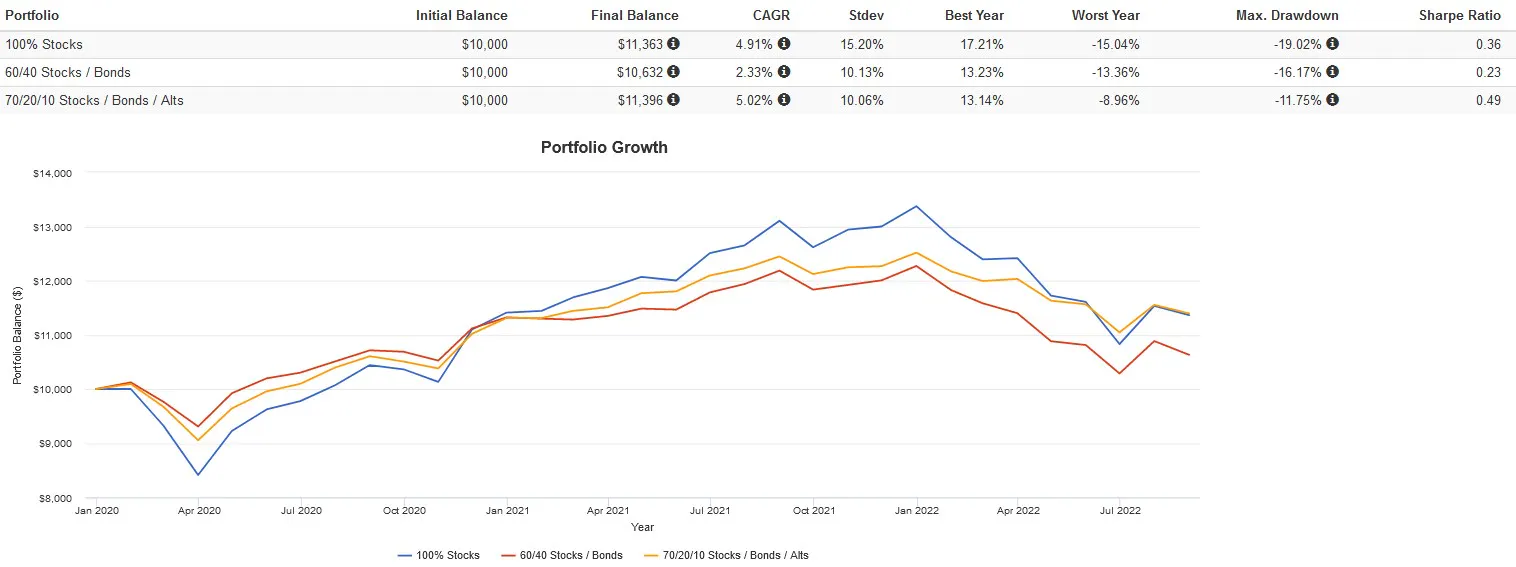
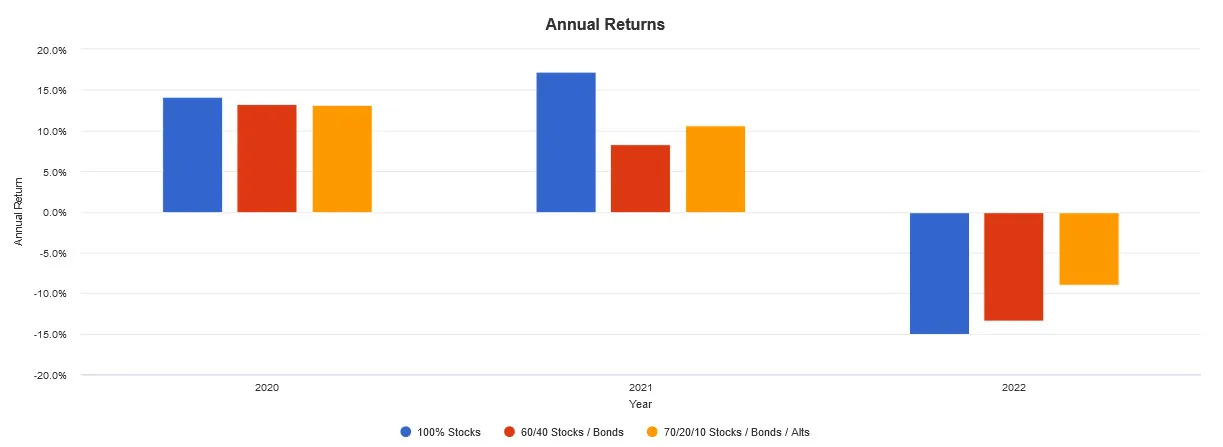
From a portfolio perspective, the addition of NALT resulted in substantially better risk-adjusted returns (Sharpe ratio), lower drawdowns, and less volatility. An investor in the third portfolio would have enjoyed a smoother ride without sacrificing any returns. However, keep in mind that this backtest was constrained in time by NALT's debut in 2019.
What's most important to me is NALT's monthly correlation with stocks and bonds. As seen below, it is low with stocks (0.30) and negative with bonds (-0.33). This, combined with NALT's goal of positive absolute returns, makes the ETF a potentially good diversifier for a traditional stock/bond portfolio.

The Final Word on Liquid Alternatives
I'll end with a discussion about the risks of using liquid alternatives. First, investors need to realize that these are actively managed strategies. You're relying on the portfolio manager and their algorithms to make the right calls consistently. Depending on how good the team is, and how solid their methodology is, this can be hit or miss.
Second, investors need to accept tracking errors. The benefits of liquid alts take time to pay off. In low volatility bull markets, liquid alternatives are likely to underperform a regular stock market index. Investors need to be aware of this and think long-term for when times are rough and liquid alternatives shine.
Finally, the higher expense ratios of liquid alternatives might not be suitable for some investors. While 0.69% is still lower than many actively managed mutual funds, it is substantially higher than index funds, which can reach as low as 0.04%. For a $10,000 portfolio, that’s a difference of around $65 annually in fees, which can compound over time to create an opportunity cost.
Please note this article is for information purposes only and does not constitute investment advice.