Investing In The 4th Industrial Revolution With ETFs
AI and automation drive economic shifts, sparking labor concerns yet presenting ETF investment opportunities in the Fourth Industrial Revolution.


The global economy is approaching an inflexion point, where technological advancement and innovation will upend many of the accepted practices and concepts of the present. The role of artificial intelligence (AI) and automation has increasingly become top of mind for business leaders and those they employ. Last year’s Writers’ Guild of America strike against the Alliance of Motion Picture and Television Producers was partly done to seek protection against AI in replacing workers. While many onlookers viewed the strike as a negligible matter, affecting a niche area of the economy, the 2024 United States port strike was a labor strike involving over 47,000 port workers who are part of the International Longshoremen’s Association (ILA) highlighted the fear workers are having towards automation; as the union also demanded that automation be banned entirely for port work. Though a resolution to the strike was quickly made, the estimated economic impact, if it prolonged, was $4.5 billion to $7.5 billion, or a 0.1 percent hit to the US annualized gross domestic product, every week.
Undoubtedly, the current pace of technological advancement is poised to change the business and societal landscape materially.
The 4th Industrial Revolution
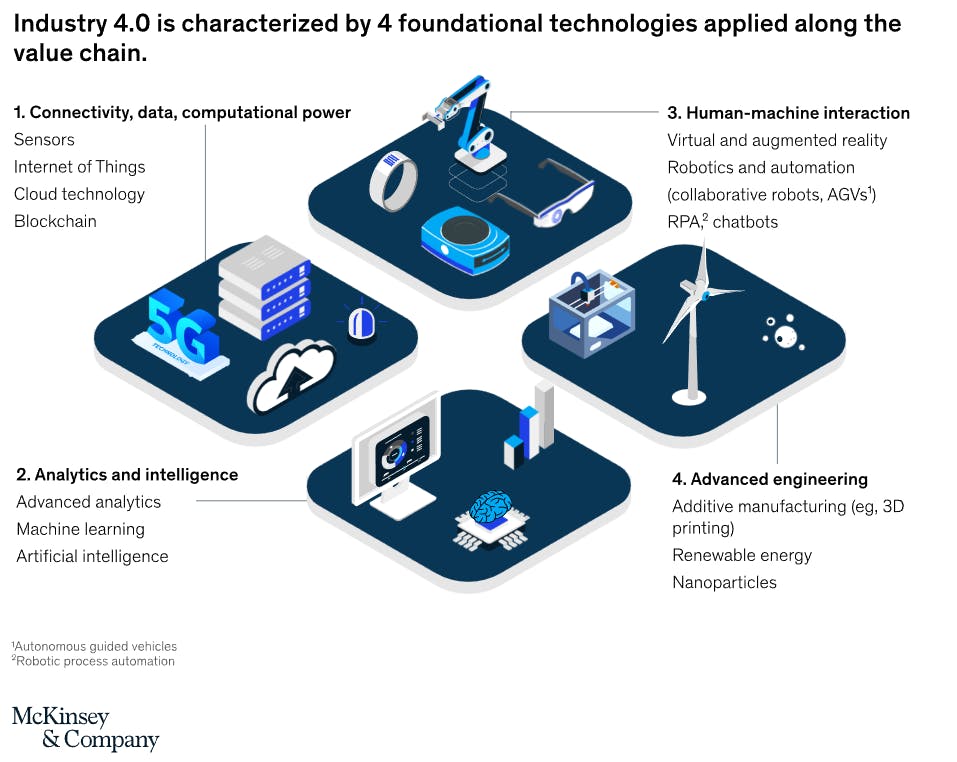
The fourth industrial revolution is the next phase in the digitization of the manufacturing sector, driven by disruptive trends such as the rise of data and connectivity, analytics, human-machine interaction, and improvements in robotics. Building off the digital revolution (i.e., the third industrial revolution), which brought computers, the Internet, and other innovations to the masses, the fourth industrial revolution advances these technologies and extrapolates their capabilities and use cases within our modern society. Research published by McKinsey & Company categories the technological developments of the fourth industrial revolution into four distinct categories: Connectivity, Human-Machine Interaction, Analytics and Intelligence, and Advanced Engineering.
With big tech firms such as Microsoft partnering with Open AI and making sizable investments in AI infrastructure, namely data centers, there is observable evidence that we are gradually approaching a new technology landscape, one that will create new opportunities for growth and investing. Supporting technology advancements, such as artificial intelligence, requires significant energy; as such, recent announcements by Amazon about entering nuclear energy deals for their AI development indicate where the tangential opportunities will arise.
Investing in the 4th Industrial Revolution
For future-focused investors, the Evolve Innovation Index Fund (Ticker: EDGE) and Global X Industry 4.0 Index ETF (Ticker: FOUR) are solutions that provide comprehensive exposure to firms engaged in innovation and are poised to be seminal contributors to the fourth industrial revolution.
EDGE is a passively managed solution that replicates the performance of the Solactive Global Innovation Index, which has been designed to reflect the performance of equity securities of companies listed domestically or internationally that are involved in innovative and disruptive trends across a broad range of industries. Similarly, FOUR is also a passively managed solution that reflects the performance of the Solactive Industry 4.0 Index, which is designed to provide exposure to the performance of equity securities of companies that are involved in the transformation of manufacturing and the industrial market through the development or implementation of new technologies and innovations.
Takeaway
As technology changes the global landscape, now is an opportune time for investors to examine, understand, and gain exposure to companies that can catalyze future economic and social growth. Both EDGE and FOUR are ETFs that provide turnkey exposure to such firms in a diversified manner.
Please note this article is for information purposes only and does not in any way constitute investment advice. It is essential that you seek advice from a registered financial professional prior to making any investment decision.