Investing in Canadian REIT ETFs: Things You Need to Know
REITs are a popular investment choice for many Canadians looking for diversification and income potential.


Canadian investors seeking above-average income potential, while still capturing attractive long-term total returns, tend to gravitate towards real estate investment trusts (REITs). These are shares of publicly traded companies that invest in an underlying portfolio of real estate, which can be from the industrial, retail, office, healthcare, or residential subsectors.
As income trusts, shares in a REIT are referred to as units. By law, they are required to distribute most of their income to unitholders, hence the high yield potential that can be paid monthly. However, they aren't the most tax-efficient of assets when compared to eligible dividends from Canadian stocks, so they're best held in a TFSA or RRSP.
Investors looking to buy REITs can use REIT ETFs in lieu of individual companies for increased diversification. This minimizes idiosyncratic risk, where the possibility of a single REIT performing poorly hurts your portfolio. A great way to find Canadian listed REIT ETFs is via the NEO ETF Screener by selecting "REIT" or "Real Estate" under the "Sector" filter.
Are REITs an Asset Class?
A common misconception is that REITs are a separate asset class, in the way that bonds, commodities, and cash are to stocks. At the end of the day, REITs are still equities. They're accounted for in market-cap weighted indexes according to their weight. For example, the S&P/TSX 60 index holds 0.62% in REITs.
Previous academic studies have found that REITs do not meet the definition of a distinct asset class despite having a lower correlation with stocks and bonds. That being said, their low correlation combined with their positive expected returns can make REITs good for diversification if over-weighted.
This is called a "tilt." For example, if your entire portfolio holding is an ETF tracking the S&P/TSX 60 index, you would have 0.62% REIT exposure. If you reduced your S&P/TSX 60 holding down to 90% and added 10% of a REIT ETF, your REIT exposure would now be approximately 10.56%.
Investing in REIT ETFs
REIT ETFs come in all shapes and sizes. Some of the things to watch out for before you buy include:
- Sector weightings: Is the REIT ETF dominated by a particular type of REIT (office, residential, industrial, retail, etc.)?
- Weighting: Is the REIT ETF market-cap weighted, or equal-weighted? If it is market-cap weighted, are there caps or restrictions on the size of individual holdings?
- Expense ratios: How much does the REIT ETF charge per year in terms of fees?
- Strategy: Does the REIT ETF track an index passively or is it actively managed?
Some of the most popular Canadian REIT ETFs include the following. Clicking on each link will take you to their respective page where you can view expense ratios, holdings, and historical performance.
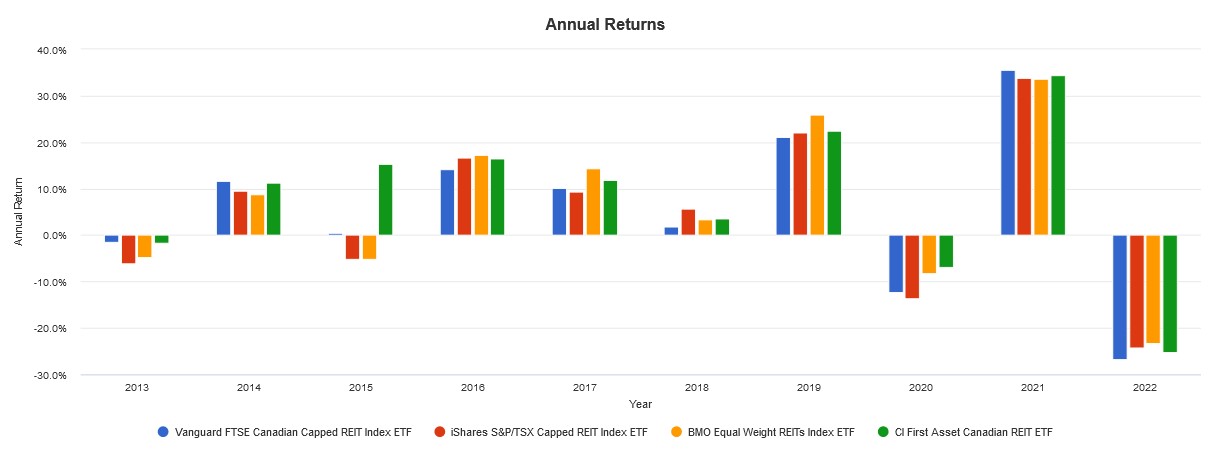
- Vanguard FTSE Canadian Capped REIT Index ETF (VRE)
- iShares S&P/TSX Capped REIT Index ETF (XRE)
- BMO Equal Weight REITs Index ETF (ZRE)
- CI First Asset Canadian REIT ETF (RIT)
And here's how all four ETFs have historically performed from 2013 to the present with all distributions reinvested:

Disclaimer: This article is limited to the dissemination of general information pertaining to investment strategies and financial planning and does not constitute an offer to issue or sell, or a solicitation of an offer to subscribe, buy, or acquire an interest in, any securities, financial instruments or other services, nor does it constitute a financial promotion, investment advice or an inducement or incitement to participate in any product, offering or investment.