Investing in Canada’s Energy Future: Top ETFs to Consider
A look at the current Canadian economic landscape, the importance of the energy sector, and ETF solutions that provide turnkey exposure.


The state of affairs regarding Canada’s political and economic future has been discussed recently. At the time this article was written, Canadian Prime Minister Justin Trudeau announced his resignation, initiating the start of a new leadership for his political party and, ultimately, the country when an election occurs.
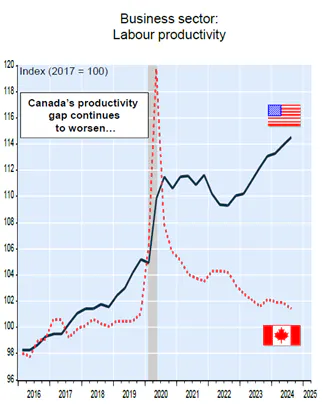
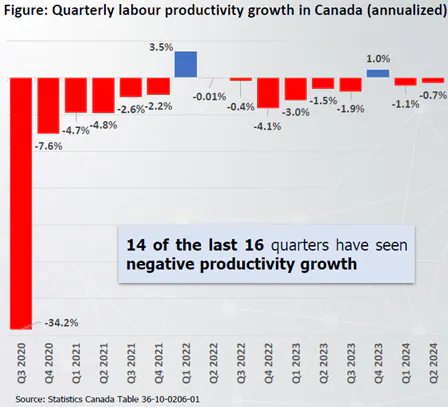
Regarding the nation’s economic landscape, productivity has been gradually declining. A recent National Bank of Canada memo noted that business sector productivity contracted at an annualized rate of 1.5% in Q3 2024—the third consecutive quarterly decline and the ninth drop in the past ten quarters. In contrast, U.S. productivity surged by a robust 2.2% in Q3 2024, marking the eighth consecutive increase. In broadening the comparative context, as outlined in a recent OECD Global Forum on Productivity presentation, Canada’s 1.8% decrease in labor productivity in 2023 was the worst in the OECD. The OECD predicts that Canada’s per capita GDP growth will rank last among OECD economies over the next 40 years.
Increasing Productivity: A Focus on Innovation
As noted in the OECD Global Forum on Productivity, four elements contribute to stronger productivity:
- Skills and work practices: Improving worker and managerial skills, organizational practices, and job design to utilize the workforce better.
- Innovation: Through research and development, new products and services can be created to increase output with fewer inputs.
- Capital Deepening: Improving the quality of tangible and intangible capital to improve the efficiency of workers.
- Growth-Oriented Business Environment: Increased competition and lowered barriers to trade between jurisdictions can boost productivity.
Focusing on innovation, as Statistics Canada noted, Canada’s research and development (R&D) spending was below the G7 average in 2022. R&D intensity, a metric that compares a country's R&D expenditures with its gross domestic product, shows that Canada's R&D intensity fell from 1.87 in 2021 to 1.81 in 2022. By comparison, intensity increased among leading R&D performers, the United States and Japan. Canada's performance was also below the average of the OECD's.
Energy: A Sector of Increasing Innovation and Importance
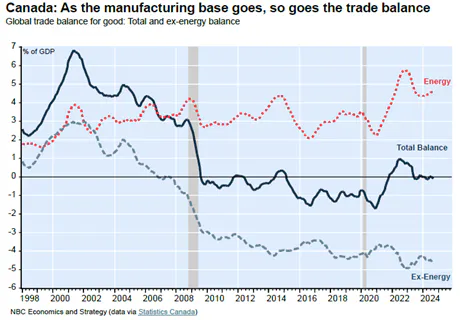
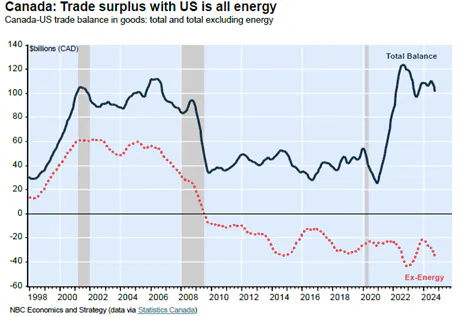
Against the backdrop of Canada’s declining R&D spending, as reported by Statistics Canada, businesses in Canada spent $2.8 billion on in-house energy-related R&D in 2022, up 17.2% from 2021. This marked the second consecutive year with significant spending increases. The importance of the energy sector in Canada’s economy cannot be overlooked. As illustrated in the previously mentioned National Bank memo, without the support of its energy sector, the country’s overall trade balance would plunge further into negative territory, revealing a critical reliance on resource exports to offset the decline in industrial competitiveness. As noted in the memo, Over the past 12 months, Canada’s $100 billion trade surplus with the U.S. (equivalent to 3.4% of GDP) has been entirely driven by energy exports, highlighting the country’s growing dependence on oil exports to sustain its trade position.
Investing In Energy
The energy sector plays a pivotal role in the Canadian economy, making it an area worth exploring. Over the past decade, as of December 2024, the energy sector ranked as the second-best performer among the sectors in the S&P/TSX Composite, trailing only the information technology sector.
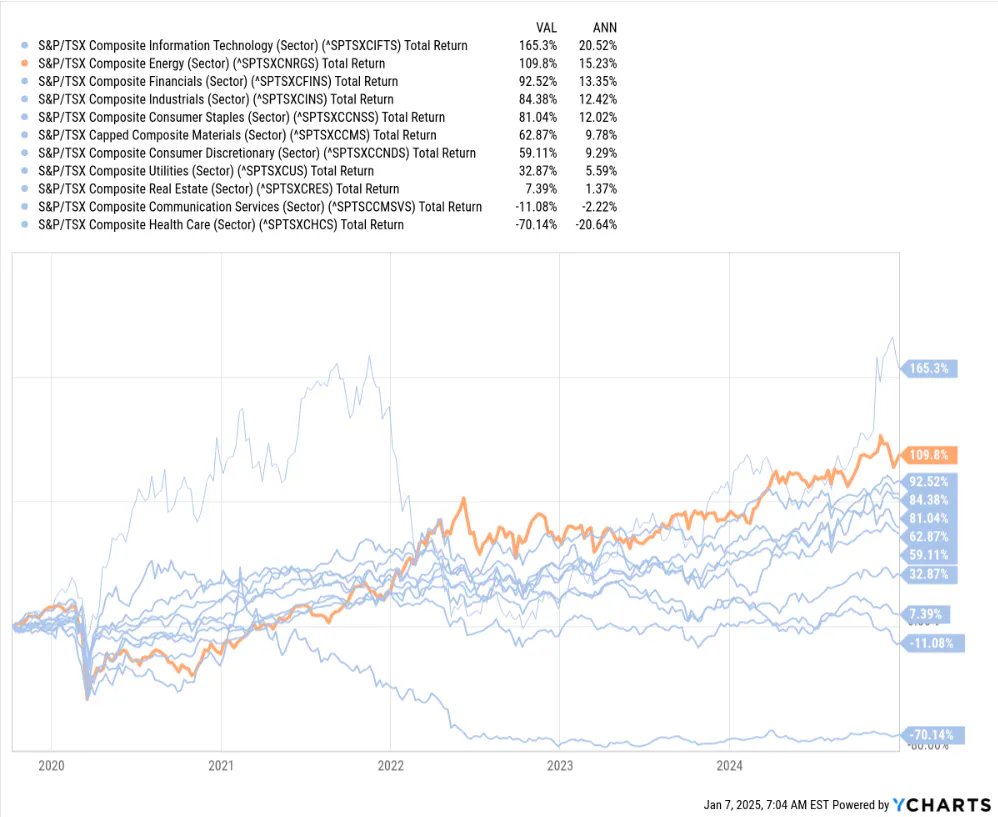
For Canadian investors looking to gain exposure to Canada’s energy sector, the following ETFs are worth consideration:
The iShares S&P/TSX Capped Energy Index ETF (Ticker: XEG) seeks to replicate the performance of the S&P/TSX Capped Energy Index, providing exposure to Canadian energy companies. As of December 2024, the 1-year performance for the fund was 14.08%.
The BMO Equal Weight Oil & Gas Index ETF (Ticker: ZEO) seeks to replicate the performance of the Solactive Equal Weight Canada Oil & Gas Index, which includes Canadian securities in the oil and gas industries. As of December 2024, the 1-year performance for the fund was 21.58%.
Takeaway
The Canadian energy sector is foundational to Canada’s economy and represents an avenue of growth for investors. Though productivity in Canada has been declining, the energy sector is an area that seemingly will continue to provide opportunities for economic growth and wealth generation over time.
Please note this article is for information purposes only and does not in any way constitute investment advice. It is essential that you seek advice from a registered financial professional prior to making any investment decision.