Investing in Canadian Energy
Canada’s new federal–Alberta pipeline partnership positions the country to expand energy exports to Asia, strengthen long-term competitiveness, and support investors seeking broad exposure to the sector.


Recently, the Mark Carney government announced that Canada and Alberta have formed a new partnership to build a pipeline to export oil and gas to Asian markets. As outlined in the memorandum of understanding signed by both Prime Minister Mark Carney and Alberta Premier Danielle Smith, the new pipeline will transport at least one million low-emissions barrels per day. Additionally, it is agreed that this new pipeline will complement the expansion of the Trans Mountain pipeline, adding an extra 300,000 to 400,000 barrels per day destined for Asian markets.
As stated by Prime Minister Carney in the announcement, “In the face of global trade shifts and profound uncertainty, Canada and Alberta are striking a new partnership to build a stronger, more sustainable, and more independent Albertan and Canadian economy. We will make Canada an energy superpower, drive down our emissions and diversify our export markets. We want to build big things, and we’re building bigger and faster together.”
Energy: Canada’s Competitive Advantage
Canada ranks as the world’s fourth-largest oil producer and has the fourth-largest proven oil reserves. Additionally, Canada is the fifth-largest producer and fourth-largest exporter of natural gas.
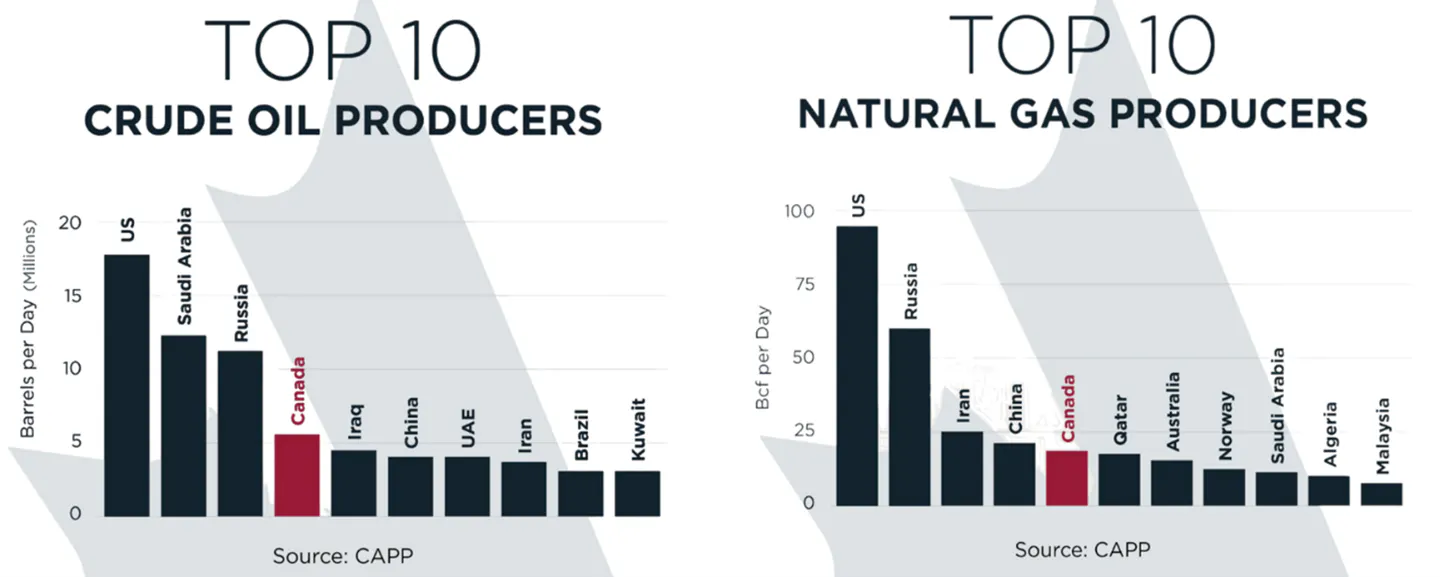
Historically, the greatest beneficiary of Canada’s oil exports has been the U.S. In 2023, 97% of Canadian crude oil exports went to the U.S., and 3% went to Europe, Asia and the Caribbean. As a result, Canada was the largest foreign supplier of crude oil to the U.S., accounting for 60% of total U.S. crude oil imports and for 23% of U.S. refinery crude oil intake. Given the change in the U.S.-Canada trade relationship, finding other export partners has become a priority.
Canada’s intent to build a new pipeline and expand the capacity of the Trans Mountain pipeline comes at an opportune time, as according to the recently released International Energy Agency World Energy Outlook 2025, global oil consumption will continue to increase through 2050, with oil prices expected to exceed $100/b by that year. The agency cited shifting US decarbonization goals, rapid growth in electricity consumption and slowing adoption of electric vehicles as factors driving the continued demand for oil.
With the increasing energy demand, Canada’s shift towards becoming an energy superpower allows the country to capitalize on an innate competitive advantage and leverage the industry expertise already present within the nation to grow and elevate an economically important sector.
Investing in Canadian Energy
For Canadian investors interested in a turnkey energy solution, the Ninepoint Energy Fund (Ticker: NNRG/NNRG.U) provides comprehensive exposure to companies that are involved directly or indirectly in the exploration, development, production, and distribution of oil, gas, coal, or uranium and other related activities in the energy and resource sector.
In speaking about the recent positioning of the fund, Ninepoint Partner and Senior Portfolio Manager Eric Nuttall states that the fund currently has a 70/30 mix toward natural gas over oil in the near term, with the former experiencing all-time highs recently. As Nuttall detailed, the performance of energy stocks this year has been notable, in part because oil companies have focused on shareholder returns through share buybacks.
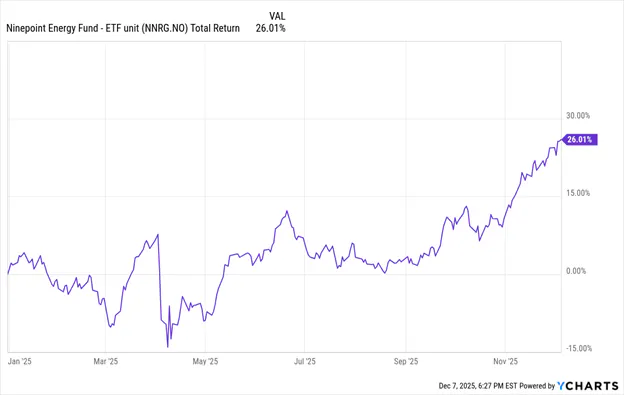
Looking at NNRG's year-to-date performance, investors have been rewarded for maintaining exposure to the energy sector.
Please note this article is for information purposes only and does not in any way constitute investment advice. It is essential that you seek advice from a registered financial professional prior to making any investment decision.