Looking for higher income and lower volatility? These Franklin Templeton ETFs may help
Franklin Templeton’s Low-Volatility High Dividend ETFs provide Canadian investors exposure to high dividend stocks with lower volatility, suited for economic cycles' ups and downs.


Though the central banks of most developed economies began lowering their respective policy rates earlier this year, the Federal Reserve’s (Fed) recent reduction was met with great enthusiasm, given the importance of the U.S. economy within the global landscape. While Chairman Powell’s positioning of the degree of the rate cut (i.e., 50 basis points) has been “to help maintain the strength of the economy and the labor market,” some uncertainty in the U.S. and the broader macroeconomic environment remains, which can impact the market moving forward.
Looking at the U.S. Macroeconomic Landscape
As outlined in the OECD Economic Outlook report¹ published earlier this year, global GDP growth is projected at 3.1% in 2024 and 3.2% in 2025. While these figures indicate a stable economic trajectory, they fall short of the more robust growth rates witnessed in the decade preceding the global financial crisis. The consistency in growth rates across these years implies a period of economic stability, albeit at a lower level than historical averages, reflecting ongoing challenges and structural changes in the global economic landscape.
For the U.S., all incoming economic indications have been compelling - inflation has been trending toward the 2% target, economic growth remains just above 2%, and unemployment has been moving downward. Against this backdrop, the U.S. Fed has cut rates and indicated² that more rate cuts are likely to occur.
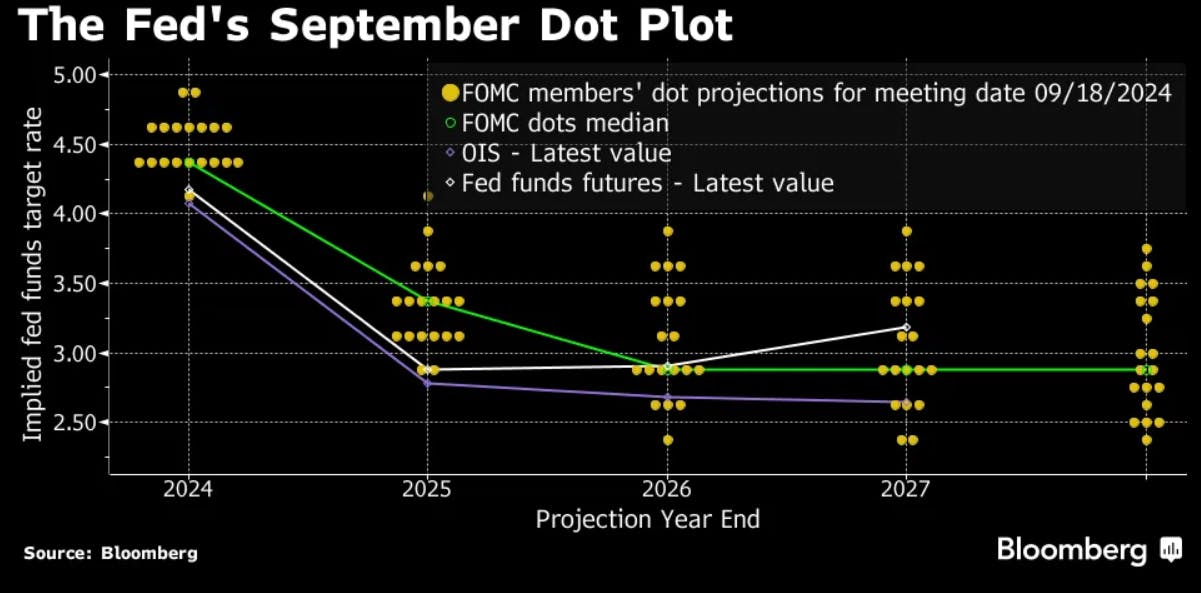
Source: Bloomberg
The most significant uncertainty that could impact markets in the near term stems from the election. Research conducted by YCharts shows that investor anxiety has generally risen, leading up to election day in the last eight cycles, as evidenced by the spike in the Cboe Volatility Index.
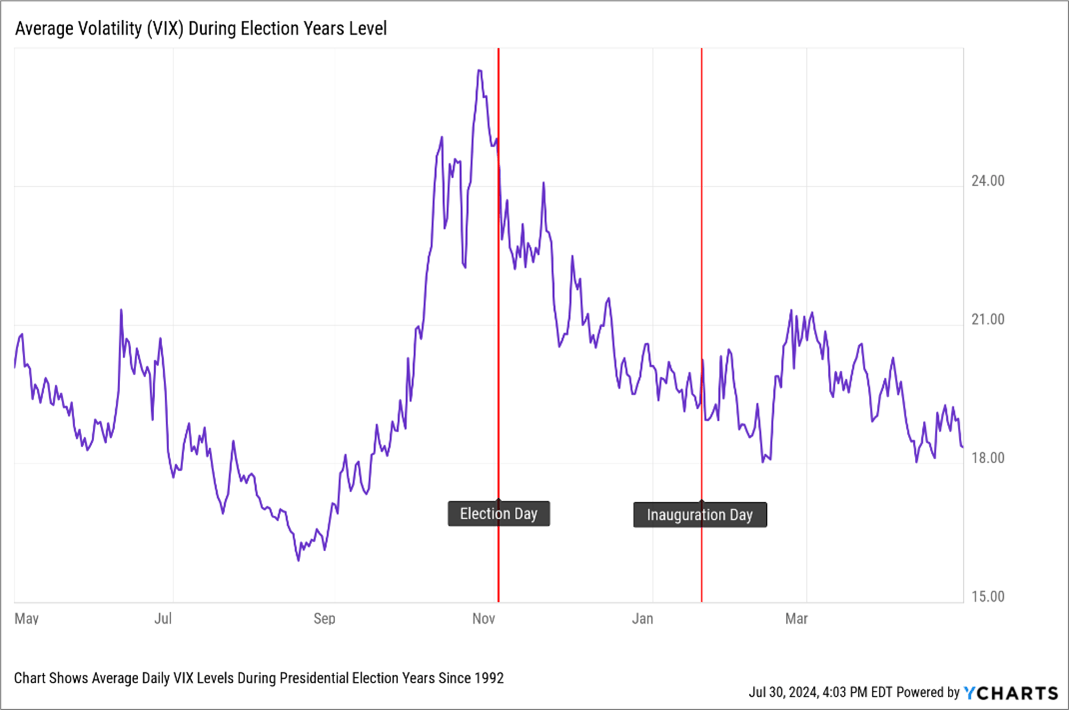
Source: YCharts, retrieved from: How do presidential elections impact the market?³
Concerns about U.S. trade policy and its ensuing implications are top-of-mind post-election. The possibility of a second Trump presidency would mean a renewal of trade protectionist policies. As he has consistently stated, Trump’s “American First” agenda emphasizes instituting tariffs on foreign-made goods and reinvigorating the nation’s manufacturing capabilities.
As noted in his campaigns, he would impose a 60% tariff on Chinese goods, and a far lower 10% universal tariff would be proposed for other U.S. trading partners. Research published⁴ by the Tax Foundation, an international research think tank based in Washington, D.C. that collects data and publishes research studies on U.S. tax policies at both the federal and state levels, found that the Trump administration imposed nearly $80 billion worth of new taxes on Americans by levying tariffs on thousands of products valued at approximately $380 billion in 2018 and 2019, amounting to one of the largest tax increases in decades.
On the opposite side, the Biden administration reinstated steep tariff hikes on Chinese imports, including a 100% duty on electric vehicles, to boost protections for strategic industries from China’s state-driven industrial practices. Should Kamala Harris become president, these tariffs are believed to remain.
Developments in the Global Landscape
As reported⁵ by Bloomberg, China released a surprise stimulus package to spur its economy to achieve its intended growth target of 5%. The People’s Bank of China unveiled a package to support the property market, including lowering borrowing costs on as much as $5.3 trillion in mortgages and easing rules for second-home purchases. The reserve requirement will be by 50 basis points, with Governor Pan Gongsheng indicating the possibility of another 25 to 50 basis points by the end of the year. Given that China’s economic growth has slowed, dragged down by the real estate slump and low consumer confidence, these initiatives are welcomed news. Still, only time will determine their economic efficacy.
While China is making attempts to jump-start its economic growth, Germany is still seemingly stuck in the mud. Economic sentiment⁶ in the nation is declining, and major industries are underperforming. Germany’s consumer and producer prices rose more than the rest of the euro area, and household and business confidence is still struggling to recover from the energy crisis in 2022. Germany contracted in the second quarter and is at risk of a repeat in the third quarter.
Investing Through Uncertainty
Though the tentative economic progress being made by developed economies at this juncture differs, investors can still remain invested during this period by utilizing low-volatility investing strategies, such as Franklin Templeton’s Low Volatility Suite.
Franklin Templeton Canada’s low volatility strategies are Franklin Canadian Low Volatility High Dividend Index ETF (Ticker: FLVC), Franklin U.S. Low Volatility High Dividend Index ETF (Ticker: FLVU), and Franklin International Low Volatility High Dividend Index ETF (Ticker: FLVI), providing investors with equity market exposure to companies with relatively high dividend yields and lower price and earnings volatility in Canada, U.S., and international regions, respectively.
Low Volatility investing is a proven factor-based investing style that investors can utilize during periods of market uncertainty and to pursue their long-term investment objectives. Low volatility portfolios are comprised of less volatile stocks than their peers, which means that they provide higher risk-adjusted returns relative to the overall market. Given the high dividend focus of the Franklin Templeton ETFs, the methodology for the underlying indices of these mandates will give preference to stocks whose yields are supported by earnings, with relatively low price and earnings volatility and from countries with relatively low interest rates.
An indication of the investment strategy efficacy of the ‘Low Volatility – High Dividend’ investing can be seen in the performance of the S&P 500 Low Volatility High Dividend Index. The recent 1-year performance of the index shows higher yields and slightly lower volatility than the S&P 500 Index, albeit with a much lower price return than its parent index. The S&P 500 Low Volatility High Dividend index measures the performance of the 50 least volatile high dividend-yielding stocks in the S&P 500. It is designed to serve as a benchmark for income-seeking investors in the U.S. equity market.
Takeaway
Given the degree of macroeconomic uncertainty present, and their influence on equity markets, Franklin Templeton’s low volatility ETFs allow investors to pursue a proven investment strategy that provides them with innate risk mitigation and a selection of equities best suited to thrive during the ups and downs of an economic cycle. Furthermore, the dividend focus of these solutions adds an additional layer of investment surety, as the fund will prioritize companies capable of sustainably paying dividends over time.
For Canadian investors that have a low volatility and dividend focus, Franklin Templeton Canada’s Low Volatility High Dividend ETF Suite provide exposure to companies that have an established track record of operating through various business cycles.
This material is intended to be of general interest only and should not be construed as individual investment advice or a recommendation or solicitation to buy, sell or hold any security or to adopt any investment strategy. It does not constitute legal or tax advice. The views expressed are those of the investment manager and the comments, opinions and analyses are rendered as at publication date and may change without notice. The information provided in this material is not intended as a complete analysis of every material fact regarding any country, region or market.
Commissions, trailing commissions, management fees, brokerage fees and expenses may be associated with investments in mutual funds and ETFs. Please read the prospectus and fund fact/ETF facts document before investing. Mutual funds and ETFs are not guaranteed. Their values change frequently. Past performance may not be repeated.
Franklin Templeton Canada is a business name used by Franklin Templeton Investments Corp.
¹ https://www.oecd.org/en/publications/oecd-economic-outlook/volume-2024/issue-1_69a0c310-en.html
² https://www.bloomberg.com/news/articles/2024-09-23/fed-officials-leave-door-open-to-another-large-interest-rate-cut?srnd=homepage-canada
³ https://go.ycharts.com/how-do-presidential-elections-impact-the-market-guide
⁴ https://taxfoundation.org/research/all/federal/trump-tariffs-biden-tariffs/
⁵ https://www.bloomberg.com/news/articles/2024-09-24/china-unveils-broad-support-to-shore-up-real-estate-market
⁶ https://www.euronews.com/business/2024/09/17/germanys-economic-sentiment-dramatically-plummets-to-11-month-lows