Managing Market Volatility With ETFs
With volatility rising amid AI disruption and geopolitical tensions, investors are turning to ETFs offering downside protection, stability, or direct exposure to market swings.

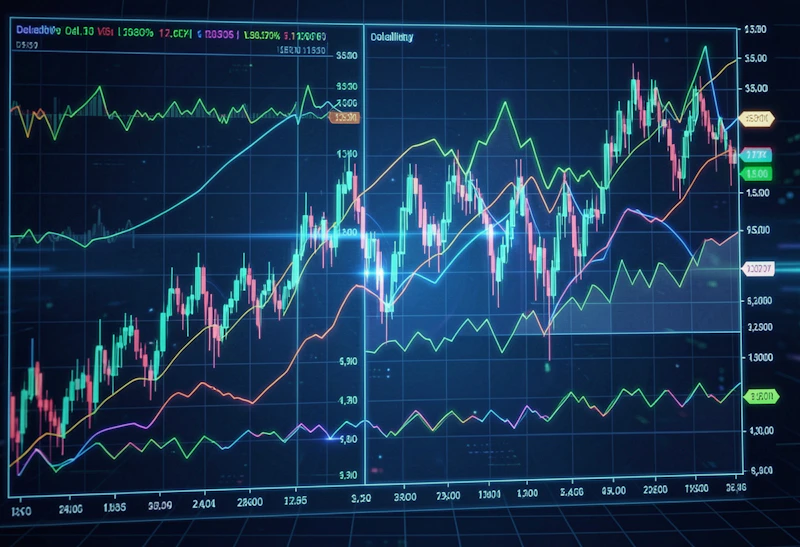
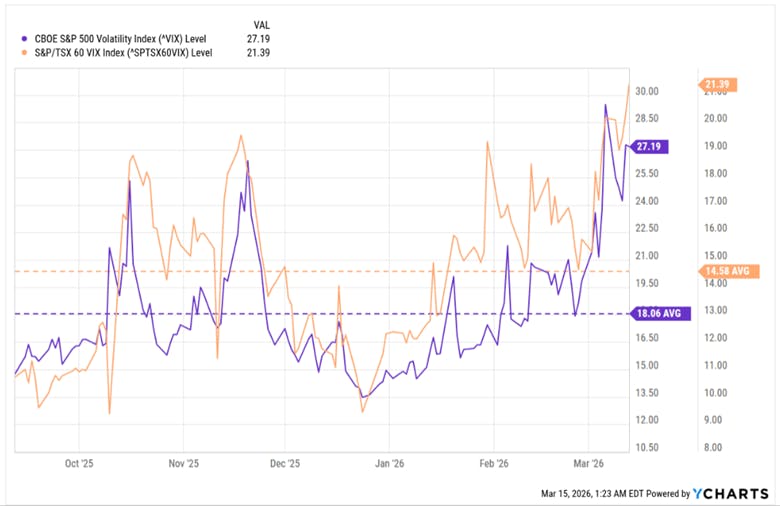
Market uncertainty has steadily grown throughout the year, starting in February 2026 with the SaaS-apocalypse, the unofficial name for the market downturn in software companies caused by the belief that AI agents will replace them. In early March 2026, uncertainty increased further, shifting from the technology arena to geopolitical concerns, when Israel and the United States launched surprise airstrikes on multiple sites and cities across Iran. Looking at the Cboe S&P 500 Volatility Index and S&P/TSX 60 VIX Index, leading measures of market expectations of near-term volatility for the S&P 500 Index and S&P/TSX 60 Index, respectively, both are above 20, indicating a period of higher volatility.
While periods of uncertainty may lead some investors to reflexively pivot towards cash and cash-like instruments for safety, there are alternative courses of action individuals can explore to mitigate or capitalize on market volatility, accessible through ETF solutions.
The Low Volatility Option
For investors looking for a defensive investment approach, low-volatility investing can be a simple option worth considering. These portfolios contain stocks that exhibit lower volatility than others, indicating that, on a risk-adjusted basis, they tend to deliver better performance and higher returns than other portfolios. Low volatility can be measured in two ways: first, using standard deviation, which assesses the volatility of individual stocks independently; and second, with beta, which measures a stock’s volatility and its correlation with the overall market. The market itself has a beta of 1.0, so stocks with a beta below 1.0 are considered less volatile than the market, while those with a beta above 1.0 are more volatile.
It is important to remember that low-volatility portfolios are not immune to market downturns; however, during market shocks, these portfolios typically perform better (meaning they experience smaller losses) than the broader market.
For Canadian investors, BMO offers low-volatility ETFs for both Canadian (Ticker: ZLB) and US (Ticker: ZLU/ZLU.U/ZLH) equities. Both solutions provide exposure to a low-beta, weighted portfolio of stocks in their respective markets using a rules-based approach.
Alternatively, the Franklin U.S. Low Volatility High Dividend Index ETF (Ticker: FLVU) is another option for investors seeking high dividends and low volatility. Tracking the Franklin Low Volatility High Dividend CAD Index NTR, FLVU selects stocks based on strong earnings and balanced risk management, aiming for stable returns and income.
Finally, the TD Q U.S. Low Volatility ETF (Ticker: TULV) seeks to optimize the portfolio by overweighting stocks expected to deliver less volatile returns and underweighting or excluding stocks expected to provide more volatile returns. The portfolio manager currently uses historical standard deviation as a tool for selecting stocks, looking at individual stocks and correlations between them to reduce volatility.
The Buffer Option
Buffer ETFs are funds designed to offer investors the potential gains of an asset’s returns, usually up to a set maximum, while also providing protection against losses up to a specified limit. In essence, investors accept limited upside in exchange for greater downside protection. These ETFs have a defined outcome period as part of their investment approach, typically lasting one year, which means the stated caps and buffers apply only to those who buy on the rebalance date and hold the ETF for the entire outcome period. Investors who buy after the rebalance date will experience different caps and buffers depending on the underlying index's performance from the rebalance date to their purchase date.
Investors generally recognize that losses can occur over a long investment horizon; however, buffer ETFs offer a different investment experience by employing a systematic risk-management approach. Through the use of options strategies, buffer ETFs provide a predetermined risk-reward framework. Investors are informed in advance about the expected range of the fund's returns. This clarity appeals to those seeking more precise control over their risk exposure and a better understanding of possible outcomes. Consequently, investors can enjoy a more stable investment experience and the reassurance that their potential losses are significantly limited.
For Canadian investors intrigued by buffer ETFs, both BMO and First Trust Canada offer dedicated buffer ETFs with a US equity focus.
The Capitalizing on Volatility Option
While some investors want to mitigate the impact of increased market volatility, other seeks to capitalize on it. Retail investors are gravitating toward volatility ETFs, many of which track the Cboe Volatility Index (VIX), one of the most well-known indices globally for assessing future market volatility. The value proposition of these volatility ETFs is simple: they reward unitholders when a sharp market downturn occurs, which usually coincides with a rapid rise in the VIX index. Market uncertainty stemming from events such as the recent strike on Iran and the ensuing geopolitical implications, benefit volatility ETF holders.
For investors interested in volatility ETFs, Global X’s BetaPro S&P 500 VIX Short-Term Futures™ ETF (Ticker: VOLX) tracks the performance of the S&P 500 VIX Short-Term Futures Index™, allowing investors to capitalize on evolving market changes. The ETF offers an opportunity for short-term speculation for investors who seek to profit from increases in the expected volatility of the S&P 500®.
It should be noted that this solution is designed for knowledgeable investors and is intended to capitalize on short-term market dislocations – not for long-term investing.
This article was written on March 15th, 2026. Please note this article is for information purposes only and does not in any way constitute investment advice. It is essential that you seek advice from a registered financial professional prior to making any investment decision.