One Year Later: These ETFs from Franklin Templeton Proved Calm Can Outperform Chaos
Twelve months, three ETFs, and one clear outcome—resilience when investors needed it most.

In March 2024, Franklin Templeton launched a suite of Low Volatility High Dividend ETFs aimed at helping investors deal with what was shaping up to be a highly unpredictable year. Twelve months later, with volatility still a defining feature of the market environment, these ETFs—Franklin Canadian Low Volatility High Dividend Index ETF (FLVC), Franklin U.S. Low Volatility High Dividend Index ETF (FLVU), and Franklin International Low Volatility High Dividend Index ETF (FLVI)— have made a compelling case as tools for income-seeking investors aiming to reduce risk while staying invested in equities—an approach supported by the performance insights and examples detailed in this article.
From trade tensions to inflation shocks, central bank pivots to concentrated market leadership, equity investors have had plenty to digest.
Through it all, this trio of ETFs has offered a simple but powerful proposition: use dividends, quality, and volatility screens to build equity portfolios that can keep investors grounded—even when markets are not.
“While you can’t derisk the markets, you can derisk your portfolio,” said Jeff Silverman, Head of Advisory Solutions at Franklin Templeton Investment Solutions. “These ETFs were designed for exactly this kind of moment—when investors are looking to lean into quality and income to create a more defensive posture in their portfolios.”
The Case for Low Vol, High Div in a Shaky World
The strategy behind the ETFs is straightforward but highly relevant in today's climate:
Focus on companies with sustainable dividends, lower price and earnings volatility, and quality fundamentals.
While the broader market has experienced wide swings—often driven by sentiment or macro noise—this rules-based approach has delivered steadier performance and more attractive valuations.
“These ETFs were put to the test almost immediately—and performed exactly as expected, offering resilience in the face of volatility,” added Alex Lee, Head of Canada ETF Product Strategy at Franklin Templeton. “In our view, this first year of performance validates the strategy.”
Each ETF in the suite takes a slightly different angle based on its regional focus, but all share the same goal: reduce downside risk, generate income, and stay invested.
FLVI: International Value in the Spotlight
Developed international equities, as tracked by the MSCI EAFE Index, beat the S&P 500 in Q1—rekindling investor interest in markets beyond North America.
With a forward P/E under 10 and a yield north of 6%, FLVI is gaining traction as a go-to option for investors looking to capitalize on the trend toward value and income opportunities abroad. Since launch, it has outperformed the MSCI EAFE IMI Index by over 1,100 basis points in CAD terms—delivering not just more yield, but stronger total returns.
Its approach integrates country-specific dividend tax considerations and limits concentration by country, sector, and individual stocks—offering a more balanced and tax-aware take on international income investing.
FLVU: Defense That Doesn’t Sit on the Sidelines
U.S. equity markets have been a rollercoaster over the past year, with leadership concentrated in a handful of mega-cap tech names—and those names under scrutiny. Franklin U.S. Low Volatility High Dividend Index ETF (FLVU) offered a compelling counterweight.
FLVU’s portfolio leans toward mid- and small-cap stocks, with no exposure to growth names and a deliberate tilt toward value and dividend-paying sectors.
That made a big difference during key drawdowns. For instance, during the rotation out of the “Magnificent 7” between February 18th and the end of March 2025, FLVU was up 5.02%, while major U.S. indices declined.
In addition to yielding 2.4 percentage points more than the Russell 3000 Index, FLVU trades at a cheaper valuation than its benchmark and has delivered more consistent returns in rough patches—making it a strong complement to growth-heavy U.S. strategies.
“FLVU offers diversified exposure to U.S. equities while avoiding the concentration risks that have come to define the market,” Silverman explained. “It leans into value and quality—traits that are increasingly important in today’s environment.”
FLVC: A Core Canadian Anchor
The relative outperformance of the S&P 500 Index compared to the S&P/TSX Composite Index since 2011 is noteworthy. Given current valuations and evolving market expectations, some investors may see the potential for a reversion trade—renewing interest in Canadian equities.
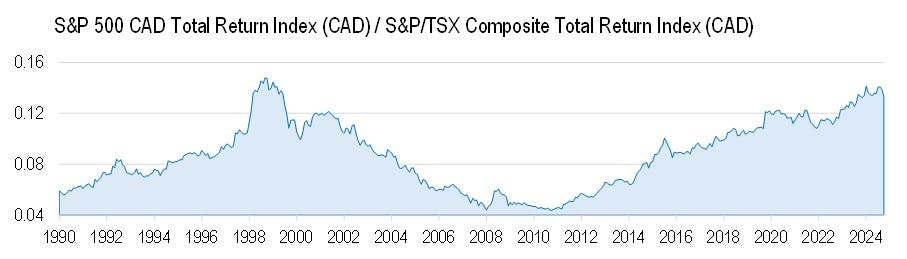
Source: Bloomberg L.P. as of March 31, 2025. Ratio of the S&P 500 Total Return Index / S&P/TSX Composite Total Return Index. All returns in CAD. Indexes are unmanaged, and one cannot invest directly in an index. They do not reflect any fees, expenses or sales charges.
In this context, the Franklin Canadian Low Volatility High Dividend Index ETF (FLVC) may serve as a core allocation for those seeking to reduce portfolio risk while maintaining exposure to quality, income-oriented Canadian stocks.
With a 15-bps management fee, FLVC is priced competitively, but its real strength lies in its construction: focusing on high free cash flow, strong ROE, and sustainable dividend payouts, all while keeping volatility in check.
Over the past year, FLVC outperformed the S&P/TSX Composite Index by nearly 300 basis points, offering not just higher yield but also better quality exposure.
At a time when investors are increasingly cautious about domestic economic growth and trade frictions, FLVC has provided a defensive, value-tilted solution—without giving up on equity exposure.
What a Year of Stress-Testing Has Taught Us
The past twelve months have underscored something most seasoned investors already know: it’s not about timing the market—it’s about staying in it, with the right tools. And when markets get choppy, rules-based approaches that emphasize diversification, income, and quality can offer both peace of mind and performance.
“These ETFs are built to pursue positive expected returns across the full economic cycle—while seeking to reduce drawdowns and accelerate any future recovery,” said Silverman. “That’s what makes them well positioned for various market conditions.”
What Lies Ahead
As these ETFs enter their second year, they face a new chapter shaped by shifting rate expectations, rising trade tensions, and Canada’s upcoming federal election.
After delivering on their promise of stability and income in their first year, all eyes are now on how they continue to perform in a market that’s anything but predictable.
This material is intended to be of general interest only and should not be construed as individual investment advice or a recommendation or solicitation to buy, sell or hold any security or to adopt any investment strategy. It does not constitute legal or tax advice. The views expressed are those of the investment manager and the comments, opinions and analyses are rendered as at publication date and may change without notice. The information provided in this material is not intended as a complete analysis of every material fact regarding any country, region or market.
All investments involve risks, including the possible loss of principal. Investments in foreign securities involve special risks including currency fluctuations, economic instability and political developments. Investments in emerging markets, of which frontier markets are a subset, involve heightened risks related to the same factors, in addition to those associated with these markets’ smaller size, lesser liquidity and lack of established legal, political, business and social frameworks to support securities markets. Because these frameworks are typically even less developed in frontier markets, as well as various factors including the increased potential for extreme price volatility, illiquidity, trade barriers and exchange controls, the risks associated with emerging markets are magnified in frontier markets. Stock prices fluctuate, sometimes rapidly and dramatically, due to factors affecting individual companies, particular industries or sectors, or general market conditions.
Any statement that necessarily depends on future events may be a forward-looking statement. Forward-looking statements are not guarantees of performance. They involve risks, uncertainties and assumptions. Although such statements are based on assumptions that are believed to be reasonable, there can be no assurance that actual results will not differ materially from expectations. Investors are cautioned not to rely unduly on any forward-looking statements. In connection with any forward-looking statements, investors should carefully consider the areas of risk described in the most recent simplified prospectus.
Commissions, trailing commissions, management fees, brokerage fees and expenses may be associated with investments in mutual funds and ETFs. Please read the prospectus and fund fact/ETF facts document before investing. Mutual funds and ETFs are not guaranteed. Their values change frequently. Past performance may not be repeated.
Franklin Templeton Canada is a business name used by Franklin Templeton Investments Corp.