A Quality-Driven Approach to Dividends
FDIV redefines dividend investing by focusing on quality and competitive advantages, not just yield, in volatile markets.

In today’s market, dividend investing is facing a quiet identity shift. Yields may still attract attention, but investors are increasingly asking a more important question: how consistent is that income?
That’s the thinking behind the Franklin U.S. Quality Moat Dividend ETF (FDIV), a strategy designed not just to deliver dividends, but to focus on the strength and durability behind them. In an environment shaped by volatility, geopolitical tension, and shifting macro trends, FDIV leans into a simple but time-tested idea: companies with durable competitive advantages have historically been associated with more resilient business outcomes.
Or, more simply, moats matter.
What Makes a “Moat” and Why It Matters for Investors
The concept of an economic moat, popularized by Warren Buffett, refers to a company’s ability to maintain a competitive edge over time. Just as a moat protects a castle, strong businesses protect their market position through structural advantages - whether that’s brand strength, pricing power, network effects, or high barriers to entry.
These characteristics are more than just theoretical. Companies with strong moats tend to exhibit consistent profitability, stable cash flows, and the ability to reinvest and grow, even in uncertain environments. For dividend investors, that foundation is critical. Consistent income doesn’t come from high yields alone, but from businesses that can continue generating earnings through different market cycles.
Beyond Yield: A More Intentional Dividend Strategy
Traditional dividend ETFs are often grouped into three broad categories: high yield, consistent payers, or dividend growers. While each approach has its merits, they can also expose investors to trade-offs - particularly the risk of “yield traps,” where high payouts are supported by weakening fundamentals.
FDIV takes a more deliberate path. Rather than starting with yield, the strategy begins by identifying companies with strong competitive advantages and financial strength. From there, it incorporates profitability and growth characteristics before factoring in dividend consistency.
The result is a more balanced approach that integrates quality, growth, and income into a single framework. Instead of maximizing yield, FDIV aims to build a portfolio of companies capable of sustaining and growing dividends over time.
Staying Invested in the U.S. With Greater Confidence
Market uncertainty has led many investors to question their exposure to U.S. equities. But stepping away entirely isn’t always the answer. A more effective approach may be to refine how that exposure is built.
FDIV addresses this by focusing on companies that are structurally positioned to endure. Businesses with strong competitive advantages are often better equipped to navigate economic slowdowns, competitive disruption, and shifting market conditions. They tend to be embedded in everyday economic activity whether through consumer staples, infrastructure, or critical services, making their earnings streams more resilient.
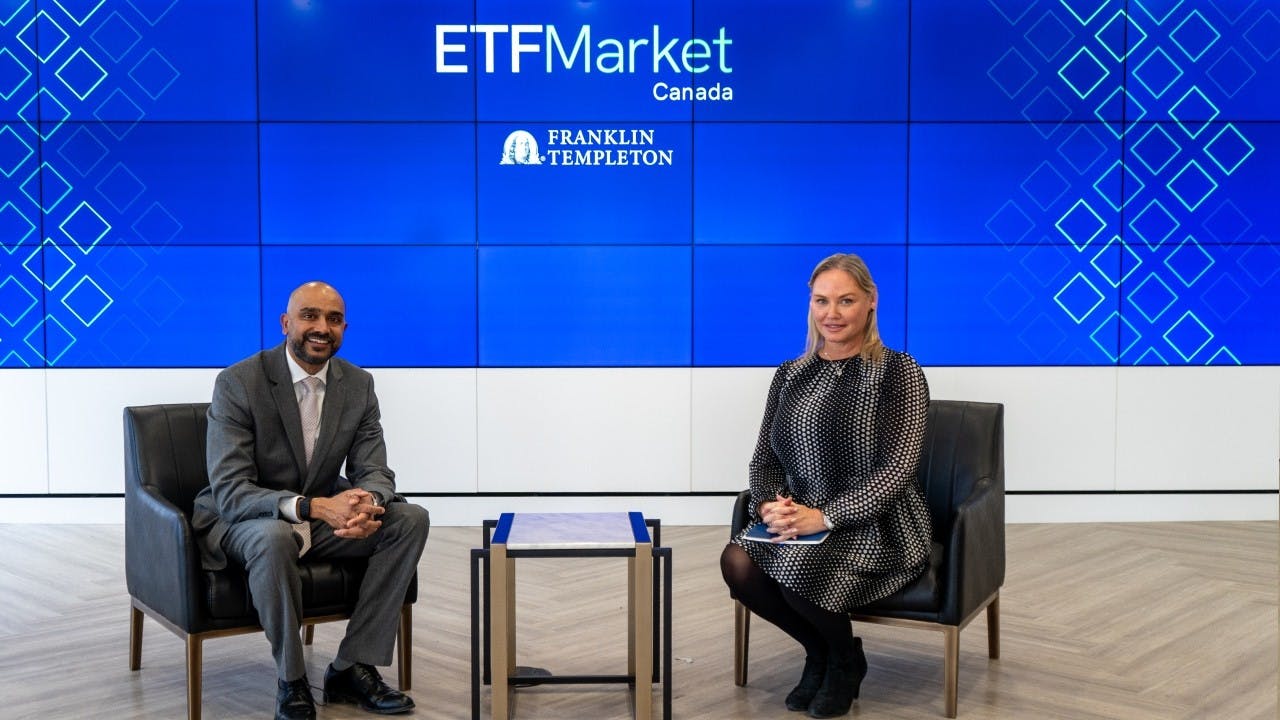
As Ahmed Farooq, SVP and Head of ETF Distribution at Franklin Templeton Canada explains in the Issuer Insights video recorded earlier this year:
“We don’t want you to chase a very high yield if your performance is going down… we want to make sure companies can grow over time.”
This philosophy reflects a broader shift in dividend investing, from focusing on what a company pays today to understanding what it can sustain tomorrow.
Where FDIV Fits in a Portfolio
FDIV is designed to be flexible within a portfolio. For some investors, it may serve as a core U.S. equity allocation, particularly for those seeking a more quality-driven approach aligned with long-term investing principles. For others, it can complement broader market exposure by adding a tilt toward companies with durable earnings and dividend profiles.
Ultimately, the ETF is less about chasing income and more about reinforcing it. By emphasizing competitive advantages, financial strength, and disciplined selection, FDIV offers a way to stay invested in U.S. equities while focusing on what underpins long-term returns.
Important Legal Information
This material is intended to be of general interest only and should not be construed as individual investment advice or a recommendation or solicitation to buy, sell, or hold any security or to adopt any investment strategy. It does not constitute legal or tax advice. The views expressed are those of the investment manager, and the comments, opinions, and analyses are rendered as at publication date and may change without notice. The information provided in this material is not intended as a complete analysis of every material fact regarding any country, region, or market.
Commissions, trailing commissions, management fees, brokerage fees, and expenses may be associated with investments in mutual funds and ETFs. Please read the prospectus and fund fact/ETF facts document before investing. Mutual funds and ETFs are not guaranteed. Their values change frequently. Past performance may not be repeated.
Franklin Templeton Canada is a business name used by Franklin Templeton Investments Corp.