RCEI vs. ZDV: Which Canadian Dividend ETF Has the Edge?
RBC's actively managed RCEI and BMO's rules-based ZDV offer two approaches to Canadian dividend investing. Here's how they compare on fees, performance, risk and holdings.

Dividend stocks have long been a favourite among income investors. The appeal is simple: companies that generate consistent cash flows can return part of their profits to shareholders, providing a potential source of income alongside capital appreciation.
For Canadian investors, there's no shortage of dividend-focused ETFs to choose from.
But funds pursuing similar income objectives can deliver very different investment experiences.
Should investors favour an actively managed strategy or a rules-based approach? And does paying more for active management necessarily translate into better results?
Using Cboe Canada's ETF Screener and comparison tools, investors can explore the options and see how different strategies stack up.
RCEI vs. ZDV: Two Approaches to Canadian Dividend Investing
In this week’s comparison, we’re looking into the RBC Canadian Equity Income Fund (RCEI) and the BMO Canadian Dividend ETF (ZDV).
Both target Canadian dividend-paying companies, but their investment strategies differ.
RCEI is the ETF series of an existing actively managed mutual fund, with investment decisions guided by a portfolio management team.
ZDV, meanwhile, follows a rules-based strategy that considers dividend growth, yield, payout levels and liquidity when selecting stocks.
One relies on portfolio managers to make investment decisions, while the other follows a defined selection process.
So which approach has delivered better results?
RCEI vs. ZDV: Fees, Performance and Fund Flows
The first difference becomes clear when comparing the funds' size and costs.
ZDV has a larger asset base and charges considerably lower fees than RCEI.
For long-term investors, fees are particularly relevant because they reduce the returns investors ultimately keep.
But lower costs are only part of the picture.
According to the comparison data presented through Cboe Canada's ETF Market tools, ZDV has also delivered strong returns across shorter and longer investment horizons.
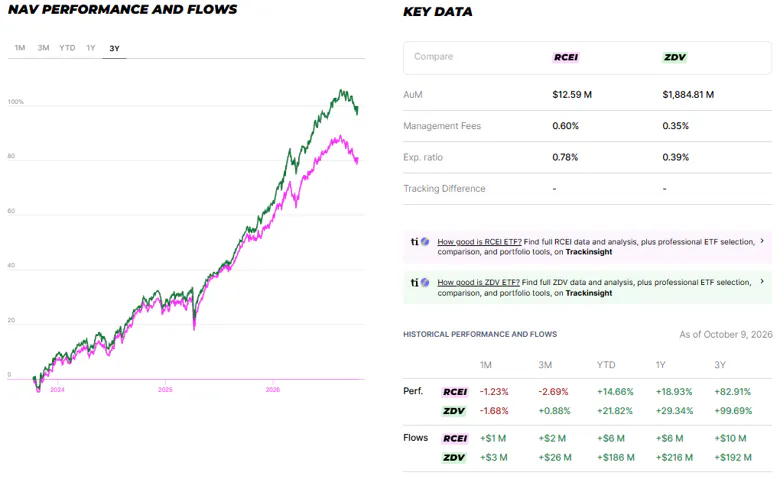
ZDV has also attracted consistent inflows, reflecting continued investor interest in its dividend-focused strategy.
ZDV's combination of lower fees and competitive historical performance gives it an advantage across the measures examined.
However, as with any investment, past performance and fund flows are no guarantee of future results.
Risk-Adjusted Returns: Has ZDV Delivered More for Less Risk?
Two ETFs can generate similar returns while exposing investors to different levels of volatility.
Risk-adjusted performance provides another way to assess how effectively a fund has rewarded investors for the risks taken.
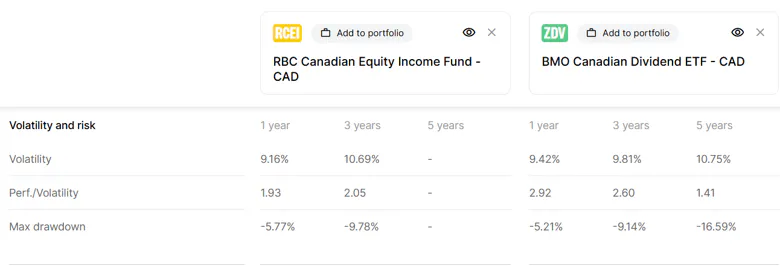
Across the one-year and three-year periods examined, ZDV demonstrated a lower risk profile than RCEI while delivering stronger risk-adjusted results.
Its historical performance therefore compares favourably not only in terms of returns, but also in relation to the volatility experienced by investors.
For income-focused investors seeking a balance between returns and risk, these measures are an important part of the comparison.
RCEI vs. ZDV: Similar Holdings, Different Concentration
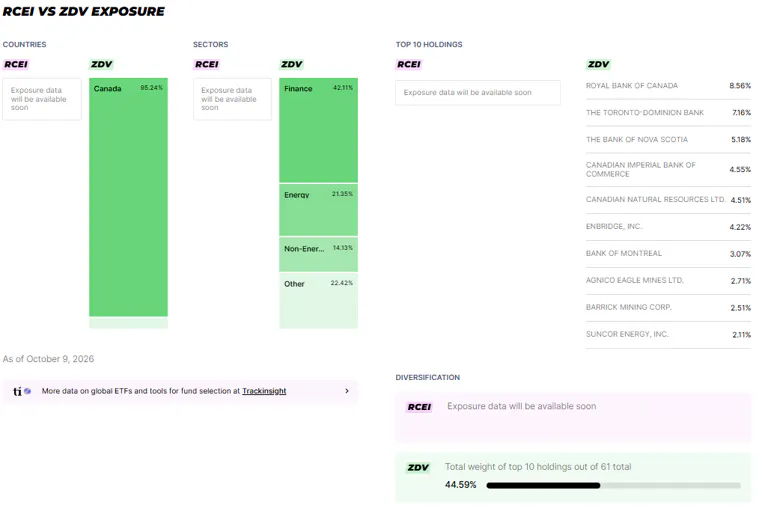
Both ETFs invest heavily in Canada's established dividend-paying companies, particularly in the Financials and Energy sectors.
However, their portfolios differ in size and concentration.
ZDV holds 61 stocks, with its 10 largest positions representing 44.6% of assets, as of October 14, 2026. Royal Bank of Canada (8.45%) and Toronto-Dominion Bank (7.10%) lead the portfolio, followed by Bank of Nova Scotia (4.99%), Canadian Natural Resources (4.80%) and Canadian Imperial Bank of Commerce (4.33%).
Financials account for the largest sector exposure, with five major Canadian banks representing approximately 27.9% of the fund.
Energy is the second-largest sector allocation, with Canadian Natural Resources, Enbridge (4.04%) and Suncor Energy (2.50%) among its leading holdings. Agnico Eagle Mines (2.82%) and Barrick Mining (2.57%) provide additional exposure to Materials.
RCEI holds approximately 100 stocks, with its top 10 accounting for 37% of assets, as of August 31, 2026.
Royal Bank of Canada (7.8%) and Toronto-Dominion Bank (6.3%) are also its largest positions, followed by Enbridge (3.6%), Brookfield Corporation (3.2%) and Bank of Montreal (3.2%).
Other major holdings include Canadian Natural Resources (3.1%), Canadian Imperial Bank of Commerce (2.8%) and Suncor Energy (2.5%).
While nine companies feature in both funds' top 10 holdings, ZDV allocates a greater share of its assets to its largest positions.
RCEI offers broader diversification by number of holdings and a lower concentration among its top 10, although this does not necessarily translate into lower overall portfolio risk.
The Verdict: Does ZDV Have the Advantage?
Based on the performance, risk and cost measures examined, ZDV has demonstrated a stronger overall profile than RCEI.
Its lower fees, larger asset base, solid fund flows and stronger risk-adjusted performance provide several arguments in its favour.
The holdings comparison adds another consideration.
ZDV maintains a more concentrated portfolio, placing greater weight on a smaller group of established Canadian dividend payers.
RCEI, meanwhile, holds more companies and allocates a smaller proportion of assets to its 10 largest positions.
A more concentrated portfolio can benefit when its largest holdings perform well, but it can also be more exposed when those companies struggle.
For Canadian income investors, both funds deserve consideration. The choice ultimately depends on investment objectives, costs, risk tolerance and the preference for active management versus a rules-based strategy.
This article was written on October 10, 2026, with holdings data updated through October 14, 2026. It is intended for informational purposes only and does not constitute investment advice. Investors should consult a registered financial professional before making investment decisions.