Small-Cap ETFs: Options for Canadian Investors
Tilting your portfolio towards small-cap stocks could potentially increase returns, albeit at the cost of higher risk.


The majority of Canadian index, sector, or even thematic ETFs are market-capitalization weighted. That is, large cap stocks are assigned a proportionately higher weight, followed by mid-caps, and then small caps. For example, the popular iShares Core S&P/SSX Capped Composite Index ETF (XIC) covers the investable Canadian market but is still comprised of mostly large-cap stocks at around 85% of the ETF.
For most investors, a market-capitalization weighted approach is sensible. With this strategy, you match the market's return by mimicking its composition at a given point in time. However, investors can choose to overweight, or "tilt" their portfolios to certain types of stocks. These can include sector tilts (e.g., energy, financial, utilities), thematic tilts (genomics, blockchain, technology), and style tilts (e.g., growth, value).
A popular type of tilt is towards small-cap stocks. Under this approach, investors choose to overweight the allocation of small-cap stocks in their portfolios relative to their market-cap weights. For example, an index might be 15% small-caps, but an investor might choose a 25% weighting for small-caps. In this case, the investor has tilted towards small caps. This approach has historically provided higher returns, but at the cost of greater risk. Let's dive into it.
What is a Small-Cap Tilt?
There are many definitions of what exactly a small-cap stock entails, but in general, it refers to a company with a market capitalization of $300 million to $2 billion. Different fund managers and index providers will have their own criteria for this, so it's important to read the fine print in the prospectus before investing, as some purportedly small-cap funds actually track mid-caps!
The thing to understand here is that historically, investing in small-caps has outperformed the market on a trailing and rolling basis. The theory behind this is rooted in the work of Eugene Fama and Kenneth French, who identified a set of three (later expanded to five) risk factors that could help explain, in most cases, stock returns above the benchmark (known as “alpha”).
The risk factors currently include market, size, value, profitability, and investment. You may recognize some of these factors from the description of some "smart beta" ETFs out there, which are simply funds that attempt to target one or more of these risk factors. The size risk factor is defined as the returns of small-cap stocks minus the returns of large-cap stocks (Small minus Big, or SmB).
How Has the Small-Cap Tilt Performed?
Below I've plotted a backtest of U.S. small-cap stock versus the S&P 500 from 1977 to present with all dividends reinvested. Keep in mind that this backtest is hypothetical in nature, does not reflect actual investment results and is not a guarantee of future results. The hypothetical returns do not reflect trading costs, transaction fees, commissions, or actual taxes due on investment returns.
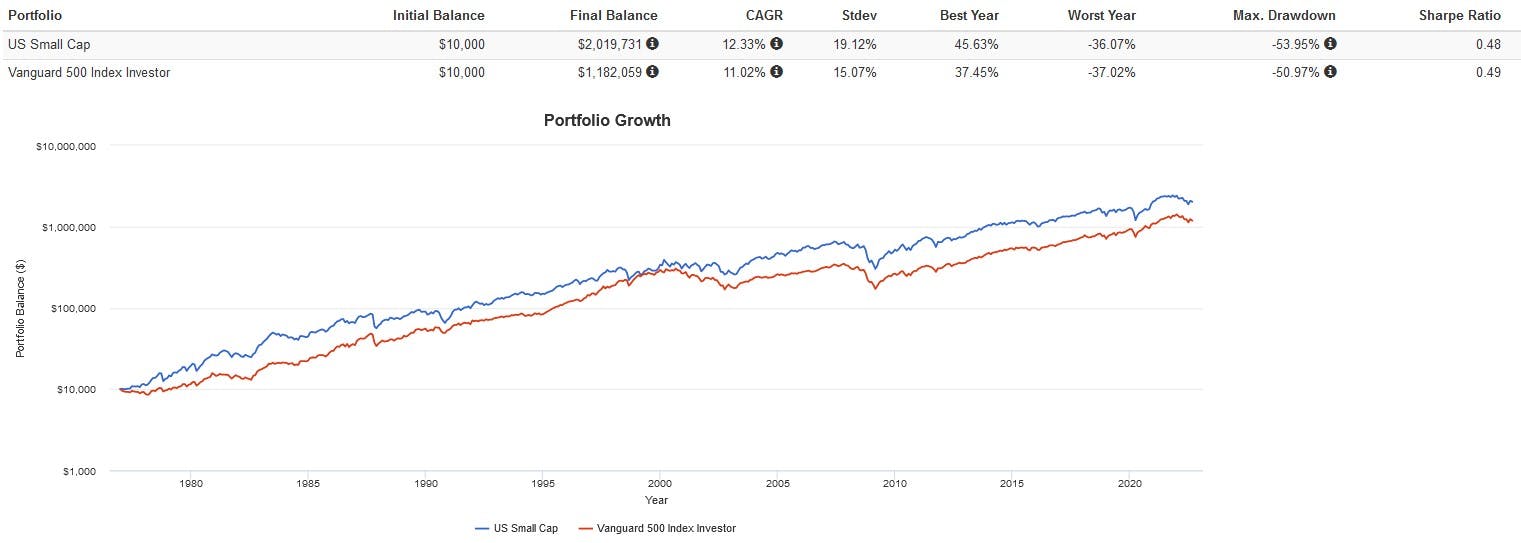
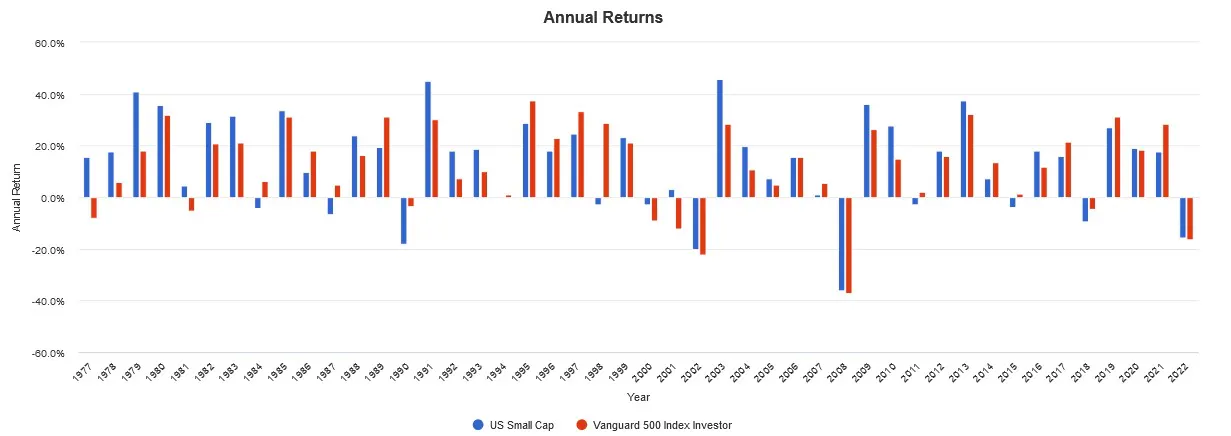


We can observe two things:
- Small-cap stocks outperformed on both a trailing and rolling basis, but only over the long term (10+ years) and not on a risk-adjusted basis (as evidenced by the similar Sharpe ratio). This suggests that small-cap investors did better because they took on proportionately more risk. This might be distasteful for the average investor who cannot tolerate high volatility.
- There have been extended periods of time where small-caps underperformed large-caps like in the years preceding the 2000 Dot-Com Bubble and in the post 2018 low interest rate environment. In this case, the small-cap premium returned negative, meaning that large-caps had more returns. This is to be expected. Even the market risk premium has returned negative at times, with risk-free T-Bills beating stocks. A small-cap tilt requires a long-time horizon and conviction to pay off.
Investing in Small-Cap ETFs
The following Canadian ETFs track small-cap stocks from different geographies and could be good additions to a portfolio. However, this is dependent on your risk tolerance, time horizon, and investment objectives. Small-cap tilts are best suited for long-term investors who can withstand higher than average risk in exchange for a chance at greater returns. For most investors, the tracking error and bouts of underperformance can make a small-cap tilt difficult to stick to.
As with selecting any ETF, ensure you pay attention to the fund's expense ratio, assets under management (AUM), underlying index/holdings, and distribution yield. Clicking on each of these ETFs will take you to the NEO ETF Screener which shows these important details.
Please note this article is for information purposes only and does not constitute investment advice.