Tariffs On, Tariffs Off: ETFs for the U.S.-Canada Trade War
Trade tensions rise, but opportunity knocks—Here are two 2 ETFs poised to potentially benefit from the US-Canada tariff showdown.


The adage, ‘Nobody wins when the family feuds’ is meant to convey the senselessness of conflict between families or the closest of friends. But even among family, sometimes a provocation is a setup for meaningful conversation. This was seemingly the case over the past few days, as President Trump initially issued an executive order imposing a 25% tariff on imports from Canada and Mexico. These tariffs were then put on hold for at least a month when the respective leaders of Canada and Mexico discussed the matter with President Trump.
In the same executive order, President Trump also instituted a 10% tariff on Chinese goods. In response, China has imposed a 15% tariff on U.S. coal and liquefied natural gas (LNG), a slew of new export restrictions, and an antitrust investigation into Google, as reported by the Washington Post.
U.S.-Canada Trade Relationship
Canada and the U.S. have historically had a strong trading partnership, with an estimated $3.6 billion (US$2.7 billion) worth of goods and services crossing the border each day in 2023, as reported by Statistic Canada. The scale of this relationship is best illustrated when looking at the top import partner of each U.S. state. As illustrated by Visual Capitalist, using data as of November 2024 from the U.S. Census Bureau, Canada is the top importer for 23 states.
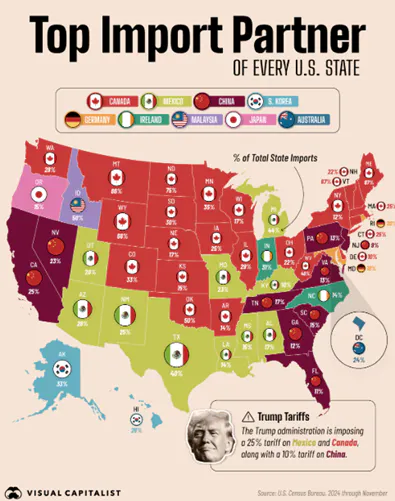
Check out the infographic on Visual Capitalist.
To further quantify the depth of the economic relationship, as stated by the Canadian Chamber of Commerce, 1.4 million American jobs are tied to Canadian exports, 2.3 million Canadian jobs are tied to U.S. exports, and 50% of bilateral goods trade between related companies, underscoring the depth of integration between our economies.
Areas of Opportunity amidst Uncertainty
Tariffs inject a high measure of uncertainty into the Canadian and U.S. economies. And while the recently announced tariffs have been paused, they could be instituted again. In assessing the impact of these tariffs on both economies, the Bank of Canada rightly projected a lowering of GDP for both nations and an increase in inflation should tariffs remain in place for a prolonged period.
This trade tension has brought to the forefront the need for Canada to leverage its competitive strength. Canada has extensive natural resources that the U.S. needs, as there are no immediate substitutes – hence the 10% tariff placed on energy. As mentioned in a previous article, the energy sector is an area of competitive strength for Canada. Mining, oil, and gas are critical resources the U.S. – and the rest of the world – needs, which Canada can supply.
Regarding mining, Canada has deep access to critical minerals that are utilized in much of today’s technology. With energy security and electrification being prominent themes of our modern economy, the supply and demand pressure for the raw materials necessary to create and maintain clean-energy technologies, semiconductors, and other innovations depend on critical minerals.
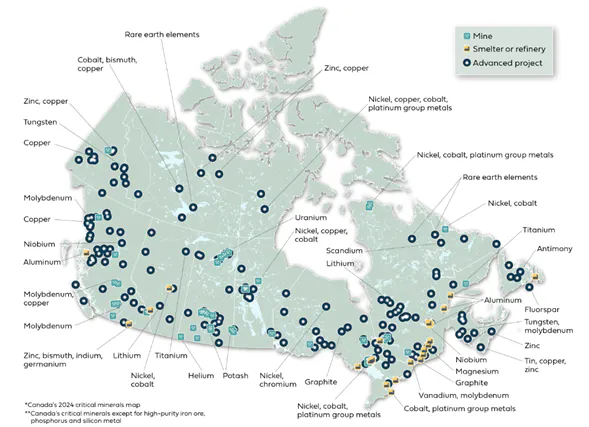
The iShares S&P/TSX Global Base Metals Index (Ticker: XBM) tracks the performance of global base metals producers, offering exposure to companies involved in the extraction of metals like copper, nickel, and zinc. These metals are vital for various industries, including electronics and renewable energy. As of January 2025, Canada’s geographic exposure within the fund is approximately 44%.
Additionally, the iShares S&P/TSX Energy Transition Materials Index ETF (Ticker: XETM) is designed to measure the performance of the equity securities of Canadian and global companies engaged in the production or exploration of materials used to enable the global energy transition. As of January 2025, Canada’s geographic exposure within the fund is approximately 59%.
Takeaway
As the global economy seemingly shifts towards a more precarious state, given the economic actions of the U.S., nations will be implementing policy actions that serve their own interests. Against this backdrop, maintaining exposure to industries that are competitive strengths and economically important is a sounds course of action. Furthermore, gaining access to safe haven assets, such as gold, would be a rationale course of action.
Please note this article is for information purposes only and does not in any way constitute investment advice. It is essential that you seek advice from a registered financial professional prior to making any investment decision.