Tech Under Pressure: What the HALO Trade Means for Investors
Rising AI capital expenditures and disruption fears are driving a rotation from technology into HALO sectors—energy, materials, industrials, and consumer staples.

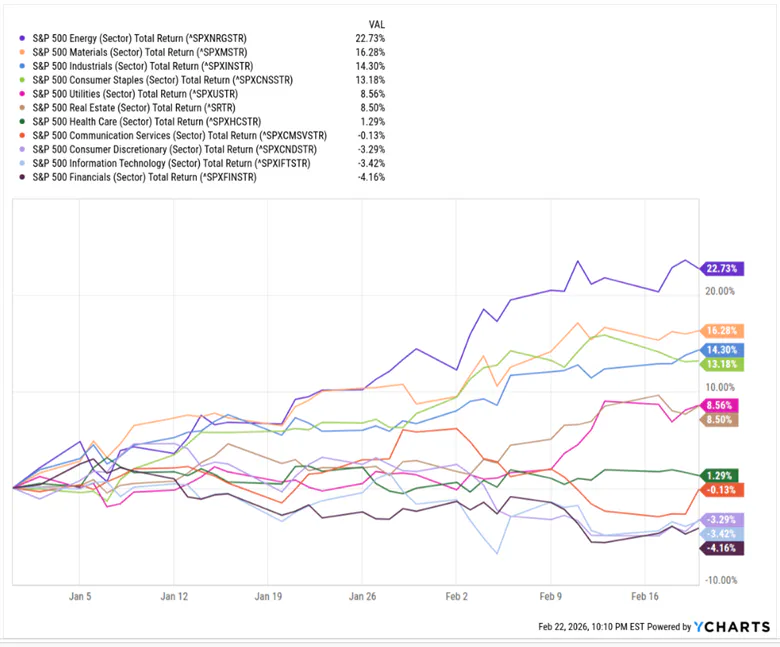
Depending on where your popular culture interests lie, the word HALO could refer to a popular video game, a Beyoncé song, or a symbolic ring of light. However, within an investment context, HALO currently refers to Hard/Heavy Assets, Low Obsolescence, an acronym meant to convey aspects of the economy that would least likely face disruption from artificial intelligence. Year to date (as of February 22nd, 2026), the performance of Energy, Materials, Industrials, and Consumer Staples has led the S&P 500 Index, while that of Information Technology and Financials has underperformed.
Disruption is expensive and far-reaching
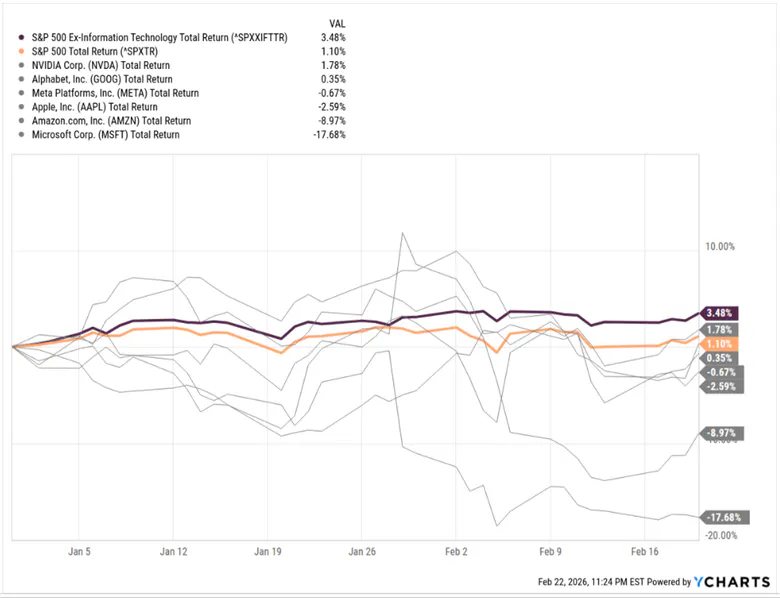
The race for advancement is an expensive endeavour, as the four major hyperscalers (i.e., Alphabet, Microsoft, Meta, and Amazon) have once again raised their capital expenditure for the year, expecting to spend almost $700 billion combined to fuel their AI build-outs. As these firms continue to develop their AI capabilities and future ecosystem, they come with lower margins and less cash generation in the present – a scenario that some investors are increasingly wary of. Furthermore, a few of these firms have begun issuing bonds to finance their AI projects.
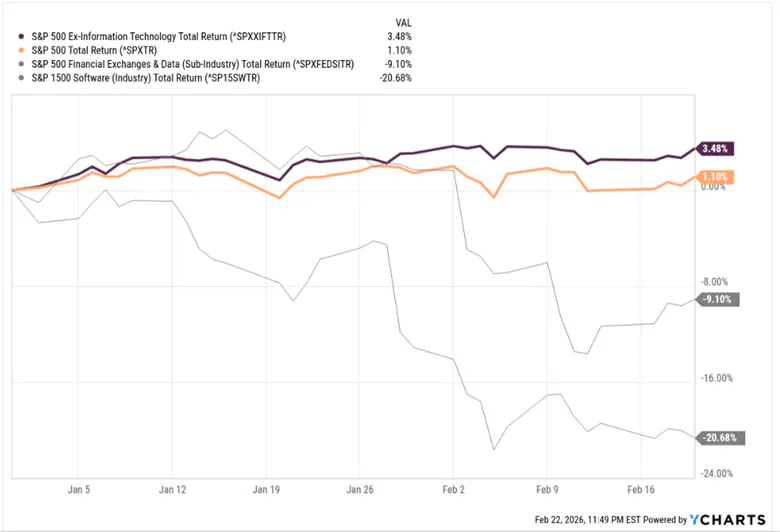
While the cost of AI is a top-of-mind concern, its far-reaching disruption is another rising consideration, as the recent downturn in Software as a Service (SaaS) stocks and financial data equities has stoked the idea that these sectors are prime for AI disruption. In turn, giving further credence to the HALO trade.
Eschew Sentiment, Accept Pragmatism
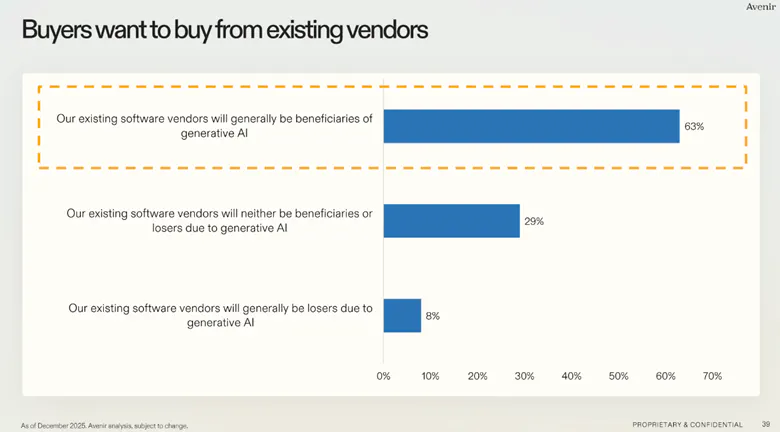
While the general public’s sentiment towards AI can be broadly categorized as uncertain, the notion that the technology will ‘wipe out’ entire industries is hyperbolic. Any industry on the verge of disruption will seek to defend its position, and that can take many forms, such as ongoing internal innovation, client entrenchment, or corporate actions (e.g., acquisitions or mergers). As captured in a recent deck assessing the potential implications of AI-native firms on SaaS companies, published by venture capital firm Avenir, prominent SaaS companies (e.g., Salesforce) are developing AI capabilities (i.e., Salesforce Agentforce) within their product offerings. Furthermore, given how deeply integrated many of these SaaS firms are into their clients' tech stacks, the desire to switch to a new vendor or build out their own capabilities from scratch – unless truly imperative – is possibly low. As such, the sell-off in the software sector is more reactionary than rational.
Investing and AI Hysteria
The current narrative around AI has generated excitement but also increased doubt about what is to come. Investing in this context requires individuals to be both prudent in their approach to asset allocation and in their sectoral/thematic exposures within their portfolios.
For investors interested in gaining exposure to sectors benefiting from the HALO trade (i.e. rotating away from tech), BMO’s Sector ETFs are turnkey solutions that provide exposure to the U.S. Energy (Tickers: ZXLE/ZXLE.F), Materials (Tickers: ZXLB/ZXLB.F), Industrials (Tickers: ZXLI/ZXLI.F), and Consumer Staples (Tickers: ZXLP/ZXLP.F) sectors.
Given the material drawdown in SaaS equities, if one believes the market’s response to these firms is an overreaction, ETF solutions such as the Evolve Cloud Computing Index Fund (Ticker: DATA/DATA.B) invest in domestic and international companies involved in cloud computing and SaaS. The fund seeks to replicate the performance of the Solactive Global Cloud Computing Index.
This article was written on February 22nd, 2026. Please note this article is for information purposes only and does not in any way constitute investment advice. It is essential that you seek advice from a registered financial professional prior to making any investment decision.