The Case for Equal Weight ETFs Amid Market Concentration
A disciplined, rules-based alternative to cap-weighted concentration risk, explained through two Canadian ETF options.


Market concentration has been a prevailing theme in recent years, given the outsized influence of Big Tech and AI-linked firms in the U.S. equity landscape. While the fervour around these firms and their technological advancements has propelled markets, any weakness they exhibit – whether real or perceived – has adversely affected investor sentiment and weighed on markets. In July 2026, investor concern around the sustainability of hyperscaler spending on the AI buildout was a source of market uncertainty.
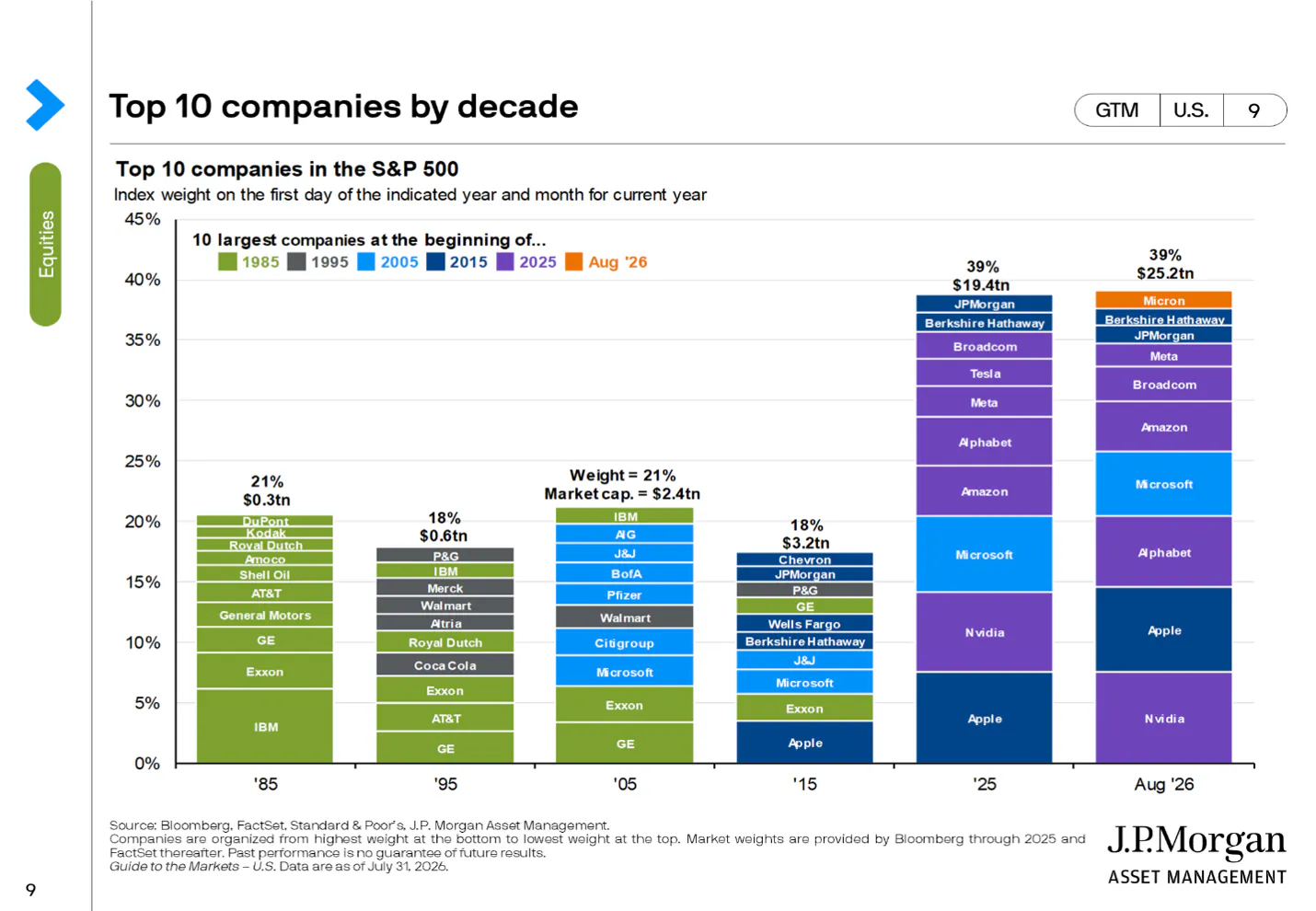
While market concentration is not a new phenomenon, the degree to which it is occurring in the U.S. equity asset class is higher than in the past; this is illustrated in the following chart showing the top 10 companies within the S&P 500 Index over the decades. While some investors have opted for strategies such as HALO (Heavy Assets and Low Obsolescence) to avoid the market’s overexposure to the AI ecosystem, there is a simpler approach that allows investors to maintain a constrained exposure to AI equities.
Equal Weight Investing Explained
Though equal-weight investing is not a new concept, it has attracted greater interest in recent years, given the AI-driven investment environment. As the name suggests, equal-weight investing assigns equal weight to each constituent. A quarterly rebalance then maintains this balance by preventing positions from drifting too far from their intended allocation. The benefits derived from this investing approach are simple but impactful:
- Reduced concentration risk: Equal allocation prevents a small group of stocks from dictating overall performance, helping investors avoid the vulnerabilities created by narrow leadership.
- Increased diversification: Broadening exposure more evenly across sectors, countries, and company sizes allows the portfolio to capture a wider exposure to the long-term growth in equity markets.
- Disciplined process: The rebalance process effectively locks in gains from names that may have run ahead and reallocates any gains to the laggards of the past quarter. This systematic “sell high, buy low” dynamic can help investors maintain valuation discipline through different market cycles.
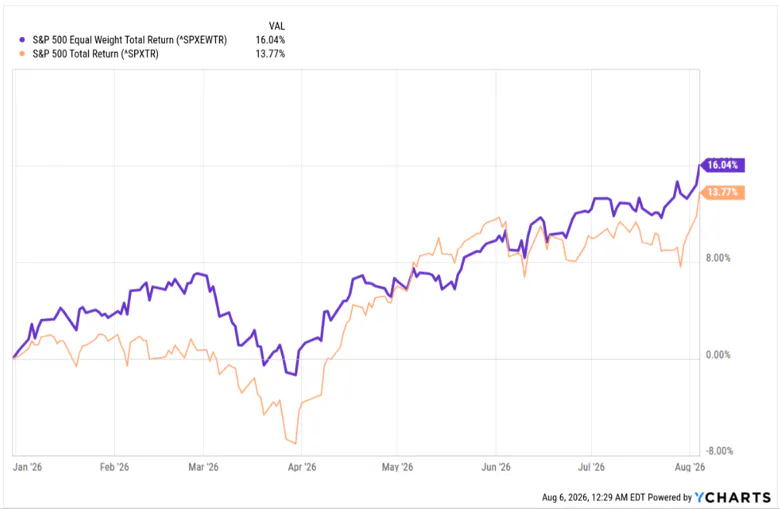
Simply put, equal-weight investing allows investors to achieve broad exposure across the market-capitalization spectrum, enabling participation in companies with distinct growth profiles. Year to date, the S&P 500 Equal Weight Total Return Index has outperformed the S&P 500 Total Return Index, particularly during periods of market downturns.
Equal Weight Investing via ETFs
For Canadian investors interested in equal weight investing ETF solutions with a U.S. equity focus, the CI Invesco S&P 500 Equal Weight Index ETF (Ticker: EQL/EQL.F/EQL.U) and BMO MSCI USA Equal Weight Index ETF (Ticker: ZEQL/ZEQL.U/ZEQL.F) are solutions worthy of consideration.
EQL invests primarily in equity securities of companies listed in the U.S. and currently holds securities of the Invesco S&P 500® Equal Weight ETF (NYSE Arca ticker: RSP) to replicate the S&P 500® Equal Weight Index, which has the same constituents as the capitalization-weighted S&P 500®; however, each company represented in the index is allocated a fixed weight of 0.20% at each quarterly rebalancing of the index.
ZEQL replicates the performance of the MSCI USA Equal Weighted Index, which includes the same constituents as its parent index, the MSCI USA Index. The Index rebalances quarterly, and at each quarterly rebalance date all Index constituents are weighted equally, effectively removing the influence of each constituent’s current price (high or low). Between rebalances, Index constituent weightings will fluctuate due to price performance.
This article was written on August 6th, 2026. Please note this article is for information purposes only and does not in any way constitute investment advice. It is essential that you seek advice from a registered financial professional prior to making any investment decision.