Is It Time To Invest In China Again?
A look at the developments that have shaped the world’s second-largest economy in recent months and what to look forward to.


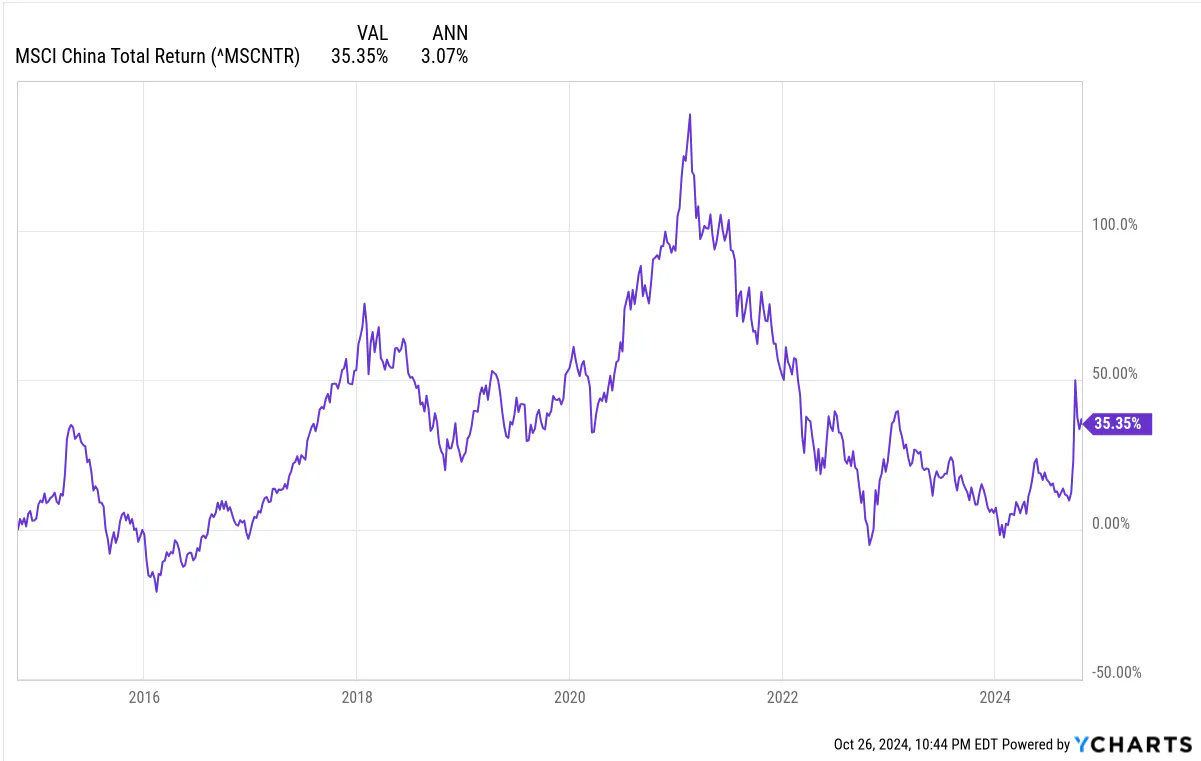
Looking at the performance of the MSCI China Total Return Index over the last decade, Charles Dickens’s quote, “It was the best of times, it was the worst of times,” comes to mind. From October 24, 2014, to February 17, 2021 (its peak), the index’s annualized return was 14.77%. However, from February 17, 2021 to October 25, 2024, the index’s annualized return has been -14.27%. As evidenced in the chart, the recent spike in performance is due to the surprise monetary policy stimulus package released by the Chinese government to spur its economy to achieve its intended growth target of 5%. In late September 2024, the People’s Bank of China (PBOC) unveiled a package to support the property market, including lowering borrowing costs on as much as $5.3 trillion in mortgages and easing rules for second-home purchases. The reserve requirement was reduced by 50 basis points, with Governor Pan Gongsheng indicating the possibility of another 0.25 to 0.5 basis points by the end of the year. Given that China’s economic growth has slowed, dragged down by the real estate slump and low consumer confidence, these initiatives were welcomed news, resulting in the dramatic rise in Chinese equities.
It is often said that happiness is a function of expectations and reality. If that is the case, Chinese equity investors may be having mixed emotions at this point. Though the recent stimulus has elicited enthusiasm from investors, it has also raised an expectation that more will be coming. However, will the additional stimulus be sufficient to meet the expectations of all market participants and stakeholders?
Expectations Around Fiscal Stimulus
As reported by Bloomberg, against the backdrop of the International Monetary Fund and World Bank’s annual meeting, China’s Vice Finance Minister, Liao Min, spoke about Beijing’s pending fiscal package by stating, “The goals are to enhance the strength of macro policies to expand domestic demand and reach this year’s GDP growth target. And in the meantime to coordinate with monetary policy to push for the restructuring of the economy, particularly to boost domestic demand including consumption. The size of this round of policies will be of quite large scale.”
The focus on consumption is quite telling, as it hints at where the Chinese government is focusing its efforts. Looking back to 2008/2009, the Chinese economic stimulus plan of RMB¥ 4 trillion (US$586 billion) sought to minimize the impact of the Great Recession on the Chinese economy by investing in key areas such as housing, rural infrastructure, transportation, etc. Though the package effectively stimulated the economy, it is often cited as the reason for China’s growing indebtedness, as the nation’s debt-to-GDP ratio is nearing 300%
Why is this relevant? China is moving away from ‘high-speed’ industrial-led growth and is looking towards ‘high-quality’ consumption-led growth as the catalyst for the economy’s recovery. As such, the Chinese government is seemingly moving away from high economic growth to more sustainable economic growth by increasing consumption, rebalancing the economy, and focusing on high-tech output. As such, the fiscal policies expected to be announced after the conclusion of the National People’s Congress Standing Committee meeting, which is scheduled to take place from Nov. 4 to Nov. 8., will reflect this new economic pathway.
Is It Time To Invest In China Again?
Answering this is truly a matter of one’s perspective and outlook on the nation, but some irrefutable facts need to be considered. Real estate and real estate activity accounts for approximately 25 to 30 percent of China’s economy. With real estate-related debt being a burden on Chinese households and the significant role of real estate within the broader economy, the real estate slowdown will continue to weigh on the Chinese economy in the near future. Against the uncertainty within the Chinese economy, households have chosen to build up savings rather than engage in spending, which runs counter to the economic desires of the state.
External events could also impact China’s economic plans, namely, the upcoming U.S. presidential elections. As mentioned in previous articles, both candidates (i.e., former U.S. President Donald Trump and current Vice President Kamala Harris) have expressed their planned economic interaction with China, the former President choosing to place tariffs on all Chinese goods. In contrast, the current Vice President will largely maintain the status quo of the Biden Administration.
However, another perspective on the matter is China is the second-largest economy in the world, and its essentialness to the global economy has been showcased in the past. At present, attempts by other nations to block or limit Chinese EV vehicles from entering their jurisdictions have been circumvented. Similarly, attempts to stem the nation’s semiconductor development and access have been futile. Thus, while the current real estate downturn may weigh down the broader economy, some sectors may be capitalizing and benefitting from the current market demands outside of the domestic economy.
Takeaway
Central to investing is patience and having a long-term view. Presently, China is at an inflection point, where the nation’s economic outlook is uncertain in the near term. However, for individuals with a long-term outlook and believe the nation is beginning a new chapter in their development, now would be a good time to gain some exposure at current market levels. For Canadian investors seeking exposure to Chinese equities, the iShares China Index ETF (Ticker: XCH) and Mackenzie China A-Shares CSI 300 Index ETF (Ticker: QCH) provide exposure to the region. XCH tracks the FTSE 50 Index, which is comprised of the 50 largest and most liquid Chinese stocks, while QCH tracks the CSI 300 index, which reflects the performance of the top 300 stocks traded on the Shanghai Stock Exchange and the Shenzhen Stock Exchange.
Please note this article is for information purposes only and does not in any way constitute investment advice. It is essential that you seek advice from a registered financial professional prior to making any investment decision.