Top ETFs to Invest in Japan
A look at recent developments influencing Japanese equities and ETFs that provide exposure.


The corporate landscape in Japan has undergone a material change in recent years, one that will ultimately benefit shareholders. In January 2024, Japan's Financial Services Agency (FSA) took action to end the decades-old practice of 'cross-shareholdings,' often called strategic holdings by companies, which involves a publicly traded company holding shares in another listed company, is coming to an end. From a corporate governance perspective, cross‑shareholdings potentially harm capital efficiency, that is, how well a company uses its money to generate revenues. Furthermore, friendly strategic shareholders can embolden management to ignore the issues raised by minority shareholders. Ending cross-shareholdings is part of a broader initiative by the FSA and Tokyo Stock Exchange to increase capital efficiency within Japan's corporate landscape, resulting in increased productivity and growing shareholder return.
Early evidence of the latter is seen in the increase in share buy-backs Japanese firms engaged in for the year. As reported by Bloomberg, Japanese corporations bought a record amount of domestic stocks last year, a net purchase of ¥7.9 trillion ($50 billion) of shares. Conversely, net buying by foreign investors was just ¥154 billion in 2024, as they pulled back sharply after the market rout in August 2024.
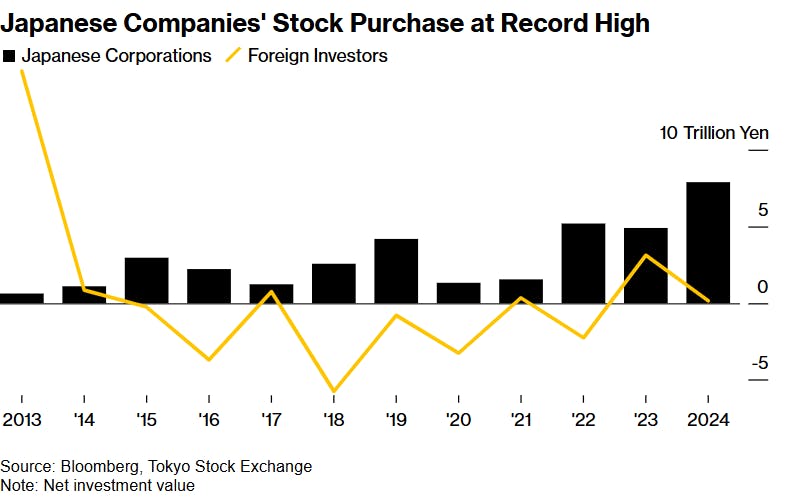
Naturally, Japanese corporations engaging in share buybacks will lift their earnings per share of companies, ultimately benefiting shareholders.
New Developments Impacting Japanese Corporations
Rising wages are another development poised to benefit Japanese corporations. As noted in a December 2024 Reuters article, Japan's base salary grew at a 32-year high pace in October 2024. Base salaries, or regular pay, rose 2.7% in October 2024, marking the fastest increase since November 1992, as more companies set higher salaries after major firms agreed to an average 5.1% raise at the spring wage talks. Against the backdrop of tariff threats from the U.S., if the steady rise in wages can be maintained, it will stimulate domestic demand and help offset slower growth by exporters. Wage growth surpassing inflation will further increase consumption, providing a particular boost to small and medium-sized enterprises and consumption and construction-related sectors.
Investing in Japanese Equities
For investors looking to gain exposure to Japanese equities, the following ETF solutions can provide comprehensive exposure:
The CI Wisdom Tree Japan Equity ETF (Tickers: JAPN/JAPN.B) seeks to track the price and yield performance of the WisdomTree Japan Equity Index CAD. The Index consists of dividend-paying companies incorporated in Japan and traded on the Tokyo Stock Exchange that derive less than 80% of their revenue from sources in Japan. By excluding companies that derive 80% or more of their revenue from Japan, the index is tilted toward companies with a more significant global revenue base. JAPN is the currency-hedged version of the ETF, while JAPN.N is the unhedged version.
The BMO Japan Index (Tickers: ZJPN/ ZJPN.F) has been designed to replicate the performance of the Solactive GBS Japan Large & Mid Cap Index. The ETF invests in large and mid-cap Japanese companies. The ETF invests in and holds the constituent securities of the index in the same proportion as they are reflected in the index. ZJPN.F is the currency-hedged version of the ETF, while ZJPN is the unhedged version.
The iShares Japan Fundamental Index ETF (Ticker: CJP) has been designed to replicate the performance of the FTSE RAFI Japan Canadian Dollar Hedged Index. Under normal market conditions, CJP will primarily invest in securities of one or more iShares ETFs and/or Japanese equity securities. CJP is a currency hedged.
In looking at the performance of each solution over the past year, all have provided compelling returns. However, there is a clear distinction when looking at the 2024 calendar year performance. As is evident, the currency-hedged version of these mandates has performed exceedingly well. A currency-hedged ETF offers reduced risk compared to the added possibility of currency value volatility that comes with an unhedged ETF. So, investors who don't want to be worried about the currency risk associated with exposure to attractive foreign investments via an ETF may be more inclined to target a hedged ETF.
Please note this article is for information purposes only and does not in any way constitute investment advice. It is essential that you seek advice from a registered financial professional prior to making any investment decision.