Top ETFs to Ride the Sector Rotation
Recent Fed rate cuts are driving sector rotation. Explore key ETFs in utilities, financials, and more as the market shifts.


Talk about saving the best for last! At long last, the U.S. Federal Open Market Committee has cut its policy rate, surprising many with a 50-basis point reduction. The rate cut is the first since the Federal Reserve began hiking in March 2022. As noted in Chairman Powell's press conference regarding this policy change, he is quoted as saying, "This recalibration of our policy stance will help maintain the strength of the economy and the labor market and will continue to enable further progress on inflation as we begin the process of moving toward a more neutral stance." The word recalibration has taken central focus by market participants as it supports the narrative that this easing cycle is not about being in a recession – but extending the economic expansion.
Understanding the implications of this interest rate change on the differing segments of the economy is essential; as such, the concept of sector rotation is important to know.
Sector Rotation Explained
Sector rotation is a strategy by which investors shift their investments from one sector of the economy to another in anticipation of changing economic conditions or market cycles. Economic cycles are often the backdrop for sector rotation discussions, with different sectors performing better at varying stages of the economy. Based on historical precedent, particular economic changes have resulted in specific sectors exhibiting strong performances.
Economic Cycles:
Expansion: During periods of economic growth, cyclical sectors such as technology, consumer discretionary, and industrials tend to outperform. These sectors benefit from increased consumer spending and business investments.
Peak: As the economy reaches its peak, sectors like energy and materials often perform well due to higher demand and rising commodity prices.
Contraction: During economic downturns, defensive sectors such as utilities, healthcare, and consumer staples tend to outperform. These sectors provide essential goods and services that remain in demand regardless of economic conditions.
Trough: As the economy begins to recover, financials and real estate sectors often lead the way, benefiting from lower interest rates and improving economic conditions.
Interest Rate Trends:
Rising Interest Rates: Financials, particularly banks, tend to benefit from rising interest rates as they can charge higher rates on loans. Conversely, sectors like real estate and utilities may underperform due to higher borrowing costs.
Falling Interest Rates: Lower interest rates can boost sectors like real estate and utilities, which rely on borrowing. Consumer discretionary sectors may also benefit from increased consumer spending due to lower borrowing costs.
Inflation Trends:
High Inflation: Sectors like energy and materials often perform well during periods of high inflation, as commodity prices tend to rise. Conversely, consumer discretionary sectors may suffer due to reduced purchasing power.
Low Inflation: Low inflation can benefit consumer discretionary and technology sectors, as stable prices encourage consumer spending and business investments.
A Look at Recent Sector ETFs Performance
Looking at the performance of each U.S. equity sector over the year thus far, there is an observable experiential difference, with one group exhibiting volatility and the other trending upward.
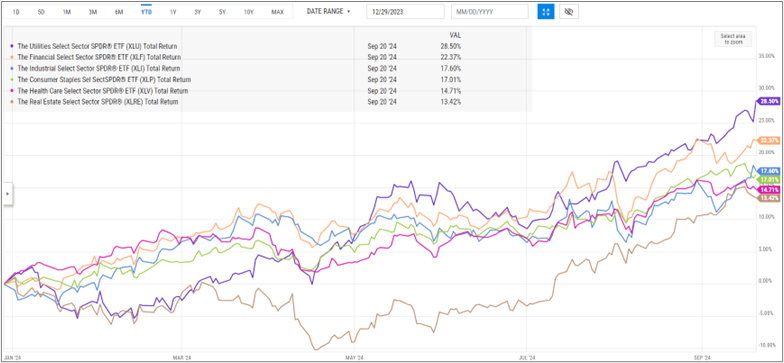
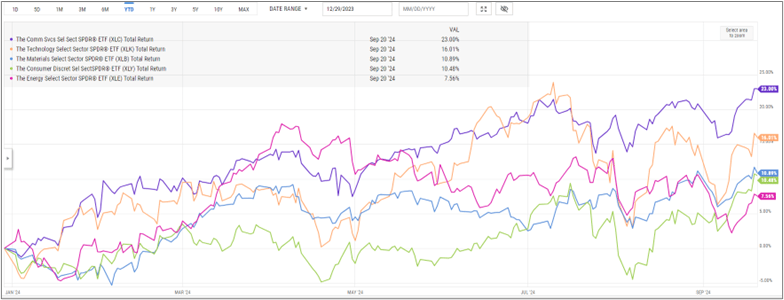
As observed from the preceding charts, some sectors of the U.S. economy were already displaying strong performance. In anticipation of the rate cut, many investors began rotating into the utility sector, which holds companies known for paying dividends. Such a characteristic would appeal to income-seeking investors, anticipating a decline in treasury yields.
The rotation to utilities is also a 'play' on Artificial Intelligence (AI), given its demanding energy requirements and the expected increases in electricity use needed to support AI applications.
The fall in rates will directly impact the financial sector, specifically banking institutions. While lower interest rates typically result in reduced earnings on loans, they can also boost banks' profit margins. For example, the net interest margin— the difference between the interest income banks earn and the interest they pay their depositors—can expand when short-term rates decline faster than long-term rates. This works in banks' favor if they borrow at lower short-term rates and lend at higher long-term rates. Thus, the fall in rates would benefit the financial and real estate sectors, particularly housing.
Finally, though the technology sector's performance has declined recently, it is still among the beneficiaries of this rate cut. With rates now expected to be lower going forward, the lower interest rate environment will make capital available for further investments in research and development and product development – think AI, cloud services, etc.
As the cost of capital decreases, the technology firms have the leeway to pursue new initiatives, given the available cash. The secondary effect of this is that large-scale enterprise firms are now more able to buy these products and services due to the shift in monetary policy. As such, sectors such as Technology and Industrials are poised benefit from the rate change.
Sector ETFs To Consider
For Canadian investors seeking exposure to the U.S. utility sector, the CI Utilities Giants Covered Call ETF (Ticker: CUTL.B) is an actively managed solution that provides exposure to at least the 20 largest utility companies measured by market capitalization listed on a North American stock exchange. As of August 2024, the ETF's geographic exposure is predominantly the U.S. Given that the fund employs a covered-call investment strategy, income generation is also a primary focus of the ETF, alongside capital appreciation.
For investors seeking exposure to the U.S. financials sector, the iShares S&P U.S. Financials Index ETF (Ticker: XUSF) provides broad-based exposure to the sector as the ETF tracks the S&P Financial Select Sector Index. If banking exposure is specifically being sought-after, both the Evolve U.S. Banks Enhanced Yield Fund (Ticker: CALL) and BMO Equal Weight U.S. Banks Hedged to CAD Index ETF (Ticker: ZUB) track the Solactive Equal Weight U.S. Bank Index Canadian Dollar Hedged, which provides exposure to the Finance, U.S. Banks, U.S. Commercial Banks, or U.S. Commercial Savings Institutions. Each security in the Index is allocated an equal weight rather than a market capitalization weight. The U.S. dollar exposure is hedged back to Canadian dollars. It should be noted, as evidenced in the name, CALL employs a covered call strategy.
Finally, the First Trust AlphaDEX™ U.S. Technology Sector Index ETF (Ticker: FHQ/FHQ.F) and First Trust AlphaDEX™ U.S. Industrials Sector Index ETF (Ticker: FHG/FHG.F) allow investors to gain pure-play exposure to the technology and industrial sectors, respectively.
Please note this article is for information purposes only and does not in any way constitute investment advice. It is essential that you seek advice from a registered financial professional prior to making any investment decision.