Uranium Momentum Builds: How ETFs Like HURA Offer Exposure
Uranium sees renewed momentum in 2025, fueled by World Bank policy shifts, AI energy demand, and supportive U.S. legislation.


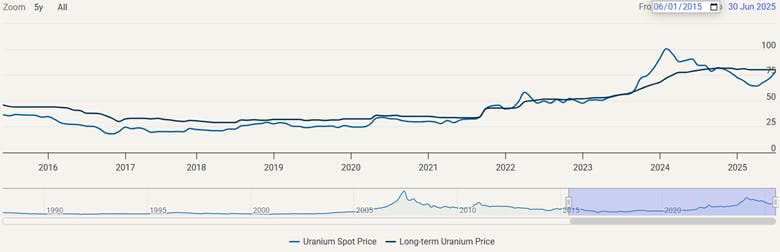
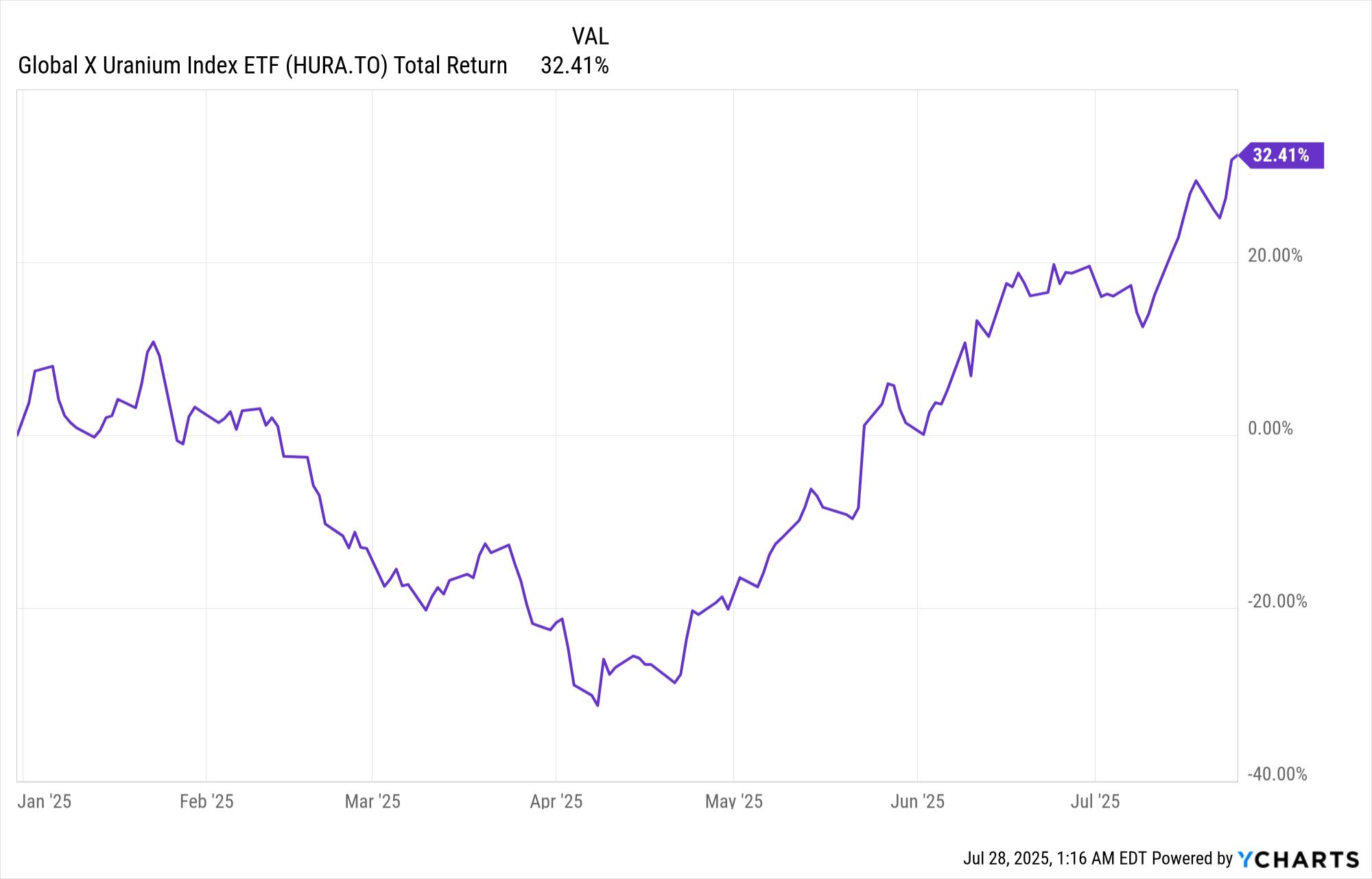
For investors interested in commodities, uranium has attracted significant attention recently due to ongoing political, environmental, and technological developments. Uranium’s spot price has gradually increased over the past decade, peaked in early 2024, and then declined. However, in 2025 so far, momentum seems to be picking up again for the metal.
Political Developments
Recently, the World Bank has shifted its long-standing stance on prohibiting the financing of nuclear energy projects, which has the potential to reshape the investment landscape for nuclear energy, given the institution’s global role. The World Bank has acknowledged the essential role of nuclear energy in providing clean and dependable power by announcing a new collaboration with the International Atomic Energy Agency (IAEA) aimed at prolonging the operational life of the current global reactor fleet. This renewed involvement of the World Bank in nuclear financing opens up opportunities for increased public funding and helps mitigate the investment risks associated with nuclear projects.
In the U.S., the passage of President Trump’s ‘Big Beautiful Bill’ has had negative consequences for clean energy, especially the subsidy regime established under the Inflation Reduction Act (IRA), which has been significantly scaled back. However, the IRA tax credit for nuclear energy generation was preserved, with a minor change that mainly excludes entities controlled mostly by China, Russia, Iran, and North Korea. This clarification is especially important given recent hesitation from utilities to engage in long-term uranium contracts.
The support for nuclear energy is consistent with President Trump’s previous actions, namely, executive orders aimed at strengthening the U.S.’s nuclear base and lessening the nation’s dependence on foreign entities.
Technological Developments
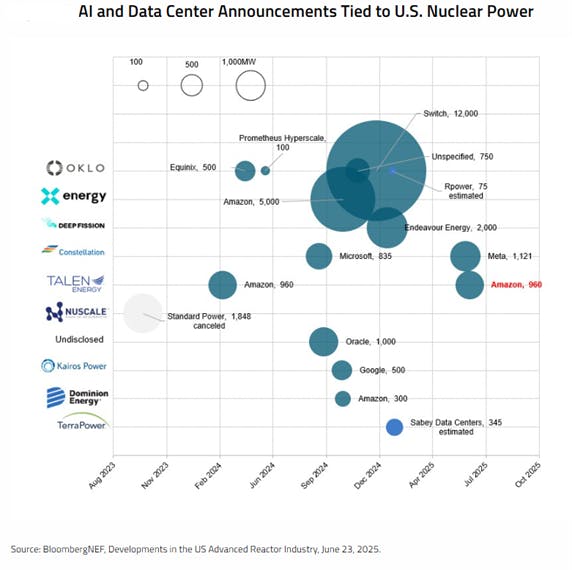
The growth of Artificial Intelligence (AI) and its substantial energy requirements has driven increased interest in nuclear energy. Recently, Amazon and Talen Energy expanded their partnership, with Talen now supplying up to 1,920 megawatts (MW) of clean power from its Susquehanna nuclear plant to Amazon Web Services (AWS). As more tech firms expand their AI capabilities, the demand for sustainable, non-intermittent energy will increase, thereby enhancing the viability of nuclear energy.
According to BloombergNEF, U.S. data centers are projected to account for 8.6% of total electricity demand by 2035, up sharply from 3.5% currently. In response, a wave of 16 U.S. nuclear power announcements tied to data centers and AI has been announced, with a combined capacity of over 28 GW, representing nearly 30% of the U.S.' current nuclear capacity.
Investing in Uranium
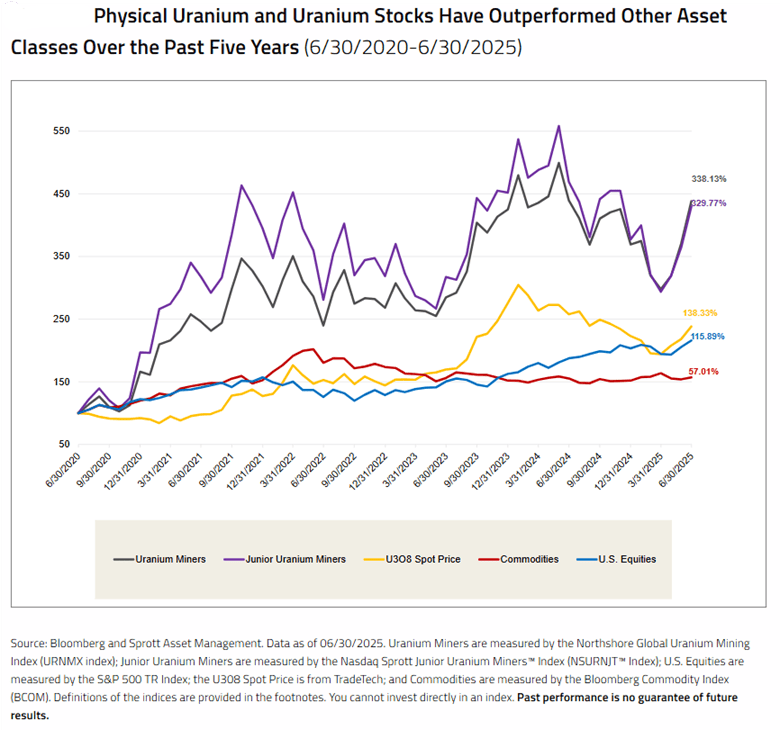
Uranium prices surged in June, with spot prices rising 9.99% to $78.56/lb, marking their best monthly performance of 2025. The recent price increase indicates short-term strength, but uranium has been gaining momentum over time. Looking at longer-term performance, uranium and uranium miners have outpaced equities and broader commodity benchmarks by a significant margin over the past five years. Given the political and technological tailwinds supporting uranium, along with the structural supply deficit and inelastic demand, the investment outlook for uranium remains strong.
For Canadian investors seeking to gain exposure to companies involved in uranium mining and exploration, the Global X Uranium Index ETF (Ticker: HURA) is a turnkey solution worth considering. HURA seeks to replicate the performance of the Solactive Global Uranium Pure-Play Index. The index is designed to provide exposure to the performance of a basket of issuers that (a) are primarily involved in the uranium mining and exploration industry, or (b) invest and participate directly in the physical price of uranium.
Please note this article is for information purposes only and does not in any way constitute investment advice. It is essential that you seek advice from a registered financial professional prior to making any investment decision.