U.S. Equity ETFs: How Sector & Factor Investing Shaped Q1 2025
U.S. equities dip in Q1 as energy, low-volatility strategies shine; defensive sectors offset tech struggles amid weak consumer confidence.


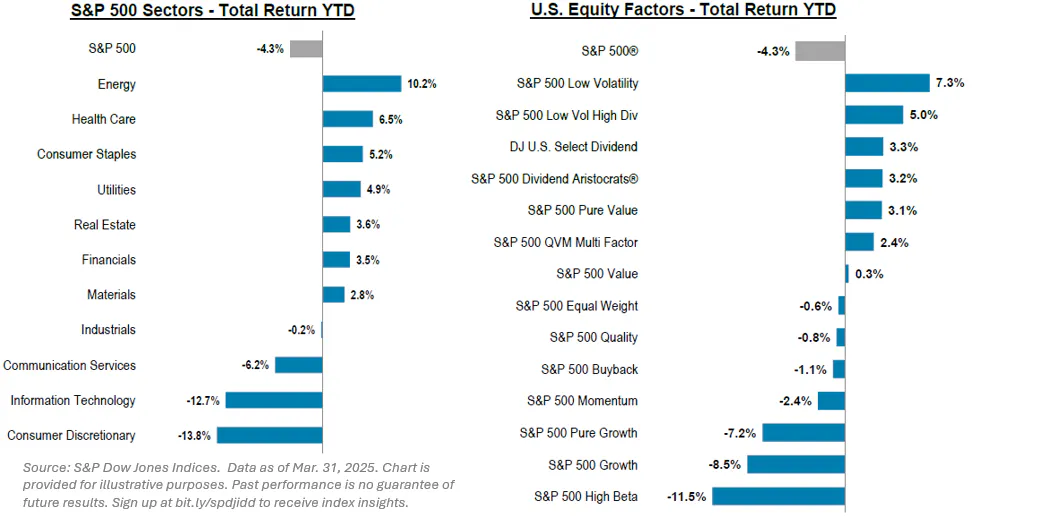
Though the performance of U.S. equities in the first quarter of 2025 had a high point, the S&P 500 Index hit a new record as recently as February 19th; it ultimately ended in negative territory for the period, returning -4.3%. While the top-level performance of the index is notable, looking below the surface provides deeper insight into the performance of U.S. equities over the last three months.
Sector Performance
Among U.S. equity sectors, the energy sector led the way with a return of 10.2%. A significant contributor to the energy sector's performance is the liquefied natural gas (LNG) industry, a vital and growing sector of the U.S. economy. The U.S. is the largest LNG exporter, with 11.9 billion cubic feet per day (Bcf/d) of LNG exported in 2024. In March 2025, as reported by Reuters, the U.S. exported 9.3 million metric tons (MT) of LNG, surpassing the December 2023 record of 8.6 MT. The demand for LNG extends beyond U.S. shores to regions such as China, Europe, Asia, and Latin America; as such, its widespread demand is a boon for the U.S. Energy sector.
Energy, alongside other top-performing sectors, namely Health Care, Consumer Staples, and Utilities, are considered 'defensive sectors'. As such, their ability to serve as a ballast against prevailing market volatility was showcased during the first quarter of 2025.
Finally, the decline in U.S. consumer confidence and the underwhelming performance of big tech names year to date, as evidenced by the respective performances of the Consumer Discretionary and Information Technology sectors, have weighed on U.S. equities.
For Canadian investors seeking to gain exposure to specific U.S. equity sectors, BMO Asset Management Inc. launched the BMO SPDR Select Sector Index ETFs, enabling Canadian investors to access all 11 Global Industry Classification Standard System ('GICS') sectors with the currency convenience of Canadian listed ETFs available in both hedged and unhedged versions. To learn more about BMO's new suite of U.S. sector index ETFs, visit their dedicated website here.
Factor Performance
The Low Volatility factor fulfilled its intended objective amid a volatile quarter, returning 7.3%. The combination of 'Low Volatility' and 'High Dividend' investment factors, as reflected in the S&P 500 Low Volatility High Dividend Index, which measures the performance of the 50 least-volatile, high-dividend-yielding stocks in the S&P 500 Index, was also strong for the quarter. While the quarter-ending performance of the Dow Jones U.S. Select Dividend Index and S&P 500 Dividend Aristocrats Index was less than the two previously mentioned indices, a clear takeaway is that the dividend/income-generating nature of the three indices is an additive quality that helped bolster performance throughout the quarter.
For Canadian investors seeking U.S. equity solutions with a low-volatility investment focus, the BMO Low Volatility U.S. Equity ETF (Tickers: ZLU/ZLU.U/ZLH) and the TD Q U.S. Low Volatility ETF (Ticker: TULV) meet this criterion. For solutions that reflect both low volatility and a dividend focus, the CIBC Qx U.S. Low Volatility Dividend ETF (Ticker: CQLU) and the Franklin U.S. Low Volatility High Dividend Index ETF (Ticker: FLVU) meet this criterion, with the latter having a high dividend focus.
The Invesco S&P US Dividend Aristocrats ESG Index ETF (Tickers: IUAE/IUAE.F) tracks companies listed in the U.S. that have increased their total dividends per share annually for at least 20 consecutive years, aiming to replicate the S&P High Yield Dividend Aristocrats Screened Floating Market Capitalization Weighted Index, while also reflecting specific environmental, social and governance (ESG) criteria.
Please note this article is for information purposes only and does not in any way constitute investment advice. It is essential that you seek advice from a registered financial professional prior to making any investment decision.