What are Preferred Shares ETFs: Canadian Edition
Preferred shares ETFs can offer high yields and modest capital appreciation, but carry specific risks.


Most Canadian income investors default to a portfolio of dividend stocks, corporate bonds, real estate investment trusts (REITs), and income trusts. More advanced investors may resort to covered call funds or split share corporations.
A more niche and esoteric asset class not commonly seen in retail portfolios are preferred shares. These are hybrid securities with features seen in stocks and bonds. As an investment, preferred shares could be a useful addition to some portfolios owing to their income potential and diversification benefits.
While investors can buy individual preferred share issues, a better method might be via an ETF. There are numerous passively indexed and actively managed ETFs on the Canadian market that hold a portfolio of preferred shares. Let's look at some of the options available today.
Preferred Shares Explained
Preferred shares are a type of hybrid security issued by corporations to raise money as an alternative to issuing bonds or common stock.
In the company's capital structure, preferred shareholders rank above common shareholders, but rank below bondholders in the event of insolvency or liquidation. As an investment, they have the following features:
- Preferred shares often payout a consistent fixed dividend, thus providing regular income potential in the same way as bonds do.
- Preferred shares have credit risk like bonds do, with credit rating agencies often assigning them rating scores.
- The income from preferred shares is taxed as dividends as with common stock, as opposed to interest income from bonds.
- Some preferred shares can accumulate dividends in arrears if a payment is missed. If this is the case, the preferred shareholders must be paid dividends first before common shareholders.
- Preferred shares can appreciate in value in the same way common stock does but are also affected by interest rate changes like bonds are.
Why Invest in Preferred Shares?
Most investors who buy preferred shares do so for the high yields, which can rival investment-grade corporate bonds. For instance, the iShares S&P/TSX Canadian Preferred Share Index ETF (CPD) currently pays a 12-month trailing yield of 5.26%, which is very similar to the current 5.40% weighted yield-to-maturity of the iShares Core Canadian Corporate Bond Index ETF (XCB).
With bond yields low for much of the last decade, preferred shares offered investors income potential without the need to increase bond duration (which increases interest rate risk) or decrease bond credit quality (which increases default risk).
Preferred shares can also offer a diversification benefit. An asset can improve the diversification of a portfolio when it has a relatively low correlation to existing portfolio assets, has sufficiently high volatility, and possesses a positive long-term expected return.
Preferred shares ETFs like CPD possess all of these traits. From 2008 to the present, CPD returned an annualized 1.57% with all distributions reinvested. In terms of volatility, it had a standard deviation of 11.04%. Finally, its correlation to the iShares S&P/TSX 60 Index ETF (XIU) was just 0.59.
Finally, preferred shares are tax efficient. One of the biggest drawbacks to corporate bonds is their poor performance in taxable accounts. This is due to the higher tax rate imposed on interest income. Because preferred shares are taxed at the eligible dividends rate, their after-tax performance is much higher.
Preferred Shares ETFs
As mentioned earlier, researching, and buying individual preferred share issues can be difficult. The preferred shares market is less liquid and transparent than the stock market. In many ways, it is like the bond market, dominated by institutional investors.
Investing in preferred shares is not without risk. Like bonds, preferred shares have interest rate risk. When rates rise, the share price of preferred shares drops because their yields must now increase to match new issues. Like stocks, preferred shares have market risk. If the stock market crashes, preferred shares will drop as well.
Preferred share ETFs can come in active or passive varieties. One quirk is that, unlike equity ETFs, active management has historically been beneficial with preferred share ETFs. This is likely due to the lower activity in the preferred shares market, which enables fund managers to exploit pricing inefficiencies. Surprisingly, they cost about the same as their passive counterparts.
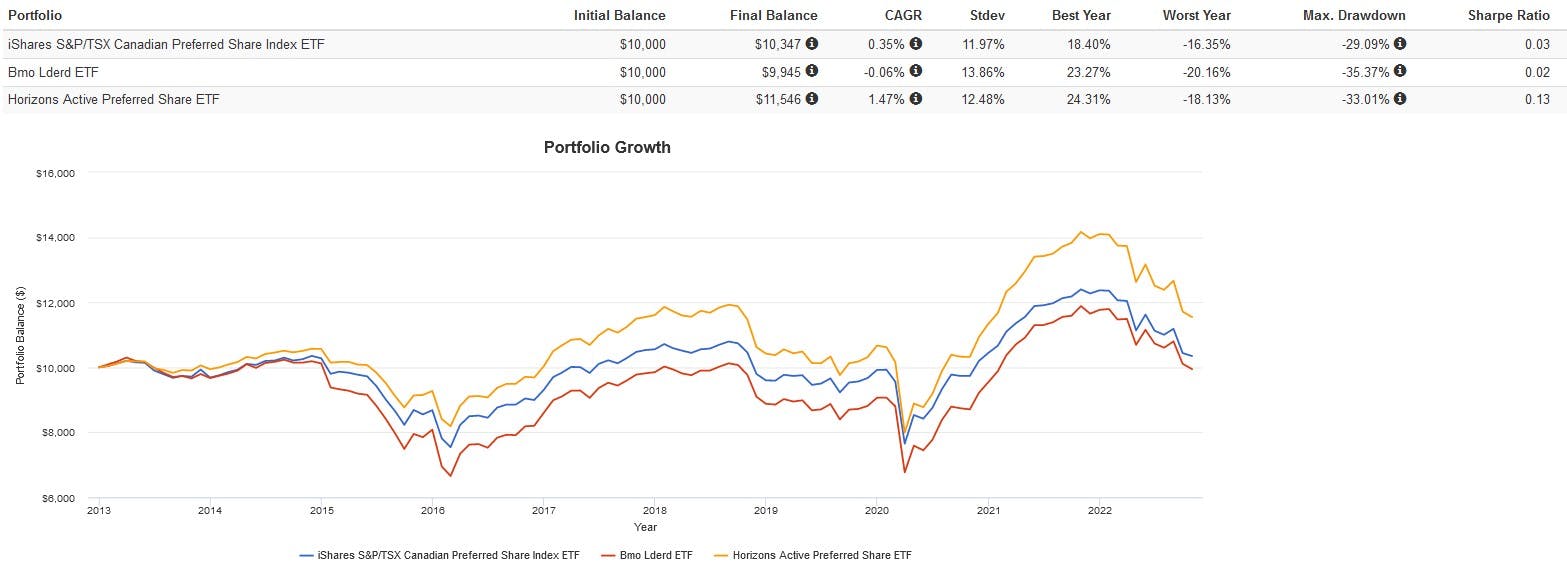
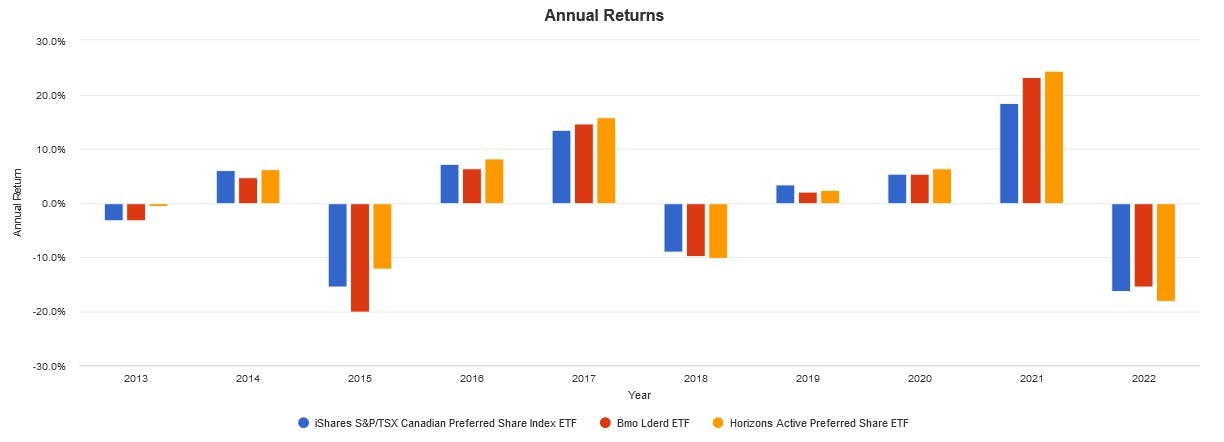
The following Canadian ETFs offer exposure to preferred shares. Clicking on them will take you to a page where you can view their strategy, holdings, and expense ratios. I've also included a backtest of their performance from 2013 to the present.
- BMO Laddered Preferred Share Index ETF (ZPR)
- iShares S&P/TSX Canadian Preferred Share Index ETF (CPD)
- Horizons Active Preferred Share ETF (HPR)
Disclaimer: This article is limited to the dissemination of general information pertaining to investment strategies and financial planning and does not constitute an offer to issue or sell, or a solicitation of an offer to subscribe, buy, or acquire an interest in, any securities, financial instruments or other services, nor does it constitute a financial promotion, investment advice or an inducement or incitement to participate in any product, offering or investment.