What the Collapse of Silicon Valley Bank Means for Canadian ETF investors
Despite recent market turmoil, Canadian banks are still seen as a good investment opportunity.


As the regional banking crisis in the U.S. rages on, investors have been left wondering what the global implications will be. The news of Credit Suisse’s demise and subsequent acquisition by UBS further eroded investor confidence last week and created worries of global contagion throughout Europe and Asia.
Money managers, analysts, and economists have all been rushing to give their opinions on the crisis as information comes in, with predictions ranging from temporary pain tempered by government stimulus to a full-blown financial meltdown and credit crunch, as in 2008.
As always, the truth is likely somewhere in the middle – and while some Canadian investors have been left wondering about the safety of their banks, most believe the Canadian banking system will maintain its reputation for stability, as it did more than a decade ago. Indeed, the effects of recent events on Canadian banks and financial institutions has been somewhat muted in comparison to other markets, which is due to a few distinguishing factors that have historically made Canada’s banks more resilient to these types of events.
Effects on the Canadian Banking Industry
So, what are the factors helping underpin the strength and resilience of Canada’s banking sector?
Conservative operations
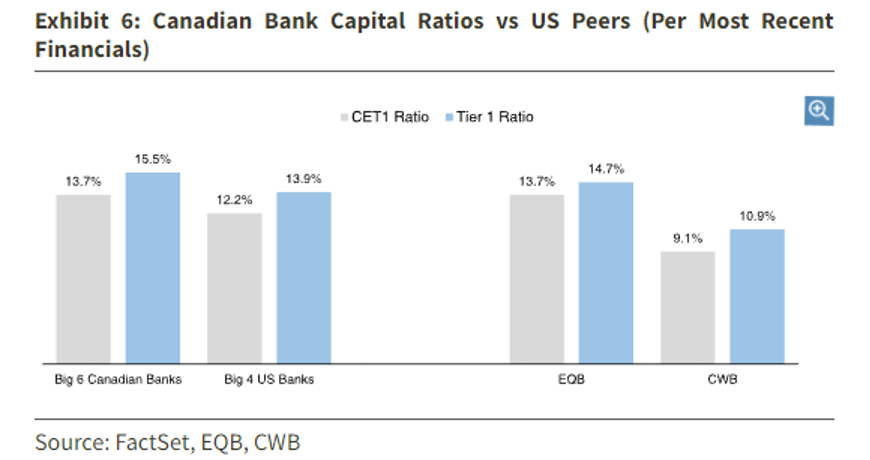
First of all, the Canadian banking system is quite different to that of the U.S. which proved to be a key factor in helping Canada avoid the worst of the crisis in 2008-2009. Canadian banks are more conservative with their lending practices, and their deposit ratios, and are certainly not focused on any one industry as was the case with SVB.
Enhanced Regulations
The second factor can be attributed to Canada’s concentrated banking sector. The “Big Five” banks in Canada account for nearly 90% of the banking market share, whereas their U.S. counterparts account for only 35%. This makes each of the five Canadian banks Domestically Systemically Important Banks (D-SIBs) and ensures regulatory scrutiny is focused on a few large institutions rather than hundreds of smaller ones. In turn, this significantly lowers the risk of smaller banks flying under the radar and causing financial damage through risky business practices.
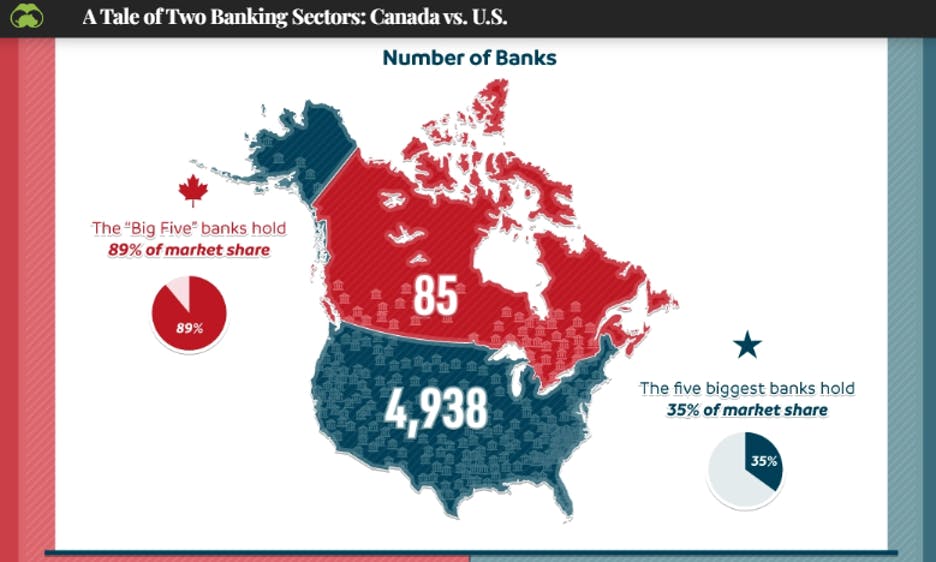
Source: Visual Capitalist (as of 2018)
Historical Stability
Lastly, when taking a retrospective view of bank failures in the U.S. and Canada, again, we can see there is a marked disparity between the two countries. More than 500 banks have gone under in the U.S. since 2009, while Canada has yet to witness a single bank failure over that same time period. In fact, the last failure was in 1996 with the collapse of Security Home Mortgage Corporation.
A recent report from Raymond James outlines the key differences between the two banking systems in more detail.
How can ETF investors take advantage?
Despite their historical safety and limited exposure to the conditions that led to SVB’s collapse, Canadian banks are not immune to the recent market turmoil and are down almost 8-10% in the last month, offering a potential opportunity for investors looking to pick up banking stocks at a discount.
The following NEO-listed ETFs provide diversified exposure to the Canadian banking sector:
- Horizons Equal Weight Canadian Bank Index (HEWB): offers exposure to the Big Five banks, as well as the National Bank of Canada. It has a low MER of 0.27%, and a trailing yield of 4.45%.
- BMO Covered Call Canadian Banks ETF (ZWB): uses covered call options to enhance the yield, which limits the upside but significantly boosts income potential. As of March 17, the ETF yields 8.21% and has a MER of 0.71%.
- Evolve Canadian Banks and Lifecos Enhanced Yield Fund (BANK): is different from the previous two funds in that it also includes exposure to Canadian life insurance companies in its strategy. It uses a covered call strategy as well as 25% leverage and currently yields over 10%. Given the additional risk associated with this strategy it is better suited to income investors with a higher risk tolerance.
Please note this article is for information purposes only and does not in any way constitute investment advice. It is essential that you seek advice from a registered financial professional prior to making any investment decision.